Arnold Press: Proper Form, Step by Step
Step-by-step guide to proper Arnold press form: setup, execution cues, breathing, tempo, common mistakes with fixes, and programming guidance. Safety-first, evidence-aware coaching.
Photo by RepBro.
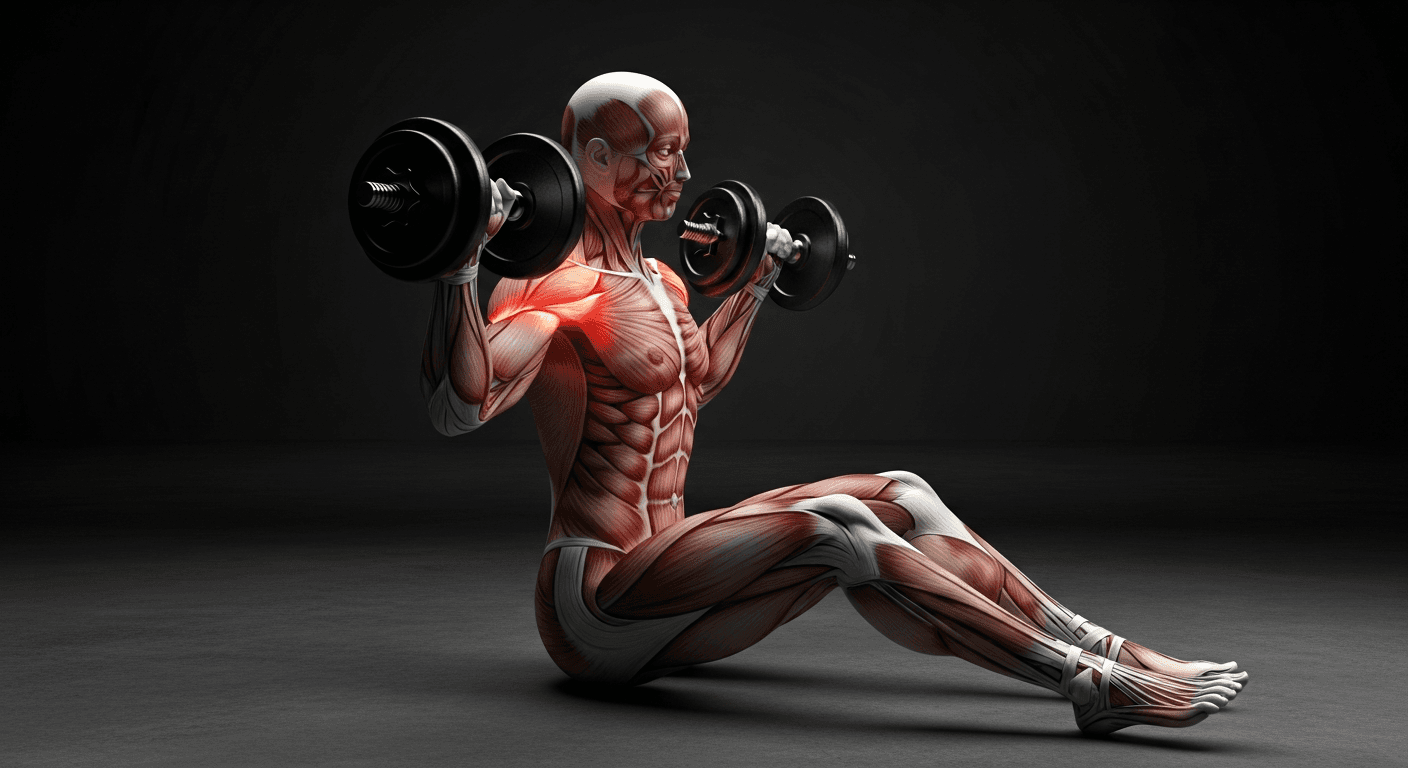
The Arnold press is a seated or standing dumbbell press that starts with palms facing you and rotates them to face forward as you press. Use controlled rotation, moderate loads, and tight core; stop if you feel sharp pain and seek professional advice for persistent issues.
What is the proper setup for the Arnold press?
- Equipment: one pair of dumbbells and a bench (inclined or upright). Seated upright on a bench with back support is recommended for beginners. Standing is acceptable if you can maintain a neutral spine.
- Start position: sit or stand tall, feet hip-width, ribcage down, and core braced. Hold dumbbells at shoulder level with palms facing your body and elbows slightly forward (about shoulder height).
- Grip and elbow path: wrists stacked over elbows; elbows under the dumbbells to keep torque on the deltoids rather than the wrists.
How do I perform the Arnold press step by step?
- Setup and brace: take a breath, brace your core, and keep a neutral spine. If seated, press your lower back gently into the bench and keep feet planted.
- Initiate the rotation: start with dumbbells at shoulder height, palms facing you. As you begin the press, externally rotate the shoulders so the palms face forward at the top.
- Press phase: press in a slightly diagonal path (forward and up) so the dumbbells finish roughly over the midline of your head. Lockout is not aggressive—stop short of full hyperextension.
- Return phase: lower under control while rotating palms back toward you to the start position. Avoid letting the dumbbells drop rapidly.
- Repeat for target reps, maintaining torso tension and consistent rotation on each rep.
Execution cues:
- "Elbow under the dumbbell": keeps leverage favorable.
- "Rotate the palms as one movement": smooth rotation avoids jerky motion.
- "Press slightly forward, not straight up": reduces shoulder impingement risk for many lifters.
- Keep chin neutral and avoid excessive neck extension.
What breathing pattern and tempo should I use?
- Breathing: inhale before you begin the concentric (or at the bottom), hold a short brace for the drive, then exhale through the sticking point near the top. For higher-rep sets, use steady inhalation on the descent and exhale on the press.
- Tempo: control the eccentric (lowering) phase—about 1–3 seconds. The concentric (press) can be 0.5–1 second but should be controlled rather than ballistic. For hypertrophy, a moderate tempo (1–2s concentric / 2s eccentric) helps tension and technique.
What common mistakes do lifters make and how do I fix them?
Mistake: Using too much weight and jerking through the rotation.
- Fix: Reduce load until you can perform smooth rotation and controlled lowering. Prioritize full range at lighter weight.
Mistake: Excessive lumbar extension (arching the low back).
- Fix: Brace the core, tuck the ribs slightly, and perform seated if necessary. Use a back-supported bench when learning.
Mistake: Letting elbows flare too wide or drop behind the plane of the shoulder.
- Fix: Keep elbows under or slightly in front of the dumbbell. Visualize pressing in a forward-diagonal path.
Mistake: Rapid drop on the eccentric and passive rotation.
- Fix: Slow the descent to maintain tension and control the rotation through the full range.
Mistake: Painful impingement or sharp pain during rotation.
- Fix: Stop that variation immediately. Try a neutral-grip dumbbell press, reduce range, and consult a qualified clinician if pain persists.
How does the Arnold press compare to other shoulder presses?
| Movement | Key difference | Shoulder emphasis | Advantages | Drawbacks |
|---|---|---|---|---|
| Arnold press | Starts palms-in and rotates during press | Anterior + lateral deltoid with rotational demand | Adds rotational mobility and variety | More complex motor pattern; higher technical demand |
| Dumbbell shoulder press (neutral or pronated) | Simpler vertical press | Lateral deltoid (neutral) or balanced deltoids (pronated) | Easier to load and teach; lower technical demand | Less rotational mobility stimulus |
| Barbell military press | Fixed bar path, little rotation | Medial/lateral deltoid + triceps | Can handle heavier loads; useful for strength | Less natural shoulder plane; can stress the sternoclavicular joint |
Use the Arnold press when you want extra anterior deltoid emphasis and a rotation/ mobility component. For pure strength or heavy loading, simpler presses may be preferable.
When and how often should I program Arnold presses?
Include the Arnold press as a primary shoulder movement or an accessory 1–3 times per week depending on your total shoulder workload. For hypertrophy, pair it with exercises that balance posterior deltoid and rotator cuff work. Keep weekly volume consistent with your overall program and prioritize recovery.
How should I progress with load, sets, and reps?
Progress using small, consistent increases in load, reps, or sets once you can complete target reps with strict form. Common practice: multiple working sets (e.g., 2–4) with rep ranges tailored to goals—strength (lower reps, heavier loads), hypertrophy (moderate reps, moderate loads). Avoid chasing heavier weights if form breaks down.
What safety checks should I use while doing the Arnold press?
- Stop on sharp or sudden pain; do not "push through" it.
- If rotation causes discomfort, reduce range or switch to a neutral-grip press.
- Keep the spine neutral and avoid compensatory lumbar arching.
- If you have a history of shoulder injury, consult a qualified professional before loading rotational shoulder presses.
What can't an app or online article do for my Arnold press?
- See or correct your specific movement flaws in real time.
- Diagnose injuries or prescribe individualized rehabilitation — that requires a qualified clinician.
- Force consistency; progress only happens when you train regularly.
Limitations: remote guidance and AI tools can provide cues and general programming but cannot replace a trained coach or clinician for hands-on assessment, individualized medical advice, or supervised rehab. If you have persistent pain, a recent shoulder injury, or surgical history, consult a licensed practitioner.
Safety note: This article provides general coaching guidance only. Stop if you experience sharp pain and seek professional assessment. Never treat this as a diagnosis.
If you track tempo, sets, or progression, consider using a tracking tool such as RepBro to log sessions and maintain consistent progression, but remember tracking does not replace professional instruction.
Short FAQ
- Q: Can beginners do the Arnold press? A: Yes, with light weight, seated support, and emphasis on slow rotation and core brace.
- Q: Does the Arnold press hit the side delts? A: It targets anterior and lateral deltoids; balance it with posterior work.
- Q: Is rotation necessary each rep? A: Yes—controlled rotation is the defining feature; avoid skipping rotation or converting to a standard press.
References and evidence base: Guidance in this article follows widely accepted resistance-training principles: control, progressive overload, specificity, and pain-free movement. For medical or rehabilitative needs, consult a licensed clinician.
Frequently asked questions
- Is the Arnold press safe for shoulders?
- The Arnold press can be safe when performed with controlled range of motion, appropriate load, and pain-free mobility. If you have shoulder pain, stop and consult a qualified professional. Modify range or swap to a neutral-grip press if rotation causes discomfort.
- Should I do Arnold presses standing or seated?
- Both are valid. Seated reduces lower-back demand and isolates the deltoids; standing engages core and stabilizers. Choose seated to limit compensatory lumbar extension or standing to train full-body stability, depending on your goals and current capacity.
- How many sets and reps are appropriate for the Arnold press?
- Use the Arnold press as a primary or accessory shoulder exercise. Typical guidance for hypertrophy is moderate loads for multiple sets and 6–12 reps; use heavier loads for fewer reps if strength is the goal. Adjust frequency based on overall shoulder workload each week.