Arnold Press Alternatives at Home (Minimal Equipment)
Five at-home substitutes for the Arnold press using dumbbells, bands, or bodyweight. What each preserves and loses, programming notes, and when to head to a gym.
Photo by RepBro.
You can mimic the Arnold press at home with five simple options: single-arm rotational dumbbell press, standing neutral-grip dumbbell press, pike (or elevated) push‑up, band overhead press with rotation, and paired front+lateral raises. Each keeps vertical pressing and anterior deltoid work to varying degrees; choose by equipment, load capacity, and progression needs.
What does the Arnold press train and why is it popular?
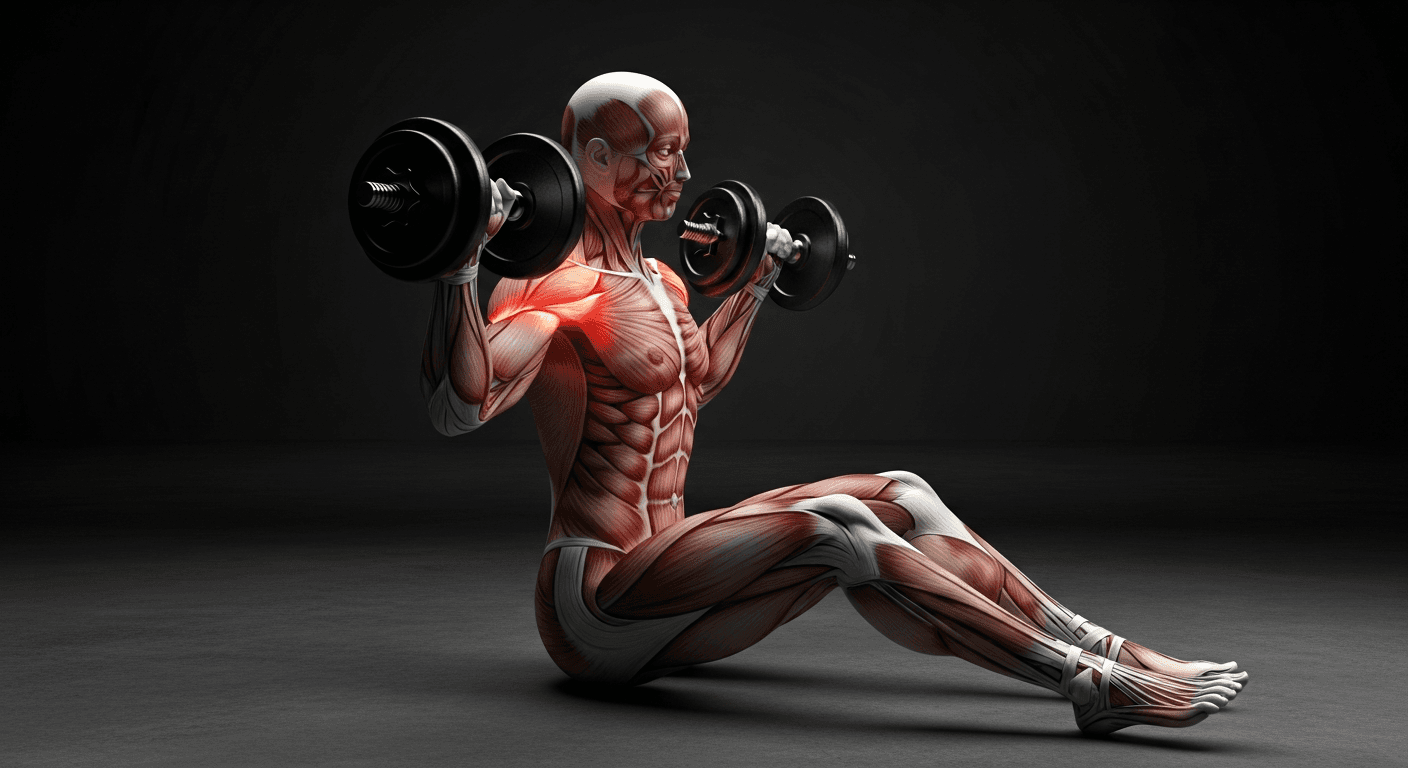
The Arnold press combines a rotational start (hands supinated at chin) that externally rotates during the press into a vertical press. That sequence stresses the anterior deltoid and front-to-mid deltoid transition while adding a rotational component that also challenges the rotator cuff and scapular control. It is essentially a vertical press with added internal-external rotation and time-under-tension through a larger range of motion.
What at-home alternatives replicate the Arnold press mechanics?
Below are five practical alternatives using minimal equipment. For each I list what it preserves from the Arnold press, what it loses, and quick programming notes.
- Single-arm rotational dumbbell press
- What it preserves: The rotational path (start neutral/supinated, rotate during press) and unilateral control, which closely mimics the Arnold pattern.
- What it loses: Maximum absolute load compared with heavy barbell setups; rotation can be slightly less smooth with heavy weights if mobility or strength limits.
- How to program: 3–5 sets of 6–12 reps per side for hypertrophy; progress by adding weight, reps, or slowing the eccentric.
- Standing neutral-grip dumbbell press (alternating or bilateral)
- What it preserves: Vertical pressing torque and core involvement; safer for shoulders than strict barbell presses for some lifters.
- What it loses: The deliberate rotational component of the Arnold press and the same time-under-rotation on the anterior deltoid.
- How to program: 3–6 sets of 6–15 reps. Use a neutral grip if you have shoulder discomfort.
- Pike push-up (or elevated pike push-up for more vertical angle)
- What it preserves: Vertical load direction close to overhead pressing, high relative stimulus to anterior and mid delts, and bodyweight training specificity.
- What it loses: Progressive loading precision; harder to quantify and increase load beyond bodyweight without variations (e.g., elevation, weighted vest).
- How to program: 3–5 sets of 6–15 reps; increase difficulty with elevation or decline foot placement.
- Band overhead press with rotation
- What it preserves: Continuous tension through the press and the ability to include a rotation similar to the Arnold pattern by twisting the hand during the lift.
- What it loses: Maximum absolute load and the same eccentric loading characteristics as free weights; bands change resistance curve.
- How to program: 3–6 sets of 8–15 reps; add band strength or use chains of bands to increase resistance.
- Paired front raises + lateral raises (superset)
- What it preserves: Isolates the anterior and lateral deltoid heads that the Arnold press targets, and increases time under tension to mimic portion of the movement.
- What it loses: The compound vertical pressing pattern and rotator cuff demand of a true overhead press.
- How to program: 3–4 supersets, 8–15 reps each exercise; use slow eccentrics to increase stimulus.
How do these alternatives compare to the Arnold press at a glance?
| Alternative | Equipment | Muscle emphasis | Pros | Cons |
|---|---|---|---|---|
| Single-arm rotational DB press | Dumbbells | Anterior + mid delts, rotator cuff | Closest mechanical match; unilateral control | Lower max load than gym barbell |
| Standing neutral-grip DB press | Dumbbells | Vertical pressing, anterior delts | Stable, easy progression with heavier DBs | No rotational element |
| Pike push-up | Bodyweight | Anterior + mid delts | No equipment, high specificity to vertical press | Hard to quantify progressive overload |
| Band overhead press with rotation | Bands | Anterior delts, continuous tension | Portable, scalable resistance | Resistance curve differs from weights |
| Front + lateral raises superset | Dumbbells or bands | Anterior and lateral delts | Isolates heads, increases TUT | Not a compound press; less core demand |
When is a home swap adequate and when should I get to a gym?
Use home alternatives when: you lack a barbell or heavy plates, are focused on maintenance or hypertrophy with moderate loads, or want to prioritize joint-friendly variations. They are also appropriate when you must avoid travel or have limited time equipment-wise.
Consider the gym when: you need heavy progressive overload for maximal strength adaptations (low-rep heavy sets), want specialised implements (barbell, landmine, heavy dumbbells above your home max), or need machines for rehabilitation/specificity under a coach. If your home dumbbells top out and you stall on progressive overload despite increasing sets/reps, hitting the gym will likely be necessary.
How often and how should I progress these alternatives?
Train shoulders 2–3 times per week by splitting volume across sessions; this aligns with general resistance-training consensus that muscles benefit from being worked multiple times per week. For hypertrophy use moderate reps (roughly 6–15) and accumulate 8–20 hard sets per muscle each week depending on experience and recovery. Progress by increasing weight, reps, or reducing rest; use planned deload weeks every few weeks when performance drops.
Safety
Stop any exercise that causes sharp joint pain. Pay attention to shoulder mobility and scapular control during rotational presses; perform warm-ups and rotator-cuff prehab if you have a history of instability. Consult a qualified professional for persistent pain or injury. Never diagnose via apps or articles.
Limitations: what apps and online plans cannot do
No app or article can see and correct your form in real time; that requires a qualified coach or clinician. Apps cannot fully manage medical diagnoses or individualized rehab protocols. A plan only works if you use it consistently; consistency, progressive overload, and recovery are the primary determinants of progress.
If you track sets and progression, a logging tool such as RepBro can help record loads and progression, but it does not replace professional coaching.
Summary: With a focused selection of single-arm rotational presses, neutral-grip dumbbell presses, pike push-ups, band rotational presses, and targeted raise supersets you can replicate most of the Arnold press stimulus at home. Choose based on how much load you can apply, your mobility, and your progression pathway; go to a gym when you need heavier, more precise overload to continue making strength gains.
Frequently asked questions
- Can I replace the Arnold press with dumbbells at home?
- Yes. A single-arm rotational dumbbell press reproduces the Arnold press's rotation and anterior deltoid emphasis while requiring only dumbbells. It keeps vertical pressing mechanics but usually limits absolute load and may reduce the smoothness of the rotation compared with heavy gym setups.
- How often should I train shoulders with these alternatives?
- Train shoulders two to three times per week, distributing total sets across the week. For hypertrophy, use moderate reps and multiple sets; for strength, include lower-rep heavier work if you can progressively load. Adjust volume based on recovery and overall program.
- Will these alternatives build the same shoulder size and strength as the Arnold press?
- They can if you can apply progressive overload and cover both vertical pressing and horizontal/lateral work. Home options may limit maximal load; if you cannot progress weight, growth will slow. Prioritize progressive overload, exercise selection, and frequency for continued adaptation.