Arnold Press: Which Muscles It Trains and Practical Alternatives
Clear, evidence-aware guide to which muscles the Arnold press trains, how to use it in a program, and 3–4 practical alternatives with when to choose each.
Photo by RepBro.
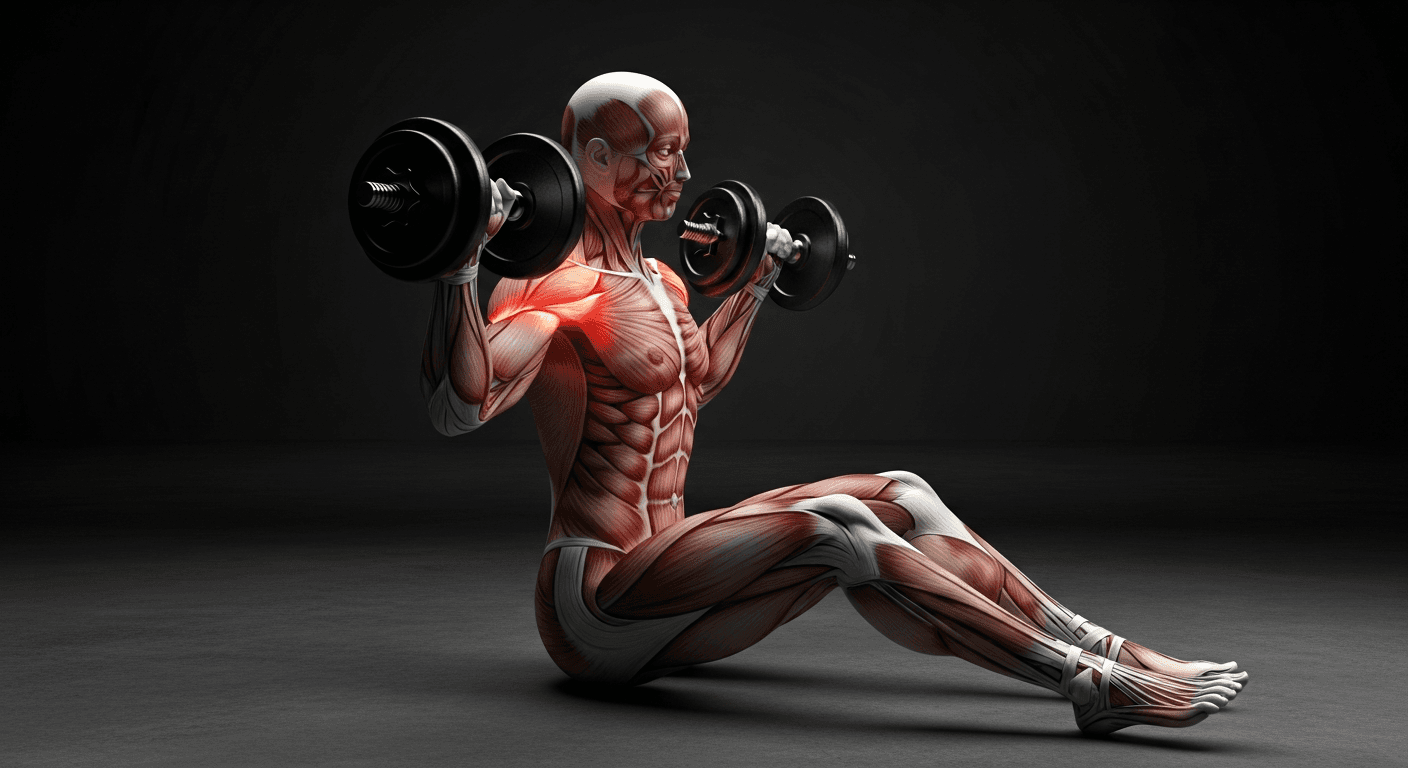
Direct answer (short): The Arnold press primarily trains the anterior (front) and medial (side) deltoid, with secondary involvement of the rotator-cuff muscles, upper trapezius, and triceps. Its rotation shifts emphasis through the range of motion, making it useful for shoulder mass and variety, but not mandatory for strength or function.
Which muscles does the Arnold press work and which are primary vs secondary?
The Arnold press is a compound overhead press variation that combines rotation and shoulder abduction. Primary muscles:
- Anterior deltoid (front) — engaged early in the pattern when dumbbells start in front of the shoulders.
- Medial deltoid (side) — receives substantial load as you rotate and abduct toward lockout.
Secondary muscles:
- Triceps brachii — assists lockout and stabilizes elbow extension.
- Upper trapezius and serratus anterior — help stabilize the scapula during the press.
- Rotator cuff (supraspinatus, infraspinatus, teres minor, subscapularis) — active for shoulder stability and control during rotation.
The rotational component creates a different moment arm than a strict overhead press, so it can change where lifters perceive effort compared with a neutral-grip dumbbell press or barbell press.
How does the Arnold press fit into a shoulder or upper-body program?
Use the Arnold press as a pressing variation for hypertrophy and as a density/variation tool. Practical programming points based on strength and hypertrophy consensus:
- Frequency: include shoulder-focused work 1–3 times per week depending on total program and recovery. The Arnold press can appear once or twice weekly as part of that volume.
- Reps and load: use hypertrophy ranges (roughly 6–12 reps) when the goal is size; use heavier, lower-rep sets for strength with more conventional overhead presses.
- Progression: prioritize progressive overload — increase weight, reps, or sets gradually while maintaining form.
- Recovery: monitor shoulder fatigue; rotate variations across training blocks and plan periodic lower-volume weeks.
The Arnold press is not necessary for strength-specific programming (barbell strict or push press are more specific for maximal load), but it is a useful accessory for deltoid development and movement variety.
How does it compare to a standard dumbbell or barbell overhead press?
- Range of motion and rotation: Arnold press adds internal-to-external rotation, changing muscle activation timing.
- Load: you will typically use less absolute load than a strict barbell press because of the rotational control required.
- Transfer: barbell strict and push presses transfer better to maximal overhead strength tasks; Arnold press transfers well to shoulder hypertrophy and muscular balance.
What are 3–4 solid alternatives and when should I pick each?
Below are practical alternatives with guidance about when to choose them.
| Alternative | What it trains | When to choose it |
|---|---|---|
| Seated/standing dumbbell (neutral or pronated) overhead press | Similar deltoid/triceps emphasis without the added rotation | You want a simpler pressing pattern, heavier loading, or reduced shoulder rotation demand; good for strength phases or when equipment is two dumbbells |
| Barbell strict overhead press | Anterior and medial delts, triceps, core stability | You need to build maximal pressing strength or train heavy loads; efficient for progressive overload with a barbell |
| Push press | Same muscles plus hip drive contribution | Use to overload the upper body with momentum and train power; not ideal if strict shoulder isolation is the goal |
| Single-arm landmine press | Anterior/medial delts with anti-rotation core demand, limited shoulder rotation | Pick this if you have shoulder rotation pain, limited mobility, or limited equipment (one barbell); the arc is more forgiving and easier to load progressively |
When to pick each: choose dumbbell or barbell strict presses for strength phases and heavier loading. Use the Arnold press or lateral-variation work for hypertrophy and to hit middle delts differently. Select landmine or neutral-grip presses if you have pain with rotation or limited shoulder mobility.
How should I progress the Arnold press without stalling?
Follow progressive-overload principles used broadly in resistance training: increase load, increase reps, add sets, or improve technique over time. If you hit a plateau, change a variable — reduce range briefly and push heavier (for strength), switch grip/variation (for joint comfort), or increase training frequency while reducing per-session volume. Rotate variations every 4–8 weeks to manage fatigue and stimulus.
What are the common technical cues and safety considerations?
Cues:
- Start with dumbbells at shoulder height, palms facing you.
- Press while rotating palms out so that at lockout palms face forward or slightly inward depending on grip.
- Keep ribs down, core braced, feet stable; avoid excessive lumbar extension.
Safety note: stop an exercise if you feel sharp or acute pain. If you have persistent shoulder pain, seek evaluation from a qualified clinician before continuing rotational overhead work. This article does not diagnose conditions or guarantee injury prevention.
Comparison table: How the Arnold press stacks up (quick glance)
| Feature | Arnold press | Dumbbell strict press | Barbell press | Landmine press |
|---|---|---|---|---|
| Rotational demand | High | Low | Low | Low–moderate |
| Typical loading | Moderate | Moderate–heavy | Heavy | Moderate–heavy |
| Deltoid distribution | Anterior + medial | Anterior + medial | Anterior-dominant | Anterior + medial |
| Good for pain/limited mobility? | No (rotation) | Yes (neutral grips ok) | No (bar path fixed) | Yes (for many) |
What should I watch for with injuries or limitations?
- Shoulder impingement or rotator-cuff irritation: the rotational component can exacerbate symptoms. Prefer neutral grips or landmine variations and consult a clinician.
- Neck or upper-trap overactivity: reduce load, check tempo, and emphasize scapular control.
- Limited equipment: dumbbells or a barbell allow most alternatives; landmine setups or kettlebells offer accessible substitutions.
Limitations — what an article or app can’t do for you
No article, app, or AI can see or correct your form in real time, diagnose specific injuries, or replace individualized clinical or coaching assessment. If you have existing pain, medical conditions, or recent surgery, consult a qualified health professional. A program only works when you reliably follow it; consistency and appropriate recovery are more important than the exact exercise picked.
Safety reminder: always stop on sharp pain, use appropriate loads, and consult a qualified professional for persistent issues. This guide summarizes consensus training ideas but is not personalized medical advice.
Frequently asked questions
- Does the Arnold press target the front delts more than a regular press?
- Yes. The Arnold press starts with the dumbbells in front of the shoulders and rotates during the lift, initially biasing the anterior (front) deltoid. As you rotate to lockout the medial deltoid gets more of the load, so overall it distributes stress across anterior and medial heads.
- How often should I do the Arnold press for muscle growth?
- Treat the Arnold press as one exercise in your shoulder work and include it within a broader program 1–2 times per week, depending on total shoulder volume. Progress by adding load, reps, or sets over weeks, and schedule periodic lower-volume weeks (deloads) for recovery.
- Is the Arnold press safe if I have shoulder pain?
- If you have existing shoulder pain, especially pain with rotation, avoid the Arnold press until a clinician rules out pathology. Substitute less-rotational options (e.g., single-arm landmine press or neutral-grip dumbbell press) and consult a qualified professional before returning to rotation-heavy movements.