Exercise Guides·5 min read
Bench Press: Proper Form, Step by Step
Definitive bench press form guide: setup, grip, bar path, breathing, tempo, common mistakes and fixes. Safety-first, evidence-aware, step-by-step.
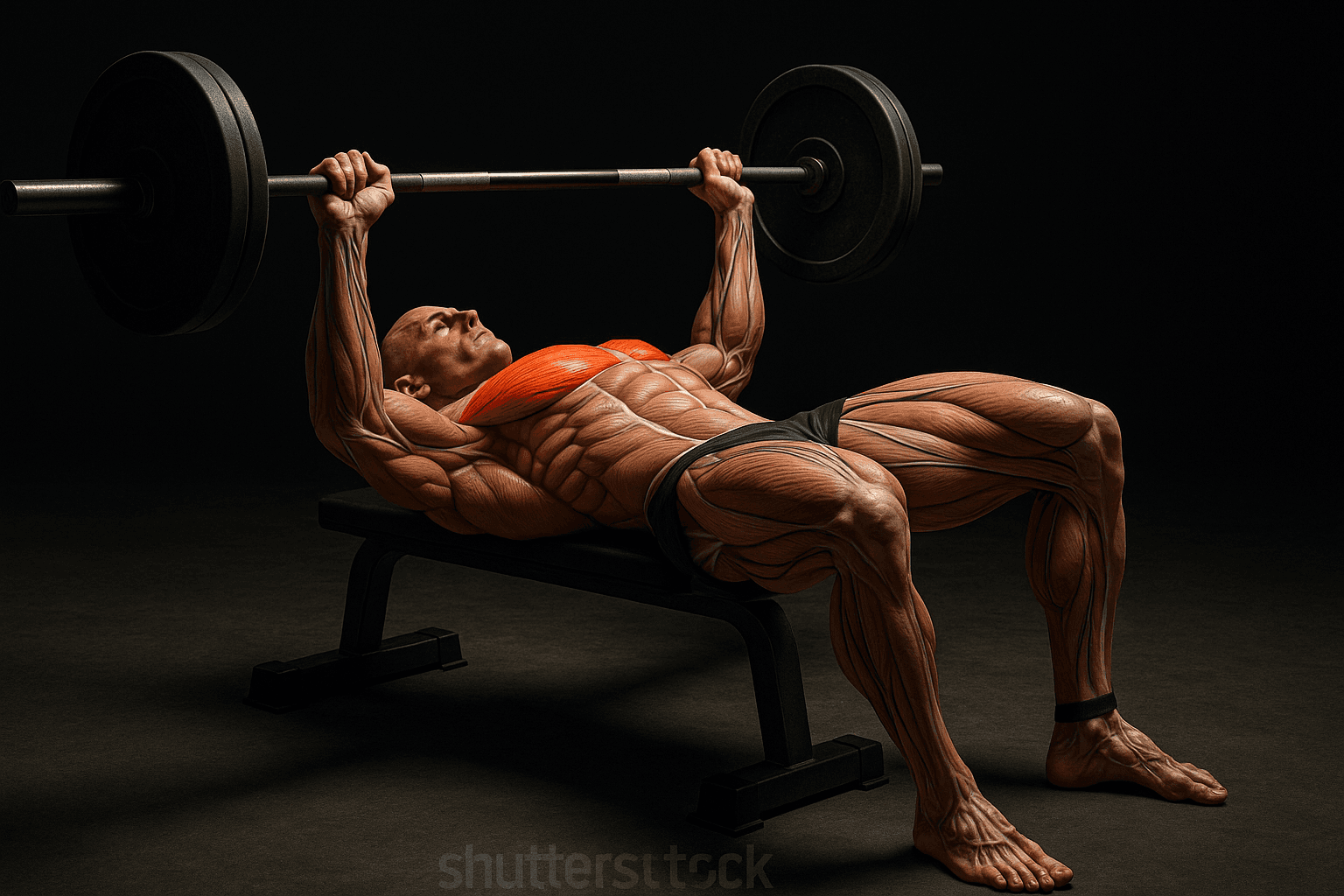
Photo by RepBro.
Bench press proper form: lie flat on the bench, plant feet, retract the shoulder blades, grip so forearms are vertical at the bottom of each rep, lower the bar to the mid-chest in about 1-2 seconds, then press up while exhaling, keeping a controlled, slightly arced bar path.
What is the correct bench press setup?
- Bench and feet
- Lie with eyes under the bar. Feet planted flat on the floor about hip-width. If your feet don't reach, place plates under them to avoid toe elevation.
- Maintain a small arch in the lower back: ribs down, glutes on the bench. This creates a stable base but does not mean an extreme competitive arch unless you train for that.
- Scapulae and upper back
- Pinch your shoulder blades together and down. Think of creating a shelf with your upper back rather than shrugging. This protects the shoulder joint and shortens the range of motion.
- Grip and wrist position
- Grip the bar so that when the bar is at your chest your forearms are vertical. For most people this is slightly wider than shoulder-width.
- Keep wrists neutral to slightly extended so the bar rests directly over the heel of your hand. Avoid excessive wrist bend.
- Head and eye position
- Keep your head on the bench and eyes under the bar before unracking. Look up and slightly back during the lift; avoid lifting your head to see the bar.
How should I unrack and position the bar?
- Use an even, controlled push to unrack. Move the bar horizontally until it clears the rack pins and is directly over your shoulders.
- Lock your elbows briefly at the top to confirm an even grip, then lower immediately into the first rep with control.
What is the correct bar path and touch point?
- Bar path: a slightly curved line. Start over the shoulders, lower the bar to the mid-chest (nipple to lower-sternum area), and press back up toward the original overhead position.
- Touch point: mid-chest. The touch point may vary with limb length and bench height; use the mid-chest as a reference.
How should I breathe and brace?
- Inhale before lowering to fill the diaphragm and brace the core. This increases thoracic stability.
- Hold that breath briefly while lowering and initiate the press, then exhale through the sticking point or once the bar passes halfway up. For very heavy singles, experienced lifters may use the Valsalva technique; beginners should avoid prolonged breath-holding.
What tempo should I use?
- Beginners and technical work: 2 seconds down, 0-1 second touch, 1 second up.
- Strength work: 2-1-1 or 3-1-1 with heavier loads.
- Hypertrophy: 2-0-1 or 3-0-1 with controlled rep speed and slightly higher reps.
- Keep the concentric intentional and controlled; avoid bouncing the bar off the chest.
What are the execution cues during the lift?
- Pull the bar down into your chest, not toward your face.
- Keep elbows at about a 45-degree angle relative to the torso for balanced shoulder loading. Some lifters prefer slightly narrower or wider; 45 degrees is a safe default.
- Press by driving through the heels of your feet, maintaining a rigid torso and pressing the feet into the floor.
- Keep the bar path slightly back toward the rack position as you finish the rep.
What safety checks should I follow?
- Use collars on the bar to secure plates.
- Train with a spotter or in a power rack with safety pins at an appropriate height for heavy sets.
- Stop immediately if you feel sharp or unusual pain and consult a qualified professional; do not self-diagnose.
What are the common bench press mistakes and how do I fix them?
- Elbows flaring to 90 degrees
- Problem: Excessive shoulder stress and inefficient pressing.
- Fix: Tuck elbows to about 45 degrees by imagining you are trying to bend the bar in half. Use lighter weight to reinforce the pattern.
- Shoulders not retracted
- Problem: Longer range of motion and unstable shoulder position.
- Fix: Squeeze scapulae before each unrack and keep that tightness throughout the set. Practice scapular squeezes on the bench as part of warm-up.
- Feet lifting or unstable foot position
- Problem: Loss of leg drive and core stability.
- Fix: Plant feet flat and push through the heels. If your feet don’t reach, add 5-10 cm of platform under them rather than lifting toes.
- Bouncing the bar off the chest
- Problem: Increases risk and promotes poor control.
- Fix: Lower with a controlled tempo (1-2 seconds), pause briefly at the chest, and press without a rebound. Train with submaximal weight to groove a controlled touch.
- Overly wide or narrow grip
- Problem: Poor force transfer or excess shoulder stress.
- Fix: Adjust hands so forearms are vertical at the bottom. Use a marker on the bar to keep grip consistent.
- Excessive head or shoulder movement
- Problem: Wasted energy and instability.
- Fix: Keep head on the bench and shoulders pinned; only the arms should move during the lift.
When should I seek coaching or medical advice?
- Seek technical coaching if you can’t keep the setup across multiple sets or if you get consistent joint discomfort. Use video feedback or a qualified coach to correct subtle issues.
- Stop and consult a qualified healthcare professional for any sharp, shooting, or persistent pain. This guide is not a diagnosis.
How do I integrate the bench press into a training plan?
- Frequency: 1–3 times per week depending on goals. Strength-focused plans often include 2 bench sessions per week with varied intensity.
- Volume and load: For strength prioritize 3–6 sets of 1–6 reps at 80–95% 1RM. For size use 3–5 sets of 6–12 reps at 65–80% 1RM.
- Track progress with tools like RepBro to log sets, reps, and tempo for consistent improvement.
One-sentence safety note: Stop on sharp pain and consult a qualified professional; this article does not diagnose or treat injuries.
Honest takeaway: Bench press well by prioritizing a stable setup, vertical forearms at touch, controlled tempo, and progressive, pain-free loading.
Frequently asked questions
- How wide should my grip be on the bench press?
- Grip so your forearms are vertical at the bottom of the lift. For most lifters this is slightly wider than shoulder-width. Exact inches vary; use the vertical-forearm cue rather than a specific hand measurement.
- Should I touch my chest on every rep?
- Touching the chest ensures full range of motion and consistent technique for most lifters. Stop short only if coached to do so for a specific program or to avoid pain, and consult a professional if pain occurs.
- What tempo is best for strength vs hypertrophy?
- For strength, use a 2-1-1 tempo (2s eccentric, 1s pause, 1s concentric) with heavier loads. For hypertrophy, 2-0-1 or 3-0-1 with slightly higher reps works well. Adjust based on fatigue and form.