Bulgarian Split Squat: Muscles Worked and Best Alternatives
Clear breakdown of which muscles the Bulgarian split squat trains, programming tips, and 4 practical alternatives with when to pick each.
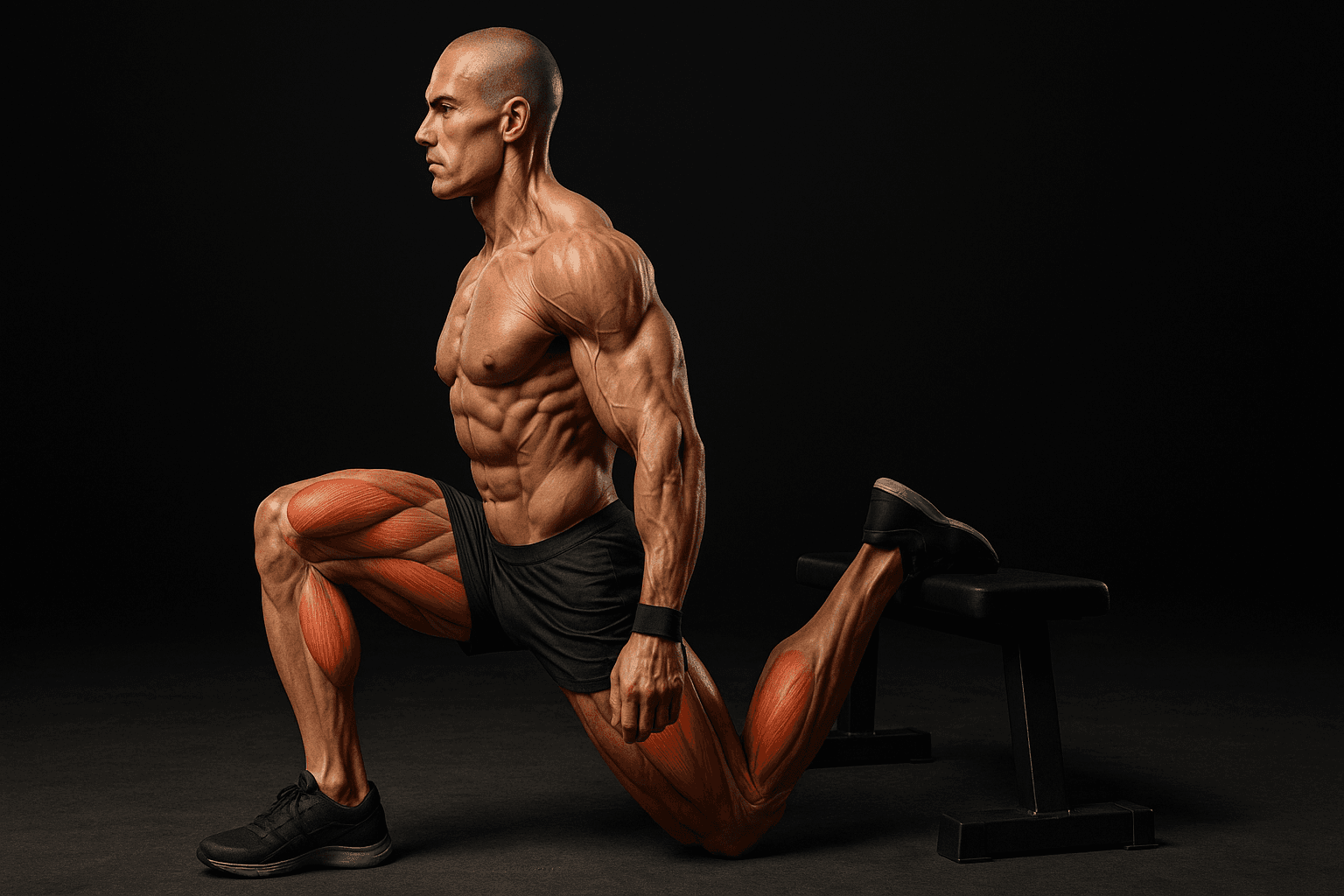
Photo by RepBro.
What muscles does the Bulgarian split squat work?
The Bulgarian split squat is primarily a unilateral quadriceps and glute exercise. The front-leg quadriceps (vastus lateralis/medialis/intermedius and rectus femoris) and the gluteus maximus are the main movers. Secondary muscles include the hamstrings, adductors (inner thigh), calves (gastrocnemius), and a range of stabilizers: hip abductors/rotators and the core. Because it’s single-leg and uses a rear foot elevation, it also challenges balance and reduces the need for very heavy bilateral loading.
How do I know which muscles are doing the work during the lift?
- If you feel the work primarily in the front thigh, you’re loading the quads. - If you feel it more in the rear of the hip and glute on the front leg, you’re emphasizing the gluteus maximus. - A more upright torso and closer foot placement bias the quads; a slightly longer stance and more hip hinge bias the glutes and hamstrings. Use a mirror or record one set to check joint angles.
How should I program the Bulgarian split squat?
- Role in a program: 1) As a main unilateral leg movement on lower-body days, 2) As an accessory after squats or deadlifts to address imbalances and increase single-leg workload. - Frequency: 1–2 times per week per leg. - Sets/reps: Strength: 3–5 sets of 4–6 reps per leg; Hypertrophy: 3–4 sets of 6–12 reps per leg; Endurance/conditioning: 2–3 sets of 12–20 reps per leg. - Rest: 60–180 seconds between sets depending on intensity. - Progression: increase load first, then reps, then reduce rest, or add tempo (2–3 s eccentric). Aim for systematic, small increases (e.g., +1–2.5 kg / 2.5–5 lb per session when possible).
Form checklist (short):
- Bench height: 40–50 cm (16–20 in) is common; adjust so the rear foot rests comfortably. - Foot distance: ~60–80 cm (24–31 in) from bench to front foot, depending on leg length—goal is roughly 80–90° knee flexion at the bottom. - Keep front knee tracking in line with toes; avoid letting the knee travel far past toes under heavy loads. - Keep weight through the front heel; push through the whole foot. - Torso: relatively upright for quad emphasis, slight forward lean for hip emphasis. - Control descent; avoid bouncing out of the bottom.
Safety note: stop if you experience sharp joint pain. If you have persistent knee, hip, or back pain, consult a qualified health or movement professional before continuing.
What are the best alternatives and when should I pick each?
Here are four practical alternatives, why they work, and when to choose them.
- Split squat (rear foot on the floor — not elevated)
- Why it’s useful: Keeps the rear foot planted, reducing demand on hip flexor mobility and balance while still training each leg separately. - When to pick it: If you have limited balance, an unstable bench, or are rehabbing balance-related issues. Also good when you want to reduce lumbar or hip irritation from rear-foot elevation. - Equipment: None beyond bodyweight or dumbbells/barbell. - Programming: Use the same sets/reps as Bulgarian split squats.
- Reverse lunge (stepping back)
- Why it’s useful: Easier on the knees than forward stepping or lunging forward; good for hip extension and eccentric control. - When to pick it: If you have anterior knee pain or limited hip mobility, or if you want a more dynamic movement that’s easier to load heavily with a barbell. - Equipment: Dumbbells, kettlebells, or barbell. Works well if you prefer fewer balance demands.
- Step-up (box or bench)
- Why it’s useful: Emphasizes extension at the hip and knee in a controlled, high-force way; easy to scale by box height and load. - When to pick it: If you struggle with single-leg stability or want a joint-friendly, progressive overload option. Use a 20–40 cm (8–16 in) box depending on height and mobility. - Equipment: Box/bench and dumbbells or barbell. Good for bridging to heavier bilateral lifts since you can systematically load step-ups.
- Single-leg Romanian deadlift (RDL)
- Why it’s useful: Strongly targets the posterior chain (glutes and hamstrings) and improves hip hinge mechanics—balances the quad-dominant nature of Bulgarian split squats. - When to pick it: If you’re plateauing on the Bulgarian split squat with a quad-dominant bias, or if you have knee discomfort and want a posterior-chain-focused alternative. - Equipment: Dumbbell or kettlebell. Focus on hip hinge and balance; keep a soft bend in the standing knee.
How to choose among these when equipment, injury, or plateaus are a factor?
- Equipment-limited (no bench): choose split squats, reverse lunges, or step-ups. - Knee pain with deep knee flexion: prefer reverse lunges and step-ups at conservative heights, or single-leg RDLs where knee flexion is minimal. - Balance/instability issues: start with split squats (rear foot down) or step-ups instead of rear-foot-elevated variants. - Plateau on Bulgarian split squat (no more load on front leg): rotate in single-leg RDLs to strengthen the posterior chain, use heavier step-ups to practice higher loads, and consider reducing range or using tempo to focus on weak points.
Any training tools or tracking tips?
- Track load per leg (for example, 20 kg dumbbell per hand while doing 8 reps per leg). - Log sets, reps, and difficulty (RPE or bar speed) to spot plateaus. - If you use the RepBro app, mark left/right progress to catch asymmetries early; compare single-leg options with the guide at https://www.repbro.app/vs for exercise tradeoffs.
Safety reminder: never push through sharp pain; stop and seek professional help if pain persists. This guide is educational, not diagnostic.
One-sentence takeaway: The Bulgarian split squat is a high-value unilateral movement that mainly targets the quads and glutes—use it 1–2 times weekly and choose split squats, reverse lunges, step-ups, or single-leg RDLs when equipment, pain, or plateaus make the Bulgarian unsuitable.
Frequently asked questions
- Are Bulgarian split squats better than regular squats for quad development?
- They can give similar or greater quadriceps stimulus per leg because they're unilateral and allow a greater knee angle, but they don't replace bilateral lifts for maximal load; include both depending on goals.
- How many reps and sets should I do for Bulgarian split squats?
- For strength use 3–5 sets of 4–6 reps per leg with heavier load; for hypertrophy 3–4 sets of 6–12 reps per leg; for conditioning 2–3 sets of 12–20 reps. Adjust rest to 60–180 seconds depending on goal.
- Do Bulgarian split squats hurt the knees?
- They shouldn't cause sharp pain if you use correct foot position and load, but people with existing anterior knee pain may prefer less knee-flexion options; stop on sharp pain and consult a professional.