Cable Fly: Proper Form, Step by Step
Definitive cable fly form guide: setup, execution cues, breathing, tempo, common mistakes and fixes. Safety-first instructions—stop on sharp pain.
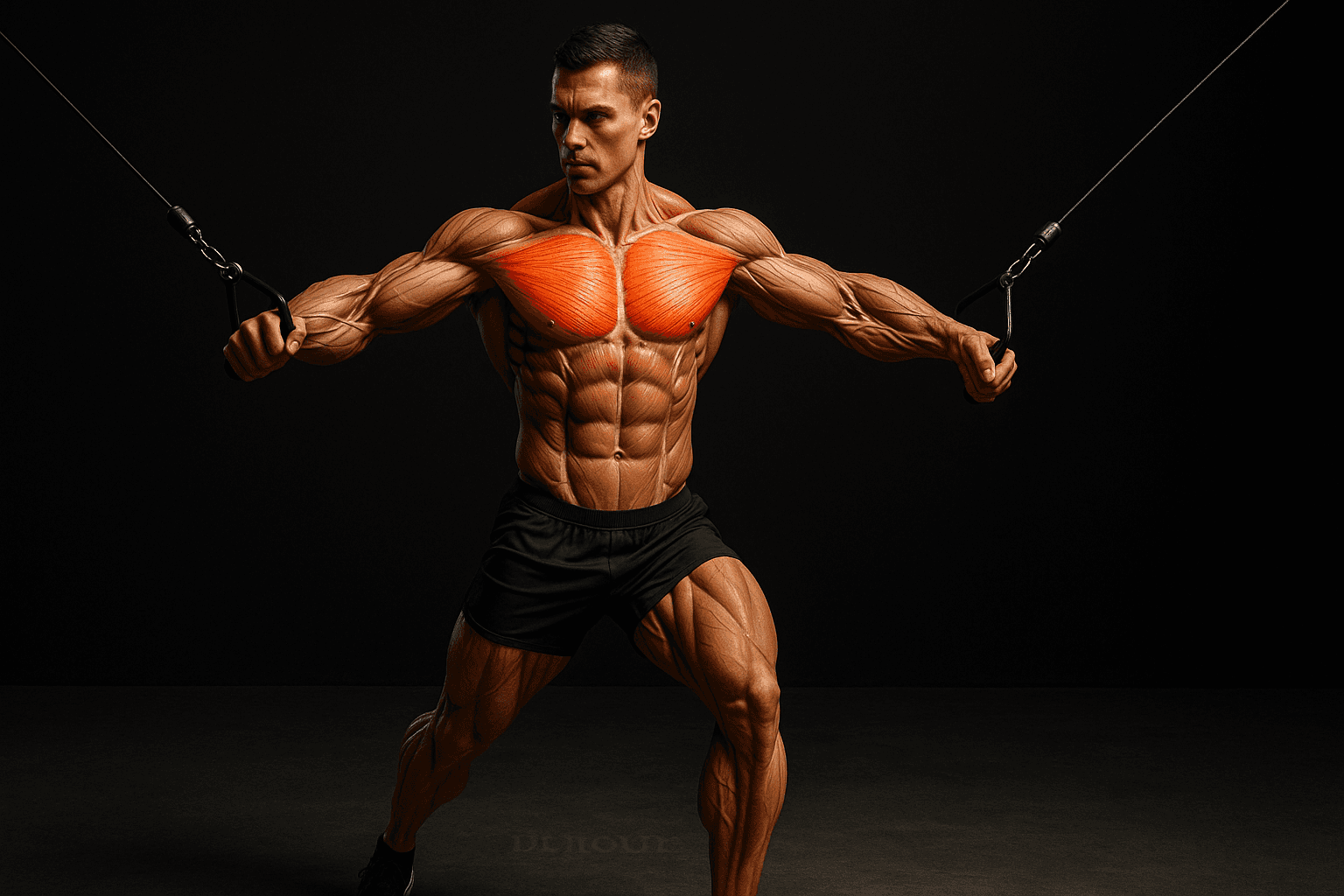
Photo by RepBro.
What is the proper cable fly form?
Proper cable fly form is a controlled, chest-focused horizontal adduction performed from a stable stance with the pulleys set around chest to shoulder height, a constant slight elbow bend (about 10–20°), and an intentional scapular position so the movement come from the pecs, not the shoulders. Move on a slow, steady arc, avoid shrugging, and stop on sharp pain—consult a professional if pain persists.
How do I set up the cables and my body position?
- Pulley height: chest to shoulder height for a standard flat fly. For upper chest emphasis, set pulleys slightly low; for lower chest, set pulleys slightly high. Start with chest-height for most lifters.
- Handles: use single D-handles, one in each hand.
- Weight: choose a load that allows 8–15 clean reps; avoid grinding heavy loads that collapse your form.
- Stance: staggered stance (one foot slightly forward) or split stance for balance. Feet hip-width apart is fine if you prefer both feet aligned.
- Torso: slight forward lean from hips, about 10–20°; keep the spine neutral. Tuck the ribcage slightly so you feel your pecs engage.
- Grip: neutral grip (palms facing inward). Hold handles lightly—don’t squeeze into a fist.
- Scapula: set your shoulder blades mildly retracted and depressed—imagine a small pinched position without over-squeezing.
How do I perform a cable fly step by step?
- Start position: stand centered between the stacks, handles out to the sides so your arms are abducted roughly 30–45° from your trunk. Elbows are slightly bent 10–20° and fixed in that position throughout the set.
- Brace: take a 2–3 second diaphragmatic inhale, brace your core and keep a neutral neck.
- Initiate: exhale and bring your hands together in a slow, controlled arc, leading with the elbows but feeling contraction in the chest. Aim to have hands meet or cross just in front of your sternum—about 5–10 cm (2–4 in) in front of the chest.
- Peak contraction: pause 0–1 second at the top to feel the pecs shorten; avoid forcing a big squeeze that causes shoulder elevation.
- Return: inhale and slowly let the handles travel back to the start in the same arc, stopping when you feel a natural, safe stretch in the pecs—no bouncing or letting the shoulder roll forward.
- Repetitions: perform 8–15 reps per set. Rest 60–120 seconds depending on your goal (strength vs hypertrophy).
What breathing and tempo should I use?
- Tempo example: 2-0-2 (2 seconds to adduct, 0 second hold, 2 seconds to return). For better control use 3-0-3 when learning.
- Breathing: exhale during the concentric (bringing hands together), inhale during the eccentric (returning to start). Use full diaphragmatic breaths and avoid breath-holding except brief Valsalva for heavy compound lifts—don’t do that here.
- Rep ranges: 8–12 for hypertrophy-focused sets; 12–15 for lighter pump days; 6–8 only if you still can control form throughout.
What are common mistakes and how do I fix them?
-
Mistake: Excessive elbow extension or locking out. Fix: Keep a constant 10–20° bend; cue yourself to keep the elbow soft like holding a plate under each armpit.
-
Mistake: Rolling or shrugging shoulders forward. Fix: Set the scapula briefly at the start and keep shoulders down; think about bringing the chest to the handles, not the hands to the chest.
-
Mistake: Using too much weight and swinging. Fix: Drop weight until you can complete 8–15 reps with a 2–3s concentric and eccentric and a paused top—no momentum.
-
Mistake: Hands meeting too low or too high in front of the body. Fix: Aim for hands to meet at midline near the sternum—about the height of your nipples—so the pecs, not shoulders, do the work.
-
Mistake: Too large range leading to shoulder pinching. Fix: Reduce the eccentric range so you stop where you feel a safe, soft stretch in the pecs; never force a deeper stretch that causes shoulder discomfort.
Is the cable fly safe and when should I stop?
Safety note: stop immediately if you feel sharp or radiating pain. Discomfort from working muscles is normal; sharp, joint, or nerve pain is not. If pain occurs, discontinue the exercise and consult a qualified coach or medical professional—never try to self-diagnose.
Use lighter loads, reduce range of motion, and re-check elbow angle if you have shoulder issues. Cable flyes are accessory movements—if they don’t feel right, substitute a safer chest press or machine fly until you resolve issues with a professional.
What quick cues and checklist should I use before each set?
- Pulley height set to chest level.
- Elbows soft at 10–20°.
- Scapula mildly retracted and depressed.
- Stance stable and core braced.
- Tempo set (2–0–2 or 3–0–3).
- Weight allows controlled 8–15 reps.
Use a simple checklist on your phone or training app to track tempo and cues; tools like RepBro make it easy to log tempo and notes for each set so you can objectively monitor form progress.
When should I progress or change variations?
Progress by improving tempo control first, then add 5–10% more load once you can do 3 sets of 12 with clean technique. Change pulley height to emphasize different regions of the chest, or alternate between single-arm and two-arm cable flyes to correct side-to-side imbalances.
One-sentence honest takeaway: The proper cable fly is a controlled arc with a slight elbow bend, chest-driven contraction, and slow tempo—stop if it hurts and ask a pro for guidance.
Frequently asked questions
- Should I use heavy weight on cable flyes?
- No. Use a weight that lets you keep a controlled arc and a steady tempo for 8–15 reps; if form breaks before 8 reps, reduce the load.
- Are cable flyes better than dumbbell flyes?
- They each have pros: cables provide continuous tension and adjustable angles; dumbbells provide a larger range of motion. Use both to target the chest differently.
- What should I do if my shoulders hurt during cable flyes?
- Stop any set that causes sharp pain. Check elbow angle (keep a slight bend) and pulley height, reduce load, and consult a qualified coach or medical professional if pain persists.