Conventional Deadlift: Muscles Worked and Best Alternatives
Which muscles does the conventional deadlift train, where it fits in a program, and 4 practical alternatives for equipment limits, injuries, or plateaus.
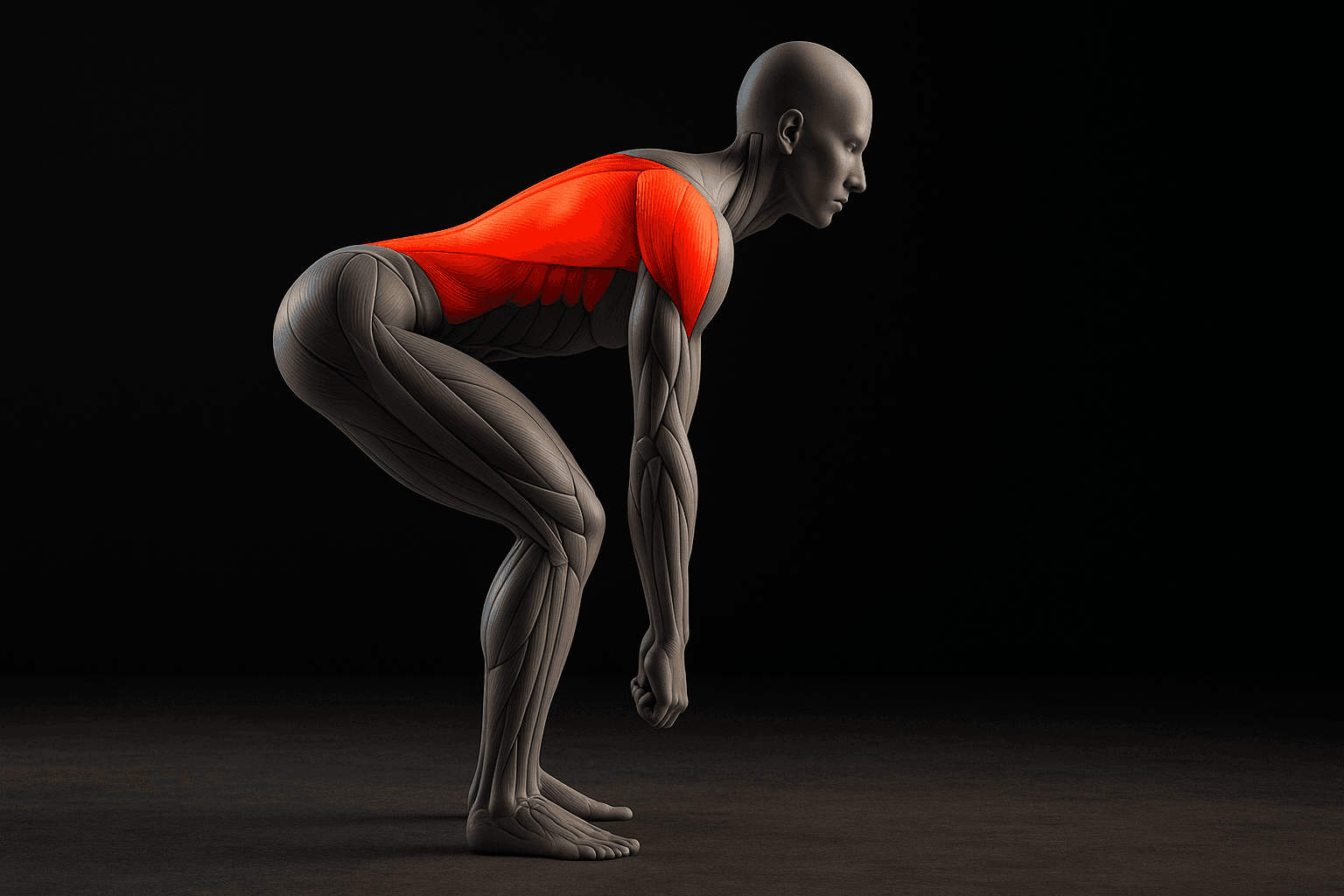
Photo by RepBro.
The conventional deadlift primarily trains the posterior chain — gluteus maximus, hamstrings (biceps femoris, semitendinosus, semimembranosus) and spinal erectors — with secondary loading of the quadriceps, adductors, upper back (trapezius, rhomboids), core stabilizers, and forearm/grip muscles. In short: it’s a hip-hinge power and strength move that also taxes the whole body as a compound lift.
What exactly are the primary and secondary muscles worked?
Primary movers
- Gluteus maximus: generates the hip-extension torque to stand the bar up.
- Hamstrings: act as hip extensors and help control hip position through the lift.
- Spinal erectors (erector spinae): maintain trunk extension and resist flexion under load.
Secondary contributors
- Quadriceps (vastii and rectus femoris): provide knee extension early in the pull, especially from the floor.
- Hip adductors: assist hip extension and help stabilize the femur.
- Upper back (trapezius, rhomboids): stabilize the scapula and keep the bar close to the body.
- Core (obliques, transverse abdominis): prevent spinal flexion/rotation.
- Forearms/grip: hold the bar — grip strength often limits deadlift performance more than leg or back strength.
These roles shift with stance, bar position, and anthropometrics. Taller lifters or longer torso lifters often feel more spinal erector and hamstring demand; shorter lifters or those with longer femurs may recruit more quadriceps.
Where does the conventional deadlift fit in a program?
- Role: primary strength exercise for hip extension and whole-body pulling strength. Use it as a main lift on lower-body or full-body strength days.
- Frequency: 1–3 times per week. Example splits: one heavy deadlift day (3–6 sets of 1–5 reps) plus one lighter speed or volume session (3–6 sets of 3–6 reps) if you deadlift three times weekly.
- Rep/Set guidance:
- Max strength: 3–6 sets × 1–5 reps at 85–95% of 1RM.
- Strength-endurance or technique: 3–5 sets × 3–6 reps at 70–85% of 1RM.
- Hypertrophy/accessory focus: 3–5 sets × 6–12 reps with reduced load and stricter tempo.
- Intensity cycling: keep at most two consecutive weeks of very heavy maximal loading; use a deload or lighter week every 3–6 weeks to manage CNS and musculoskeletal fatigue.
- Pairing: avoid putting maximal deadlifts back-to-back with maximal squats in the same day for most lifters. Put them on separate days or prioritize the one aligned with your primary goal.
What are safe technique reminders?
Stop if you feel sharp pain; consult a qualified professional for persistent pain or red-flag symptoms. Keep a neutral spine, brace the core, keep the bar close to the legs, and drive through the heels. Use progressive loading and don’t chase ego numbers before technique is consistent.
What are 4 solid alternatives and when to pick each?
- Romanian Deadlift (RDL)
- Why: isolates the hip hinge and loads hamstrings and glutes more than the initial pull off the floor.
- Best when: you need to improve hip-hinge mechanics, hamstring strength for lockout, or reduce knee contribution. Also useful for hypertrophy phases (3–6 sets × 6–10 reps).
- Equipment: barbell or dumbbells.
- Injuries/limitations: lighter spine loading than maximal conventional deadlifts if performed with submaximal loads; still requires a healthy hip hinge.
- Trap Bar (Hex Bar) Deadlift
- Why: places the load more neutrally around the body, reduces horizontal shear on the lumbar spine and usually allows a more upright torso and greater knee drive.
- Best when: you have low-back sensitivity, are taller, or want to train higher reps (e.g., 3–5 sets × 5–10 reps) and powerful triple-extension without maximal axial loading.
- Equipment: trap/hex bar at a gym. Can be done with dumbbells in a pinch but not identical.
- Plateaus: often increases lockout ability and can break a plateau by improving force production in a more comfortable position.
- Barbell Hip Thrust
- Why: isolates gluteus maximus and allows very high gluteal loading with less spinal compression.
- Best when: your primary weakness is hip extension/lockout, or you need to emphasize glute hypertrophy without heavy axial loading. Typical sets: 3–6 × 6–12+ reps.
- Equipment: barbell and bench; can be done with band or single leg variations.
- Injuries/limitations: not a full-body pull; pair with a pulling movement to maintain back strength.
- Single-Leg Romanian Deadlift (or Dumbbell Deadlift)
- Why: reduces absolute load on the spine, improves unilateral strength, balance and addresses side-to-side asymmetries.
- Best when: equipment is limited (one or two dumbbells or kettlebells), you’re rehabbing or managing lower-back loading, or you need to correct unilateral weaknesses. Use 3–4 sets × 6–10 reps per leg.
- Equipment: dumbbells/kettlebells.
- Plateaus: helps by isolating weak sides and improving transfer to bilateral lifts.
Bonus: Kettlebell Swings
- Why: trains explosive hip extension and posterior chain endurance with low technical entry.
- Best when: you need power conditioning, limited equipment, or lower-load posterior-chain stimulus. Use high-rep sets (10–20+ reps) with short rest for conditioning or 3–6 sets of 10–15 for power work.
How to pick among these alternatives?
- Equipment-limited (no barbell): single-leg RDLs, dumbbell deadlifts, or kettlebell swings.
- Low-back sensitivity: trap bar deadlift or hip thrust first; progress to conventional variations only when symptom-free under load.
- Stuck on lockout: RDLs and hip thrusts directly strengthen hip extension lockout.
- Need unilateral carryover or mobility balance: single-leg RDLs.
- Want power and conditioning: kettlebell swings or trap bar speed pulls.
If you want a quick head-to-head comparison (trap bar vs conventional deadlift) or to import a sample deadlift-focused plan, see the deadlift comparisons and plan import tools on [RepBro] and the comparison page at https://www.repbro.app/vs.
Stop if you feel sharp pain; consult a qualified professional for persistent pain or red-flag symptoms.
One-sentence takeaway: The conventional deadlift is a powerful posterior-chain builder — choose alternatives (RDL, trap bar, hip thrust, single-leg RDL, or swings) based on equipment, pain tolerance, and the specific weakness you’re addressing.
Frequently asked questions
- Is the conventional deadlift mostly a back exercise?
- No. The conventional deadlift is a whole-posterior-chain movement — primary movers are the glutes, hamstrings and spinal erectors; the back works hard to stabilize and transmit force but isn’t the only target.
- How often should I deadlift each week?
- For most lifters, 1–3 times per week depending on intensity: once for maximal strength work (heavy singles/doubles), up to three times when using varied intensities (heavy, speed, and volume days).
- Which alternative is best if I have low-back pain?
- Trap bar deadlifts and hip thrusts are often easier on the low back because they reduce shear and axial loading; pick the one that feels symptom-free and allows progressive loading.