The Most Common Dip Mistakes (and How to Fix Them)
Fix the most common dip mistakes fast: depth, elbow flare, scapular shrug, momentum, grip and shallow reps — what each costs and one practical fix each now.
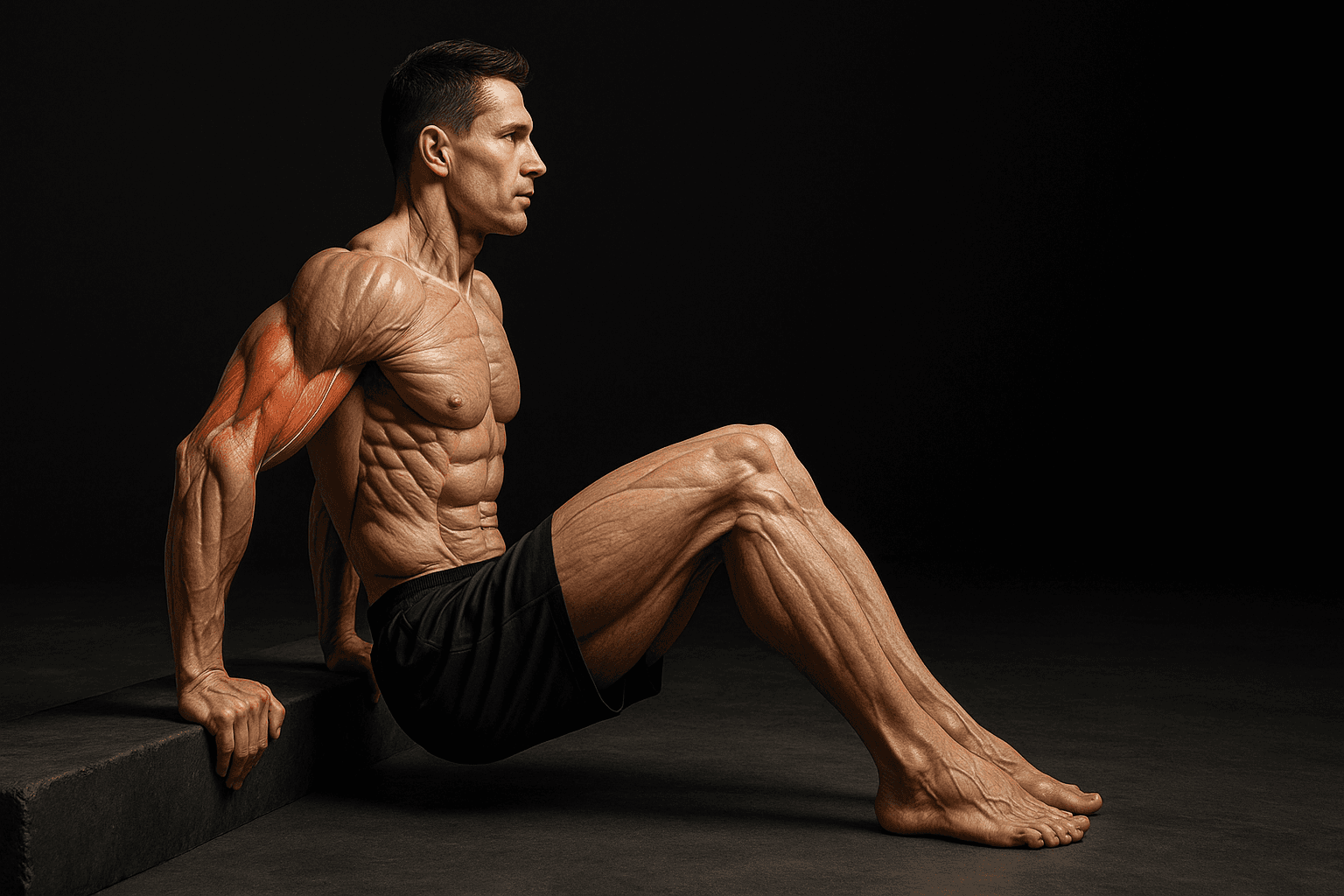
Photo by RepBro.
The most common dip mistakes are excessive depth, elbows flaring, shrugged shoulders, using momentum, wrong hand spacing, and shallow reps — each costs strength or increases injury risk. Below are why they happen, what they cost, and one concrete fix for each.
Are you going too deep?
Why it happens: People often equate 'deeper is better' with muscle gain. Without sufficient shoulder mobility or control, dips below roughly 90° elbow flexion (upper arm parallel to the floor) put more shear on the anterior shoulder.
What it costs: Loss of training consistency from shoulder soreness, slower strength progress, and a higher chance of painful impingement. You gain little extra chest/triceps stimulus past the point of safe control.
One concrete fix: Limit depth to 90° elbow flexion for 6–12 weeks. Use a marker under the bars or a box to touch your chest lightly at that depth. Progress by adding 0.5–2.5 kg (1–5 lb) or reducing assistance only after 3 sets of 5–8 controlled reps at that depth.
Are your elbows flaring out?
Why it happens: Elbow flare often comes from trying to shift the load to the chest or from weak triceps/rotator cuff control. Habit, poor scapular stability, and wide hand placement make it worse.
What it costs: Flared elbows increase shoulder torque and reduce effective triceps leverage — slower triceps gains and more shoulder strain.
One concrete fix: Tuck elbows to roughly a 30°–45° angle from the torso. Cue 'elbows in, not pinned' and perform 3 sets of 6–10 reps focusing on smooth descent and ascent. If you can't maintain the tuck, use a resistance band for assistance or switch to bench dips/push-ups until control improves.
Are you shrugging your shoulders up toward your ears?
Why it happens: Shrugging is a compensation for weak scapular depression/retraction or trying to shorten the range to avoid hard parts of the movement. It often appears when sets get heavy or reps get high.
What it costs: Elevated shoulders transfer load away from prime movers and place compressive stress on the neck and upper shoulder, increasing discomfort and reducing effective chest/triceps work.
One concrete fix: Before each set, pull your shoulders down and back to set the scapulae. Hold that position during the set; if you lose it after 8–12 seconds, drop the load and repeat. Practice 2–3 sets of scapular depressions (10 reps) as part of your warm-up.
Are you using momentum or kipping?
Why it happens: When bodyweight exceeds current capacity, people swing, kick, or bounce to finish reps. Fatigue and chasing rep numbers instead of form also cause this.
What it costs: Momentum turns a strength exercise into a swing, reducing time-under-tension and mechanical overload of target muscles, and it can create jerky shoulder forces that spike injury risk.
One concrete fix: Slow the tempo: 3–4 second descent, 0–1 second pause at the bottom, 1 second up. If you can’t keep this tempo for 3 sets of 5–8 reps, regress to band-assisted dips, bench dips, or negative-only dips (3–5 second eccentrics, step up between reps).
Is your hand spacing wrong or uneven?
Why it happens: Bars or racks with poor grip position, or an unconscious preference for one side, lead to too-wide, too-narrow, or asymmetric grip. Athletes sometimes widen hands to feel more chest activation.
What it costs: Too-wide hands stress the shoulders and reduce triceps action; too-narrow hands can cramp elbows. Uneven hands create rotational torque and uneven muscle development.
One concrete fix: Set hands about shoulder-width apart (allowing 10% either side based on comfort). Use a mirror, video, or a training partner to check symmetry. If you use rings, keep them fixed or slightly angled so wrists track naturally.
Are your reps too shallow or you’re skipping lockout?
Why it happens: People stop early to avoid sticking points or because they think partial range is safer. Fatigue and poor ego management also cause half-reps.
What it costs: Reduced muscle activation, smaller strength gains, and a weaker lockout that limits heavier progressions (e.g., weighted dips).
One concrete fix: Use a target range: full lockout at the top (elbows straight but not locked into bone crunch) and 90° elbow flexion at the bottom. Program 3–5 sets of 5–12 full-range reps; if you fail mid-set, finish with shorter-range accessory work like triceps pushdowns or banded extensions.
What should you do about progression and programming?
Treat dips like a loaded compound lift: practice them 1–3 times per week, prioritize quality over quantity, and use progressive overload. Example progression: 2–3 weeks of band-assisted dips (3 sets × 6–10), 2–4 weeks of bodyweight controlled reps (3–5 sets × 5–10, 3–4 sec eccentric), then add small load increments. If you track reps or use plan imports, add them to [RepBro] to log tempo, assistance, and load, or compare variations at https://www.repbro.app/vs.
Safety note: When should you stop?
Stop any set immediately if you feel sharp or unusual pain. This guide avoids diagnosing injuries — if pain persists, consult a qualified healthcare or movement professional. Regress to an easier variation rather than pushing through discomfort.
One-sentence takeaway: Fixing depth, elbow position, scapular control, tempo, hand spacing, and full range of motion gives you safer, faster dip progress with fewer setbacks.
Frequently asked questions
- How deep should I go in a dip?
- For most people aim to stop around 90° elbow flexion — upper arm roughly parallel to the floor. Go deeper only with good shoulder comfort and progressive loading.
- Are dips bad for shoulders?
- Dips aren't inherently bad, but poor technique increases risk. Stop on sharp pain, regress to assisted variations, and consult a professional if you have a history of shoulder issues.
- Are bench dips a good alternative?
- Bench dips load the shoulder and place more stress on the anterior shoulder than parallel-bar dips. They're useful for accessibility but use them cautiously and prioritize proper progression.