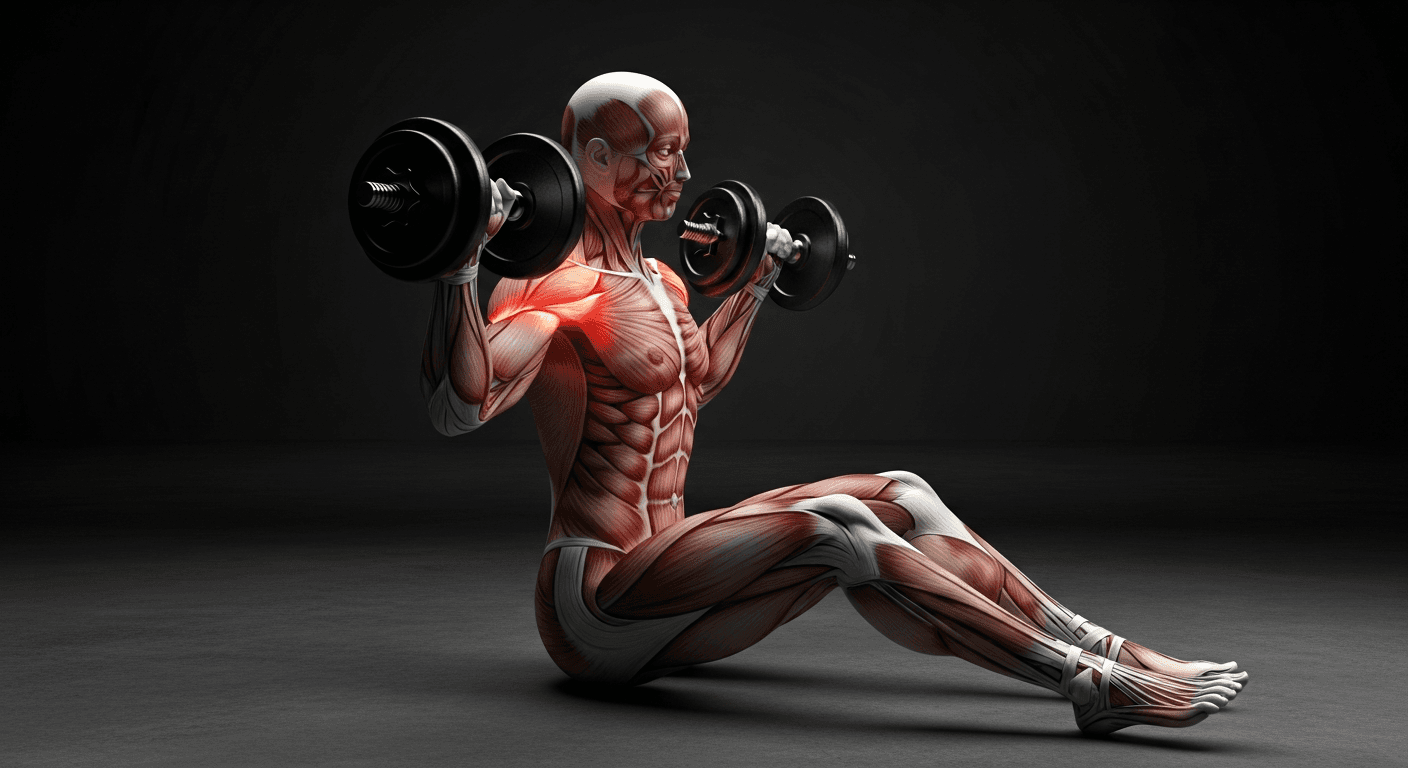
Dumbbell Row: Muscles Worked and Best Alternatives
Learn which muscles the dumbbell row trains, how to program it, and 4 practical alternatives (when to pick each for equipment, injury, or plateau).

Photo by RepBro.
The dumbbell row primarily trains the latissimus dorsi (the big lats), with secondary emphasis on the middle and lower trapezius, rhomboids, posterior deltoid, biceps brachii and forearms; it also recruits the erector spinae and core for stabilization in unsupported variations.
What exactly does the dumbbell row hit and which parts are primary vs secondary?
Primary: latissimus dorsi — the dumbbell row is one of the most direct moves to pull the upper arm down and back.
Secondary: middle trapezius and rhomboids — these retract the shoulder blade; posterior deltoid — pulls the arm backwards; biceps and forearms — assist the elbow flexion and grip; erector spinae and obliques — stabilize the torso in many versions.
Practical note: unilateral (one-arm) dumbbell rows let each side work independently, which helps correct left/right strength imbalances and often increases range-of-motion on the working side.
How should the dumbbell row fit into a program?
- Frequency: 1–3x per week depending on your split and goals. Beginners can start with twice weekly; intermediate trainees commonly hit back 2x/week.
- Sets and reps: For muscle growth, aim for 3–6 sets of 6–12 reps per session; for strength, 3–5 sets of 3–6 reps with heavier load; for endurance or extra volume, include 2–3 sets of 12–20 reps.
- Placement: Put it on the same day as other horizontal or vertical pulls. Pair with deadlift variants or vertical pulls (pull-ups/lat pulldowns) for a balanced back routine. If you do heavy deadlifts the same day, consider lower volume on rows to manage fatigue.
- Progression: Increase load, reps, sets, or improve time under tension. Track sets and weights—apps like RepBro make progressive overload easier to monitor.
What form cues change what muscles get worked?
- Elbow path: Keeping the elbow close to the body biases the lats more; flaring the elbow slightly biases the posterior deltoid and upper traps.
- Torso angle: A flatter torso (near-parallel to the floor) increases posterior chain demand; a more upright position reduces lumbar loading and slightly shifts emphasis up the chain.
- Range of motion: Pull through full scapular retraction to emphasize rhomboids and mid traps; focus on a controlled eccentric for time-under-tension.
Safety note for exercise form: stop immediately on sharp or radiating pain and consult a qualified professional; this guide isn’t a diagnosis.
Which alternatives are best and when should you pick each?
Here are four solid alternatives and practical reasons to choose them.
- Barbell Bent-Over Row
- Why pick it: Lets you use heavier absolute loads and is efficient for overall mass and strength when technique is solid.
- When to pick it: You have a barbell and want to focus on maximal loading or you’re chasing strength carryover to deadlifts and Olympic lifts.
- Downsides: Greater spinal loading and technique sensitivity; not ideal if you have lower-back issues or limited mobility.
- Quick programming tip: 3–5 sets of 3–6 reps for strength, or 3–5 sets of 6–12 for hypertrophy.
- Comparison resource: when choosing between unilateral vs barbell options, see https://www.repbro.app/vs
- Seated Cable Row (or Single-Arm Cable Row)
- Why pick it: Constant tension, easy to vary grip and elbow path, and gentle on the lower back because the torso is stable.
- When to pick it: Limited to light equipment (cable machine available), dealing with lumbar stress, or targeting midback and scapular retraction with less torso stabilization demand.
- Downsides: Often less range-of-motion than a dumbbell row unless you use a single-arm cable.
- Programming tip: 3–4 sets of 8–15 reps; choose grips to bias lats (wide grip) or rhomboids (close/neutral grips).
- Chest-Supported Dumbbell Row (incl. incline bench rows)
- Why pick it: Removes lower-back stabilization, forcing the back muscles to do the pulling without lumbar load.
- When to pick it: You have lower-back pain, are rehabbing, or want to focus purely on contraction and reduce technique drift as fatigue rises.
- Downsides: Reduced core training and slightly different motor pattern than unsupported rows.
- Programming tip: 3–5 sets of 6–12 reps with strict form.
- Inverted Row (Bodyweight Horizontal Pull)
- Why pick it: Minimal equipment—just a bar or rings—and great for beginners, shoulder health, and as a high-rep finisher.
- When to pick it: No dumbbells/barbell available, you're working on pull mechanics, or you need a low-impact option during a deload.
- Downsides: Hard to load progressively beyond bodyweight without modifications (feet-elevated or weighted vest).
- Programming tip: 3–4 sets of 6–20 reps; progress by changing body angle or adding load.
How to choose between alternatives if you're stuck or plateauing?
- Equipment limits: If you lack a barbell, prioritize cable or inverted rows; with limited equipment, single-arm cable or inverted rows give easy incremental progress.
- Injuries: If you have lower-back issues, choose chest-supported rows or seated cable rows first. If you have shoulder pain on wide pulls, narrow-grip or elbows-tucked variations reduce strain.
- Plateauing: Change the loading scheme—add heavier barbell rows for strength blocks, or use chest-supported rows to overload muscle contraction and then return to dumbbell rows stronger. Also vary rep ranges every 4–8 weeks (e.g., 6–8 weeks hypertrophy then 4–6 weeks strength focus).
Quick checklist of common mistakes
- Using torso momentum: reduces lat tension and shifts load to lower back.
- Shortening ROM: not pulling to full scapular retraction limits rhomboid/trap engagement.
- Weak progressive overload tracking: if you aren’t increasing weight/reps/sets or improving form, you won’t adapt.
One-sentence honest takeaway: The dumbbell row is a highly effective, unilateral back builder that primarily targets the lats and midback—use it 1–3 times per week, pick alternatives like barbell rows, cable rows, chest-supported rows, or inverted rows based on equipment, back health, and your progression needs, and stop on sharp pain while consulting a professional if issues persist.
Frequently asked questions
- Is the dumbbell row better than a barbell row for back size?
- No single exercise is categorically better; dumbbell rows give more unilateral control and range-of-motion for many lifters, while barbell rows let you use heavier absolute loads. Use both across a long-term plan.
- How many times per week should I do dumbbell rows?
- Do the dumbbell row 1–3 times per week depending on overall volume. Aim for 6–20 hard reps per set for hypertrophy, or 3–6 for strength, with total weekly sets for the back in the 8–20 range.
- Can I do dumbbell rows with lower back pain?
- If those rows increase sharp or radiating back pain, stop and consult a healthcare professional. Consider chest-supported rows or seated cable rows as lower-back-friendly alternatives.