Dumbbell Shoulder Press: Proper Form, Step by Step
Step-by-step guide to proper dumbbell shoulder press form: setup, execution cues, breathing, tempo, common mistakes and fixes. Safety-first, professional advice.
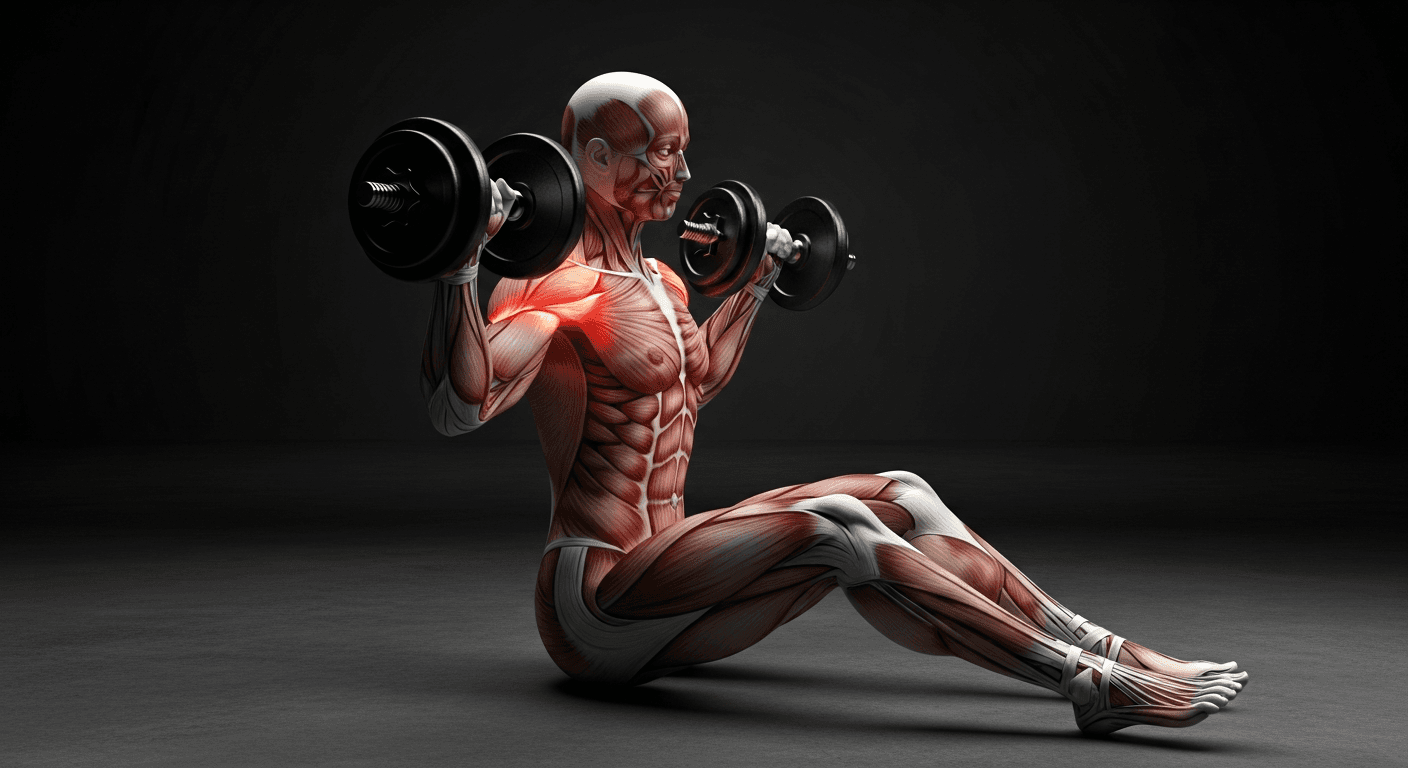
Photo by RepBro.
The dumbbell shoulder press proper form is: set the dumbbells at shoulder height with a neutral spine, press overhead in a controlled line until your arms are nearly extended (avoid shrugging or overarching), and lower under control while breathing in on the descent and out on the press. Use a grip and elbow angle that allow pain-free motion and keep the ribs down and scapulae stable.
What is the correct setup for a dumbbell shoulder press?
- Feet: Hip-width for seated or standing; feet flat and evenly loaded. For standing, a slight stagger or narrower stance is fine if it helps balance.
- Torso: Neutral spine—no exaggerated lumbar arch. Tilt the ribcage down and brace your core as if preparing for a punch.
- Scapulae: Retract and depress lightly (chest up but not shrugged). Think "set the shoulder blades" rather than squeezing hard.
- Elbows & hands: Hold dumbbells at shoulder level with wrists stacked over elbows. Elbows should be roughly 10–20° in front of the torso (not flared directly out) to reduce impingement.
- Grip: Neutral (palms facing) or slightly pronated (palms forward) are both acceptable. Choose whichever is pain-free.
- Load: Start with a weight you can control for 8–12 clean reps; increase gradually.
How do I execute the press (step-by-step cues)?
- Tighten your midline: brace your abs and pull the ribcage slightly down. Maintain a stable pelvis.
- Take a full breath in (diaphragmatic), hold briefly if using a Valsalva for heavy sets, or breathe normally for lighter sets.
- Press both dumbbells up in a vertical-ish path. Drive through the shoulders, not the traps—think "push the weights up and slightly back so they travel over the midline of the shoulder." Do not over-arch the back.
- At the top, the dumbbells should either touch lightly or be a few centimetres apart, with arms nearly extended (elbows soft, not slammed into joint lock).
- Exhale as you complete the press (about 0.5–1 second). Inhale as you lower the dumbbells under control.
- Lower for 1.5–3 seconds back to the start, maintaining shoulder blade stability. Reset your breath and repeat.
What breathing and tempo should I use?
- Basic tempo for most sets: 2-0-1 (two seconds down, no pause, one second up) or 2-1-1 (two seconds down, one-second pause, one second up) for better control.
- For slow, quality reps use 3-0-1 (slow eccentric) to increase time under tension.
- Breathing: Inhale on the descent; exhale on the concentric (press) or use a short Valsalva during heavy singles/low-rep sets if trained to do so. Never hold your breath into light-to-moderate sets if you feel dizzy.
How much range of motion is safe?
- Aim to lower until the upper arm is roughly parallel to the floor (about 90° at the elbow). If your shoulders tolerate more depth without pinching, you can go slightly deeper, but never force it.
- Avoid excessive posterior head tilt of the humerus (shoulder rolling back) which can create impingement—keep the motion smooth and controlled.
What are common mistakes and how do I fix them?
- Mistake: Excessive lower-back arching (lumbar hyperextension).
- Fix: Brace the core, tuck the ribs down, and either reduce weight or perform the seated press until your core control improves.
- Mistake: Pressing with the traps/shoulder shrug instead of deltoids.
- Fix: Focus on driving the elbows up, not packing the shoulders into the ears; consciously depress the scapulae and use slightly lighter weight.
- Mistake: Elbows flared straight out (90°) causing shoulder strain.
- Fix: Bring elbows 10–20° in front of the torso so the upper arm tracks slightly forward; test a neutral-grip press.
- Mistake: Letting dumbbells drift forward or backward off the midline.
- Fix: Keep the dumbbells moving along a steady, slightly posterior path so they finish above the midline of the shoulder.
- Mistake: Bouncing the weights or using momentum from the legs.
- Fix: Use a controlled tempo; for strict pressing remove leg drive or use seated variation.
What variations are useful?
- Seated dumbbell press: Reduces lower-back demand—good for hypertrophy and strict pressing.
- Single-arm seated/standing press: Challenges anti-rotation core strength and helps fix side-to-side imbalances.
- Arnold press: Adds rotation and greater front-delt involvement—use with light weight if shoulder mobility allows.
What about pain or injury concerns?
Safety note: Stop immediately if you feel sharp or unusual joint pain during the press. Discomfort that’s muscular is different from sharp, pinching, or radiating pain. If pain occurs, stop and consult a qualified professional (physiotherapist, sports doctor, or certified coach). This article does not diagnose or treat injuries.
Short FAQ
Q: Should I touch the weights together at the top?
A: Not necessary—light contact is fine, but keeping them a few centimetres apart can reduce shoulder compression.
Q: How many reps/sets should I do?
A: For general strength/hypertrophy, 3–5 sets of 6–12 reps is common; adjust based on goals and recovery.
Q: Can I do this every workout?
A: Twice weekly per muscle group is a practical starting point. Monitor fatigue and technique; prioritize recovery.
For tracking and logging progressive overload, consider using the RepBro app to record sets, tempos, and notes: https://apps.apple.com/us/app/gym-workout-coach-repbro/id6763749305. For a comparison with other overhead presses, see how the dumbbell version stacks up here: https://www.repbro.app/vs
Honest takeaway: Use a controlled tempo, a pain-free grip and elbow path, and prioritize scapular/core stability to press safely and effectively.
Frequently asked questions
- Should I use a neutral (palms facing) grip or palms-forward for the dumbbell press?
- A neutral grip (palms facing) usually feels easier on the shoulder joint and can reduce impingement risk. Palms-forward shifts slightly more emphasis to the front deltoid. Choose the grip that allows clean, pain-free movement and better scapular control.
- How much range of motion should I use?
- Lower the dumbbells until your upper arm is roughly parallel to the floor (about 90° at the elbow) or slightly below if mobility allows without pain; don't force deeper ranges that cause shoulder pinching.
- Is it better to sit or stand for the dumbbell shoulder press?
- Both are effective: seated press reduces lower-back involvement and can be safer for heavy pressing without a belt; standing press trains core and lower-body stability. Pick based on goals and current back/core control.