The Most Common Goblet Squat Mistakes (and How to Fix Them)
Fix the most common goblet squat mistakes—knees caving, heels rising, shallow depth, rounded chest, bad grip—why they happen, what they cost, and one concrete fix per error.
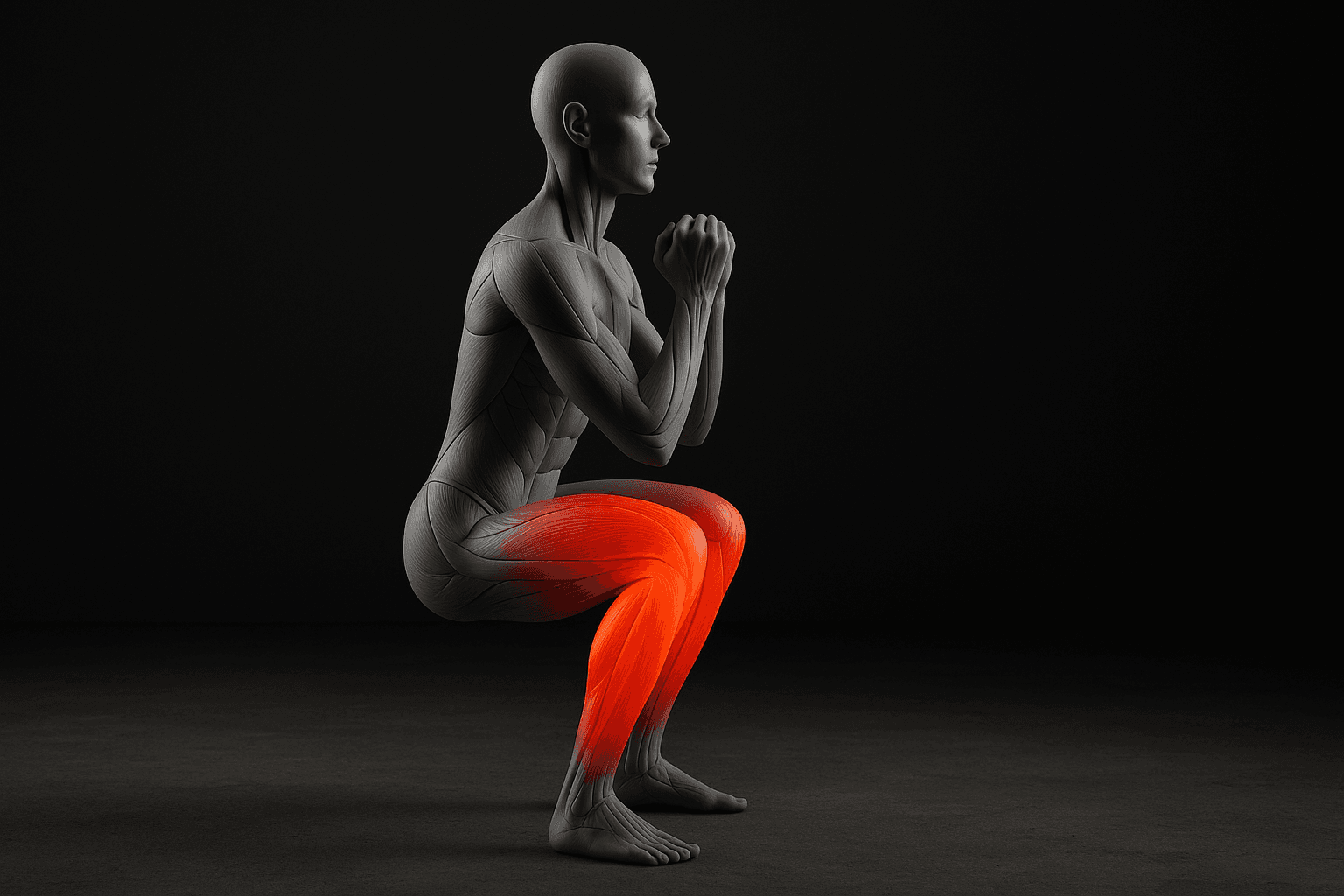
Photo by RepBro.
The most common goblet squat mistakes are knees collapsing inward, heels lifting, rounding the chest or lower back, holding the weight too high or too wide, shallow range of motion, and too-narrow stance. Below are the why, the cost, and one concrete fix for each.
Why are my knees caving in during the goblet squat?
Why it happens: Weak or under-recruited hip external rotators and glute medius, combined with driving the knees inward to find balance. Often paired with a stance that is too narrow. What it costs: Reduced quad and glute loading, slower strength gains, and increased strain on the medial knee structures — higher risk of aggravation over time. One fix: Cue and practice hip-knee alignment by pressing your knees slightly out on the way down and using a 2-3 second eccentric. Add a band above the knees for 2 sets of 10 reps to train external rotation and motor control.
Why are my heels coming off the floor?
Why it happens: Ankle dorsiflexion limit, too-wide stance, or sitting excessively back onto the hamstrings. Sometimes people compensate by rising onto toes to reach depth. What it costs: Loss of stable base, less force transfer through the posterior chain, and extra load on the knees and forefoot. One fix: Improve immediate mechanics by placing a 1–2 cm heel wedge (plates or a small board) under each heel or take a slightly narrower stance with 5–15 degrees of toe flare; long term, do ankle mobilizations like calf wall stretches 2 times daily for 2 minutes.
Why is my chest collapsing or my lower back rounding?
Why it happens: Holding the weight too heavy, gripping the weight too high, or weak upper back and core bracing. Also common when trying to reach depth quickly without bracing. What it costs: Poor loading pattern that shifts stress to the lumbar spine; limits safe progression and increase in reps or weight. One fix: Hold the dumbbell or kettlebell close to the chest with elbows pointing down, keep shoulders pulled back, and inhale to brace the core before descending. Reduce weight by 20–30% if you cannot maintain a neutral spine for 5 consecutive reps.
Why am I holding the weight incorrectly?
Why it happens: Using a kettlebell by the horns too high, gripping a dumbbell at the sides, or letting elbows flare forward — often from mimicry rather than coaching. What it costs: Poor leverage, forward torso lean, and decreased ability to keep elbows inside the knees at the bottom, reducing quad stimulus. One fix: Use a single kettlebell or vertical dumbbell held at the center of the chest, thumbs down and elbows under the wrist. Keep elbows tucked toward the ribs so the weight pulls you upright, not forward.
Why don't I hit full depth?
Why it happens: Fear of depth, stiffness in hips or ankles, or deliberately stopping because of balance concerns. Also occurs when someone uses too heavy a weight. What it costs: Smaller training stimulus, limited mobility gains, and slower carryover to other squat variations. One fix: Work to a box or bench set at the desired depth and perform 3 sets of 8 controlled box-touch goblet squats. Pause for 1 second on the box to train confidence and position, then stand up under control.
Why is my stance too narrow or too wide?
Why it happens: Copying someone else, poor pelvic control, or trying to feel quads over glutes. Stance affects hip tracking and balance. What it costs: Too-narrow stance forces knees inward and limits hip recruitment; too-wide reduces quad involvement and can stress the adductors. One fix: Start with feet shoulder-width apart (measure from outside edge of one foot to the other), toes turned out 10–20 degrees. Perform 3 sets and adjust by 2–3 cm as needed until you can reach depth without knees caving or heels rising.
Why am I dropping too quickly or bouncing out of the bottom?
Why it happens: Using momentum to cheat the eccentric, poor tempo control, or trying to squeeze extra reps when grip and breathing are breaking down. What it costs: Less time under tension, poorer motor learning, and more stress on passive tissues when you rebound instead of controlling the lift. One fix: Use a tempo of 3 seconds down, 1 second pause, and 1 second up for 3 sets of 6–8. Tempo enforces control and forces you to learn proper pathing.
When should I stop or seek help?
Safety note: Stop immediately if you feel sharp or radiating pain and consult a qualified professional. If persistent joint pain occurs, reduce load and volume and consider form coaching from a trained coach or physiotherapist. This article provides technique fixes, not medical advice.
If you want to practice goblet squats with guided progressions, log sets or compare squat variations, RepBro has tools to track technique and load, and you can read a comparison of squat options on RepBro vs for programming choices.
One-sentence takeaway: Fix one mistake at a time — pick the most limiting issue, apply the single concrete fix for two weeks, then reassess.
Frequently asked questions
- How deep should a goblet squat be?
- Aim for thighs at least parallel to the floor; deeper is fine if you can keep a neutral spine and heels down. Stop short if you lose position.
- Is the goblet squat safer than the barbell back squat?
- For many lifters, yes: goblet squats reduce spinal loading and force an upright torso. For a detailed comparison see RepBro vs resources.
- What weight should I start with for goblet squats?
- Start conservatively: 8–12 kg (18–26 lb) for beginners using a dumbbell, or 8–16 kg (18–35 lb) kettlebell, and increase when you can do 3 sets of 8 with clean form.