Goblet Squat: Muscles Worked and Best Alternatives
Which muscles does the goblet squat work, where it belongs in a program, and 4 solid alternatives (when to pick each by equipment, injury, or plateau).
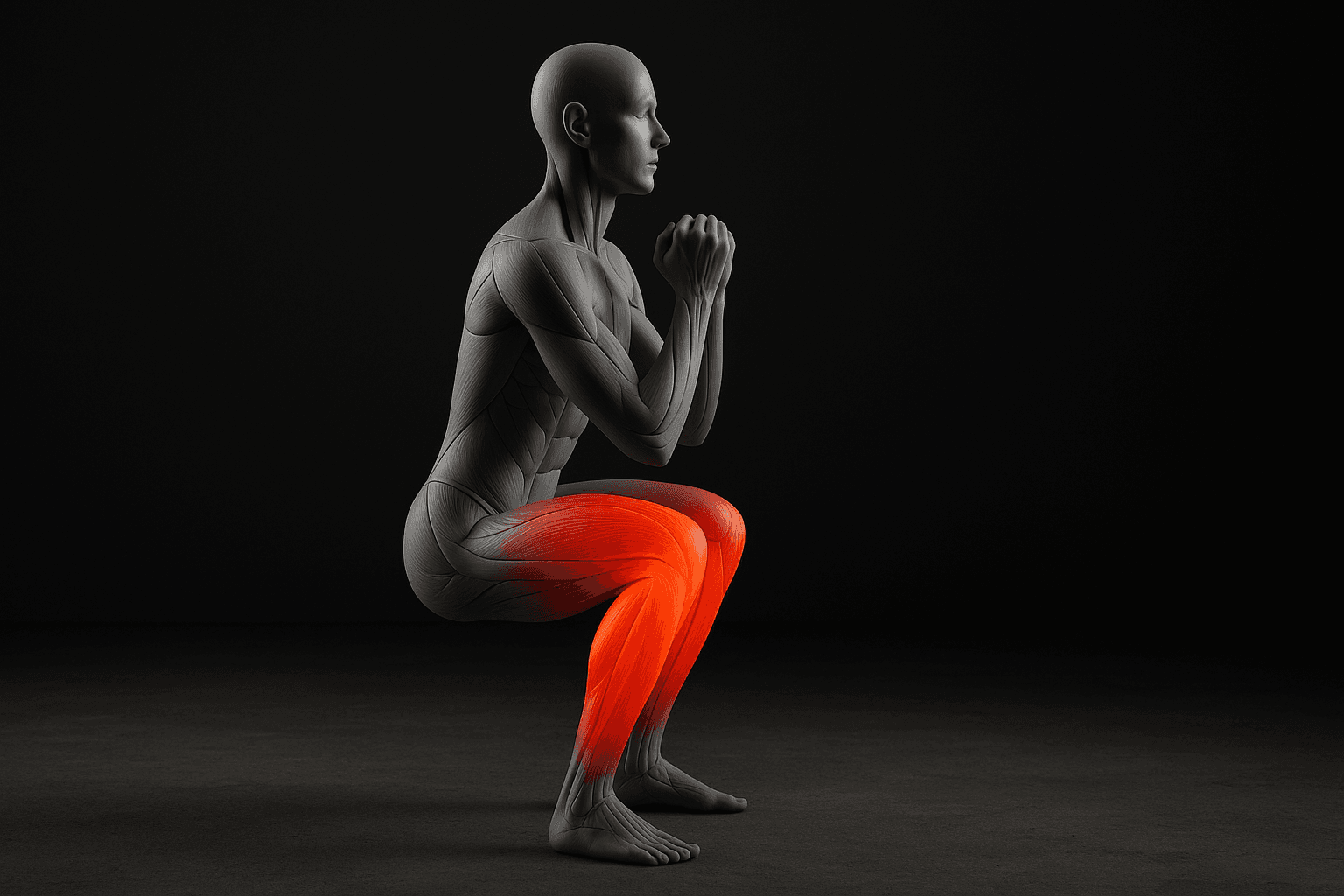
Photo by RepBro.
What muscles does the goblet squat work?
The goblet squat primarily trains the quadriceps (vastus lateralis/medialis/intermedius) and the gluteus maximus. Secondary muscles include the hamstrings (stabilizing role), the erector spinae and other lumbar stabilizers, the rectus abdominis and obliques (anti-flexion/anti-rotation), and the upper back/shoulders and forearms (the rack hold). In short: it’s a quad-dominant, whole-leg exercise with a strong core and upper‑body stabilization demand.
Why does the goblet squat hit those muscles?
Holding a weight at chest height forces a more upright torso than a back squat, which increases knee flexion and loads the quads more. The load also requires hip extension, so the glutes work through the concentric portion and when rising from deeper positions. Because you hold the weight in front, your core and upper back must resist forward collapse—hence the carryover to trunk stability and upper‑body endurance.
Where does the goblet squat fit in a program?
- As an early-session main lower-body exercise when you lack a barbell: 3–5 sets of 6–12 reps as the primary working set.
- As an accessory after a heavy barbell squat or deadlift to add volume and technical practice: 2–4 sets of 8–15 reps.
- As a warm-up or teaching tool to ingrain depth, upright posture, and hip drive: 2–3 sets of 8–12 reps with a light load.
- For conditioning or metabolic work: 2–4 sets of 12–20 reps with short rests.
Progression options: add 1–2.5 kg to the dumbbell/kettlebell, increase reps by 1–3 per set, add a tempo (e.g., 3 s eccentric, 1 s pause at the bottom), or convert to a unilateral variation. If you use the RepBro app you can track incremental load jumps and import plans using https://www.repbro.app/import.
Safety note: stop if you feel sharp joint pain. Use pain-free ranges and consult a qualified professional for persistent pain or complex medical issues.
What are the best alternatives to the goblet squat and when should I pick each?
Below are four practical alternatives with clear reasons to choose them.
1) Front squat — when do I pick it?
Pick the front squat when you have a barbell and want to overload the same upright-torso, knee-dominant pattern but with heavier absolute loads. The front squat shifts more demand to the quads and upper back and is superior for building maximal strength when you can rack a heavy barbell.
- Equipment: barbell and squat rack.
- Injuries: avoid if you have severe wrist/shoulder mobility restrictions; front rack issues can be worked around with straps or a crossed-arm position.
- Plateau fix: move from goblet to front squat to increase load capacity and neural adaptation.
Suggested loading: 3–6 sets of 3–8 reps for strength/hypertrophy.
2) Bulgarian split squat — when do I pick it?
Pick the Bulgarian split squat when you need unilateral work to fix left/right imbalances, improve single-leg stability, or continue to progress without more barbell load. It requires little equipment (dumbbell/kettlebell and an elevated rear foot) and is excellent for hypertrophy.
- Equipment: one dumbbell or kettlebell and a bench.
- Injuries: use cautiously with acute knee pain—modify depth or reduce load. Good option if wanting less spinal compression than heavy two‑legged squats.
- Plateau fix: use heavier single‑limb loading, tempo changes, or paused reps to overload differently.
Suggested loading: 3–4 sets of 6–12 reps per leg.
3) Trap-bar deadlift — when do I pick it?
Pick the trap-bar deadlift when spinal loading from a back/front squat is a limiting factor (low-back soreness) or when you want a powerful hip-and-leg lift with less forward torso lean. The neutral grip and outside hand position reduce shear on the lumbar spine while letting you lift heavier safely.
- Equipment: trap (hex) bar and platform.
- Injuries: good option for clients with mild low-back discomfort who tolerate hip-dominant moves better than deep knee flexion. Avoid if you have acute knee or hip pain that’s aggravated by hinge loading.
- Plateau fix: switch from goblet to trap-bar to increase absolute load and overload the posterior chain differently.
Suggested loading: 3–5 sets of 3–8 reps.
4) Box squat or seated goblet squat — when do I pick it?
Pick a box squat (barbell) or a tall seated goblet squat if you have limited ankle mobility, trouble finding consistent depth, or are rehabbing a movement pattern. These variations teach a clear sit-back pattern and protect the knees by limiting excessive forward travel.
- Equipment: box/bench; optionally a barbell or dumbbell.
- Injuries: useful for controlled range if knee pain flares with deep free squats; always err on the side of pain-free range.
- Plateau fix: use box height adjustments or tempo work to address sticking points and build confidence in the bottom position.
Suggested loading: 3–5 sets of 5–12 reps depending on goal.
How do I choose between the goblet squat and its alternatives?
Ask four quick questions: 1) What equipment do I have? 2) Do I need unilateral work? 3) Is spinal compression or torso angle a limiting factor? 4) Am I stuck on load or depth? Use goblet squats when you want a safe, teachable, quad-dominant pattern with core demand and you don’t need maximal load. Move to barbell front/back squats or trap-bar deadlifts to increase absolute load, or to Bulgarian split squats to fix imbalances.
Exercise form safety note: focus on chest up, hips back and down, knees tracking toes, weight on the mid-foot, and a controlled descent. Stop immediately on sharp pain and consult a qualified coach or clinician for persistent issues.
One-sentence takeaway: The goblet squat is a high-value, quad-dominant leg exercise for teaching depth and core tension—use it as a main lift when barbells aren’t available, then pick front squats, Bulgarian split squats, trap-bar deadlifts, or box variations depending on equipment, pain patterns, and where you need to break a plateau.
Frequently asked questions
- Is the goblet squat better for quads or glutes?
- The goblet squat emphasizes the quadriceps more than the glutes because of the more upright torso and knee-dominant movement, but the glutes remain a primary contributor—especially as depth and load increase.
- How many reps and sets should I use for goblet squats?
- For strength/hypertrophy use 3–5 sets of 6–12 reps; for conditioning or mobility-focused work use 2–4 sets of 12–20 reps. Rest 60–120 seconds depending on load.
- Can the goblet squat replace back squats?
- Not fully—goblet squats are excellent for teaching depth, upright torso, and core tension, but they’re limited by how much weight you can hold; use them as a supplement, progression tool, or main leg movement when barbells aren’t available.