Hammer Curl: Muscles Worked and Best Alternatives
Clear, practical breakdown of hammer curl muscles (primary and secondary), program placement, and four evidence-aware alternatives with when to choose each.
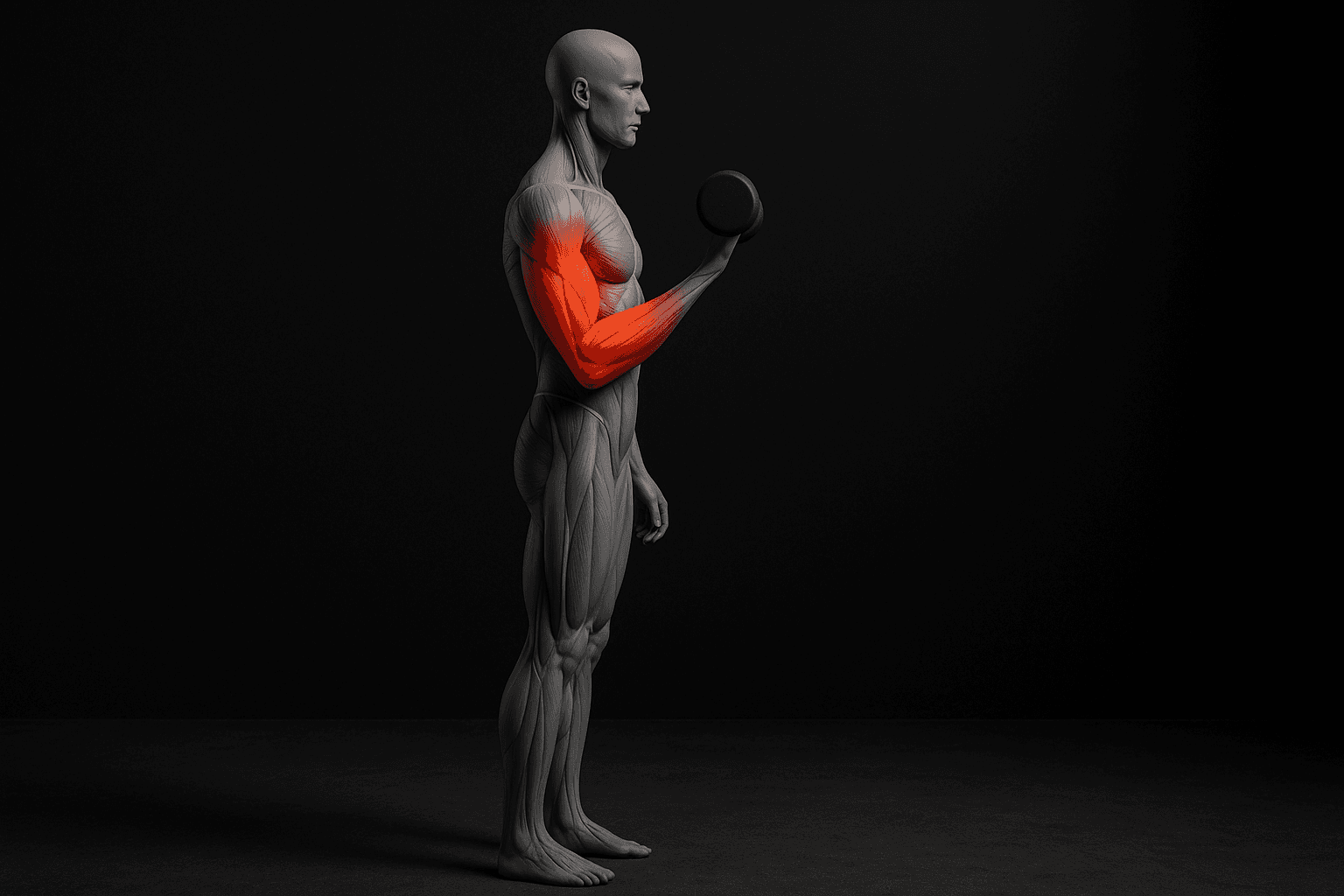
Photo by RepBro.
What muscles does the hammer curl work?
The hammer curl primarily trains the brachialis and the brachioradialis; it also loads the biceps brachii (both heads) as a secondary mover and recruits forearm flexors and wrist stabilizers. In short: primary = brachialis + brachioradialis; secondary = biceps brachii, forearm flexors, pronator teres, and shoulder/elbow stabilizers.
How does the hammer curl differ from a regular (supinated) curl?
The neutral grip used in a hammer curl (palms facing each other) shifts the emphasis away from the long/short heads’ peak-contraction that a fully supinated curl produces. That change makes the brachialis—an under-the-biceps muscle that pushes the biceps up and increases arm thickness—the dominant mover, and it increases brachioradialis (forearm) involvement. Practically, hammer curls build mid-arm thickness and forearm size more than sculpting a biceps peak.
Where should hammer curls fit in a program?
- Placement: Use hammer curls as an accessory exercise after compound upper-body lifts (rows, pull-ups, presses) or after heavier biceps work. They are fine on a pull day, an arm-specific day, or as part of an upper-body assistance block.
- Volume: 6–12 total working sets per week per arm for most trainees is a reasonable target; that can include hammer curls plus other elbow-flexion work. Beginners can start at 6–8 sets/week; intermediates and advanced trainees commonly do 8–12+ sets/week depending on recovery and goals.
- Load and rep ranges: 4–8 reps for strength emphasis, 8–15 for hypertrophy, 15–25 for endurance/forearm conditioning.
- Progression: Increase weight or reps gradually, track sessions, and prioritize full range of motion and controlled tempo—avoid excessive swinging.
Use hammer curls when you want more arm thickness, stronger elbow flexion across neutral grips (e.g., for rock climbing, pulling variations), or more forearm development without overloading the supination mechanics that can irritate some wrists.
What are the best alternatives and when should you pick each?
Below are four practical alternatives with the typical scenarios that make each a better pick than hammer curls.
- Reverse curl (barbell or EZ-bar)
- Why: Emphasizes the brachioradialis and wrist extensors even more than hammer curls; great for forearm development and grip strength.
- When to pick it: If your goal is forearm/brace strength, if you use a barbell more easily than dumbbells, or if you want a slightly different elbow/forearm angle to break a plateau.
- Equipment: Barbell, EZ-bar, or dumbbells.
- Caution: Can load the wrists; use an EZ-bar or lighter weight if wrist pain occurs.
- Zottman curl
- Why: Combines a supinated curl concentric (biceps emphasis) with a pronated/eccentric lowering (forearms), giving high total stimulus to both biceps and forearms in one movement.
- When to pick it: If you want balanced biceps peak plus forearm work and have no wrist issues; useful for plateaus when you need mixed stimuli.
- Equipment: Dumbbells.
- Tip: Control the eccentric pronation; don’t jerk the weights.
- Cable rope hammer curl (or low-pulley rope curl)
- Why: Provides constant tension through the range of motion; easy to keep strict form and reduce momentum.
- When to pick it: If you train in a commercial gym and want more time-under-tension or tighter tempo work, or if you’re coming back from a minor strength plateau and need a different loading pattern.
- Equipment: Cable machine + rope attachment.
- Benefit: Simple to progressively overload precise ranges; easy to adjust angles and keep tension on the brachialis.
- Preacher (incline) dumbbell curl or single-arm concentration curl
- Why: Limits cheating and upper-arm/shoulder involvement, forcing the biceps to work through the full range with minimized momentum.
- When to pick it: If you tend to swing on hammer curls, want to isolate the elbow flexors more strictly, or are rehabbing a shoulder that makes standing curls uncomfortable.
- Equipment: Preacher bench or incline bench, dumbbell.
- Note: These variations emphasize biceps more than hammer curls; use them if you need isolation or strict control.
When choosing among these, consider equipment availability, whether you have wrist/elbow discomfort, and what stopped progress previously (lack of tension, too much momentum, insufficient load).
If you want a quick comparison of variants and how they stack up for different goals, see https://www.repbro.app/vs, and if you track workouts consider logging these variations in RepBro.
How to perform the hammer curl safely
- Setup: Stand or sit with a neutral grip on dumbbells, thumbs up. Keep elbows close to your sides.
- Execution: Curl with a controlled concentric, stopping just short of shoulder contact. Lower slowly with control. Avoid swinging the torso and flaring the elbow forward.
- Reps/sets: 3–4 sets of 8–12 for hypertrophy is a solid default; adjust based on the program rules above.
Safety note: Stop if you feel sharp pain in the elbow, wrist, or shoulder; consult a qualified medical or movement professional for persistent pain—this is not medical advice.
What to do if you stall on hammer curls
- Change the stimulus: switch to cables or Zottman curls for 4–6 weeks.
- Increase frequency slightly: add 1 extra set twice per week rather than one large session.
- Manipulate tempo: slow the eccentric to 3–4 seconds on one set per week.
- Prioritize recovery: ensure protein, sleep, and avoid exceeding total weekly arm volume beyond your recovery capacity.
One-sentence takeaway: Hammer curls are a go-to for thicker arms and stronger forearms because they prioritize the brachialis and brachioradialis—pick the reverse curl, Zottman, cable rope, or strict preacher variations depending on equipment, pain, or plateau needs.
Frequently asked questions
- Are hammer curls better than regular curls for biceps?
- Hammer curls emphasize the brachialis and brachioradialis more than a supinated curl; they still work the biceps but are better for arm thickness and forearm development than isolating the biceps peak.
- How many sets and reps should I do for hammer curls?
- For strength use 3–5 sets of 4–8 reps; for hypertrophy 3–4 sets of 8–15 reps; for endurance or forearm conditioning 2–3 sets of 15–25 reps.
- Can hammer curls help with elbow pain?
- Hammer curls can be easier on the wrist than fully supinated curls, but if you have sharp or persistent elbow pain, stop the exercise and consult a qualified professional—do not self-diagnose.