Incline Bench Press: Proper Form, Step by Step
Definitive, safety-first guide to incline bench press proper form: setup, execution cues, breathing, tempo, common mistakes and quick FAQ.
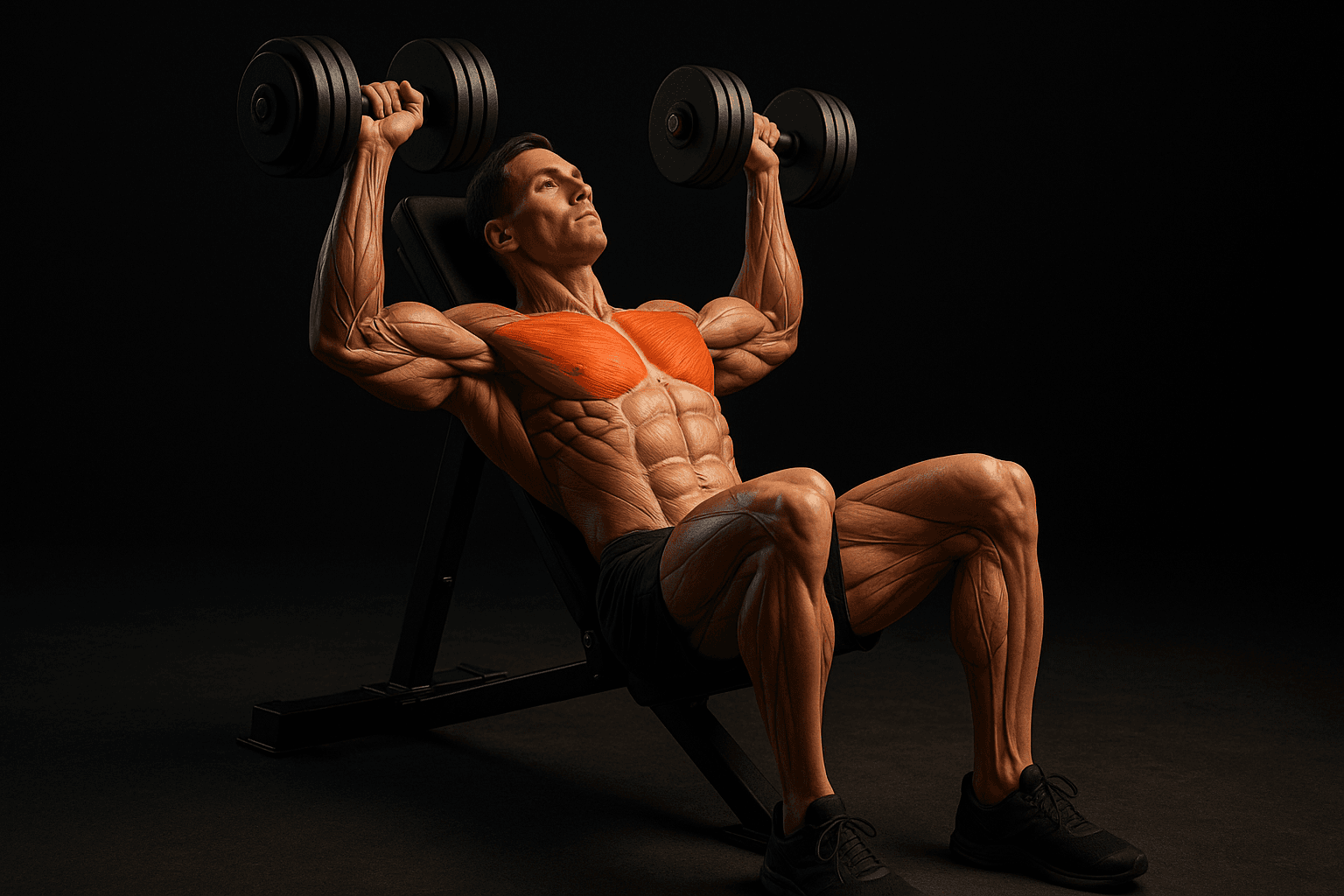
Photo by RepBro.
To perform the incline bench press with proper form: set the bench to 30–45°, plant your feet, retract your shoulder blades, grip the bar slightly wider than shoulder width, lower the bar to the upper chest in a controlled 2–3 second descent, pause 0–1 second, and press up along a slight diagonal while exhaling. Keep the ribs down, elbows at about 45° to the torso, and stop if you feel sharp pain.
What is the correct setup before lifting?
- Bench angle: choose 30° for a balanced upper-chest emphasis; use up to 45° if you want more front-delt involvement. Avoid steeper than 45° for general pressing.
- Foot position: plant both feet flat on the floor, roughly hip-width apart. Drive through the feet to create a stable base; do not let feet slide.
- Back and scapulae: retract and depress your shoulder blades (pin them together and down) to create a stable platform. Maintain a natural lumbar arch but don’t over-arch the lower back.
- Head and eyes: keep your head on the bench and eyes under the bar. That keeps the bar path consistent.
- Grip width: grip the bar so that forearms are vertical with the bar at the bottom of the lift — typically slightly wider than shoulder width (about 1.3–1.6× shoulder width). On most people this is 60–75 cm (24–30 in), but use a hand-spacing that allows the elbows to drop to about 45° from the torso.
- Safety gear: use a spotter or set safety pins in a rack at least a few centimeters below your bottom position. Stop on sharp or unusual pain and consult a professional; never attempt risky single rep maxes without a trained spotter.
How should I execute each rep exactly?
- Unrack with control: take a deep breath, brace your core, push your feet into the floor, and unrack the bar by straightening the arms. Move the bar to align over your upper chest.
- Descent (eccentric): slowly lower the bar to the upper chest/clavicle area in 2–3 seconds. Keep elbows about 45° to the torso and wrists neutral (bar in the heel of the hand).
- Brief pause: lightly touch the chest and pause 0–1 second—no bounce. Maintain scapular retraction and leg drive.
- Press (concentric): exhale and push the bar up and slightly back toward the starting position above the upper chest. Aim for a 1.5–2 second concentric. Finish with locked-ish elbows but don’t hyperextend.
- Rack safely: after the final rep, control the bar to the rack position and re-rack with a slight bend in the elbows; don’t flop the bar onto the hooks.
Tempo example: 2–1–2 (2s descent, 1s pause, 2s press). For strength-focused sets use 3–1–2 with heavier loads and a spotter; for hypertrophy use 2–0–2 at 6–12 reps.
How should I breathe and brace?
- Inhale and brace (take a diaphragmatic breath) before the descent. That increases intra-abdominal pressure and stability.
- Exhale during the concentric press. For near-max lifts a controlled Valsalva (brief breath-hold) is acceptable with an experienced coach/spotter.
- Keep the core engaged and the ribs down; don’t let your lower ribs flare upward as that shifts the bar path and stresses the lower back.
What is the safest bar path and elbow position?
- Bar path: a slight diagonal from directly over the shoulders at the top to the upper chest at the bottom. Do not press straight vertical to the chin.
- Elbows: aim for roughly 45° from the torso. Too wide increases shoulder joint stress; too narrow reduces chest activation and shifts load to triceps.
What common mistakes should I watch for and how do I fix them?
- Mistake: Bench too steep (>45°)
- Fix: Lower angle to 30° to reduce shoulder strain and better target upper chest.
- Mistake: Elbows flared to 90°
- Fix: Tuck elbows to ~45°. Practice with lighter weights and cue “drive elbows toward hips.”
- Mistake: Lifting feet or bouncing with hips
- Fix: Keep feet flat and hips down. Use leg drive from planted feet, not a hip thrust. Reduce load until you can maintain position.
- Mistake: Bar bouncing off chest
- Fix: Pause-touch technique—control the eccentric and use a 0–1 second pause at the bottom. Use a spotter/safety pins for confidence.
- Mistake: Wrists bent back
- Fix: Keep wrist neutral, bar in the heel of the palm. Wrap thumb around the bar securely.
- Mistake: No scapular retraction
- Fix: Retract and hold scapulae before unracking. Practice scapular squeezes and lighter sets to ingrain the position.
- Mistake: Using too much weight progression too quickly
- Fix: Increase load by 2.5–5% or 1–2.5 kg (2.5–5 lb) increments per session when possible. Prioritize form over ego-loading.
When should I choose dumbbells instead of a barbell?
Use dumbbells if you need a greater range of motion, want to correct side-to-side imbalances, or have shoulder mobility limits. Start with lighter weights and the same 30–45° bench angle. Barbell work remains efficient for building absolute load capacity and for simpler loading progression.
How can I program incline bench press safely?
- Frequency: 1–3 times per week depending on overall plan. Pair with flat press and rowing movements to balance pushing and pulling.
- Sets and reps: For strength 3–6 sets of 3–6 reps; for hypertrophy 3–4 sets of 6–12 reps. Use progressive overload but prioritize form and controlled tempo.
- Progression: Add small increments (1–2.5 kg / 2.5–5 lb) or add a rep each session within the target rep range.
Safety note: Stop immediately on sharp or unusual pain and consult a qualified professional. This guide is educational and not a medical diagnosis.
Where can I learn more or compare variations?
For comparisons between incline and other pressing variations see this short comparison page: https://www.repbro.app/vs. If you track lifts or import workout plans, RepBro integrates plan import and tracking tools to monitor progress: https://apps.apple.com/us/app/gym-workout-coach-repbro/id6763749305.
One-sentence takeaway: Use a 30–45° bench, scapular retraction, feet planted, a 2–1–2 tempo, and elbow tuck to 45° to press safely and effectively while stopping for any sharp pain.
Frequently asked questions
- What bench angle is best for incline bench press?
- Use 30° to 45°. Start at 30° to target upper chest with less shoulder strain; increase toward 45° if you want more anterior-deltoid emphasis.
- Should I use a barbell or dumbbells for incline pressing?
- Barbell gives heavier loading and stability; dumbbells increase range of motion and correct unilateral imbalances. Alternate both depending on goals and shoulder health.
- How should I breathe during the incline bench press?
- Inhale during the controlled descent (eccentric), pause briefly at the bottom, then exhale while pressing up (concentric). Avoid holding breath for more than a Valsalva when working lighter sets; use a controlled bracing pattern for heavy sets with a spotter.