Lateral Raise: Muscles Worked and Best Alternatives
Which muscles does the lateral raise train? Learn the primary and secondary muscles, programming guidelines, and 4 practical alternatives for different equipment and limitations.

Photo by RepBro.
What muscles does the lateral raise train?
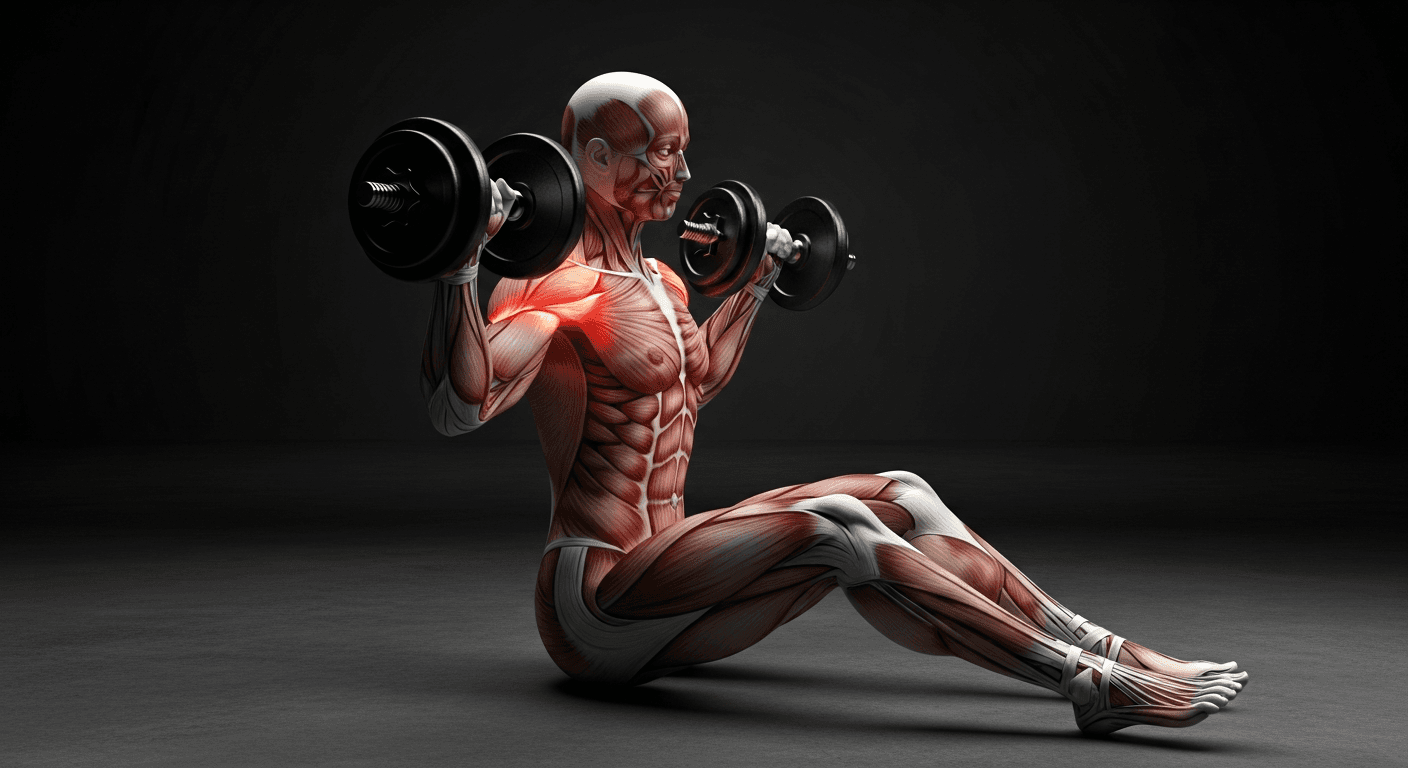
The lateral (side) raise primarily trains the lateral (middle) head of the deltoid. Secondary involvement includes the anterior and posterior delt heads to a lesser extent, the supraspinatus (part of the rotator cuff) at the start of the movement, and the upper trapezius and serratus anterior for stabilization near the top. In short: primary = lateral deltoid; secondary = other deltoid heads, rotator cuff, and some scapular stabilizers.
How much of the shoulder does the lateral raise target compared to pressing?
Lateral raises are an isolation movement: about 60–80% of the work goes to the lateral deltoid depending on your arm position and technique, whereas overhead presses distribute load across all three deltoid heads and the triceps. Use lateral raises to build width and shape, not as a replacement for compound pressing.
Where should I put lateral raises in my program?
- Frequency: 1–2 sessions per week per shoulder for most intermediate lifters. 2x/week if you prioritize shoulder width or are in a higher-volume phase.
- Weekly volume: 6–12 effective working sets for lateral delts is a reasonable starting point; beginners can start lower (4–6).
- Sets and reps: 3–5 sets of 8–15 reps per exercise. Use higher reps (12–20) occasionally to focus on time under tension and endurance.
- Order: Do lateral raises after main compound lifts (bench, overhead press, rows, squats) to avoid fatiguing stabilizers needed for heavy compounds. Put them before heavy posterior-delt work if you want to fatigue lateral delts first.
- Progression: Increase weight in small steps (0.5–2.5 kg / 1–5 lb), add reps, or add sets. If delts lag, add a second lateral-variation once per week.
Tip: Track sets and perceived exertion. If your shoulders still feel fresh after 5–6 sets, add a light drop-set or slightly higher reps.
How do I perform the standard dumbbell lateral raise safely?
- Start: Stand neutral with a light dumbbell in each hand, palms facing your body.
- Movement: Slight bend in the elbows, raise arms out to the sides to about shoulder height (scapular plane, 10–20 degrees forward can reduce impingement). Pause briefly, lower under control.
- Tempo: 1 second up, 1–2 seconds down works well. Avoid swinging or shrugging.
Safety note: Stop on sharp pain and consult a qualified professional if pain persists. Keep weight modest: lateral raises are an isolation movement—if you must cheat to complete reps, reduce load.
What are the best alternatives and when to pick each?
- Single-arm Cable Lateral Raise (best for constant tension and control)
- Why: Cable maintains tension through the whole range, so you get continuous loading at top and bottom.
- When to pick: You train in a gym with cables, want to eliminate momentum, or want micro-loading using small incremental plates on cables.
- Programming: 3–4 sets of 10–15 reps. Stand with the cable at low pulley and cross the body slightly to increase ROM.
- Limitations: Requires a cable machine; you need space for single-arm setup.
- Leaning-Away Dumbbell Lateral Raise (best for more overload and stretch)
- Why: Leaning away from an anchor increases range of motion and reduces torso movement, letting you target the lateral head more directly.
- When to pick: You're stuck on a plateau with standard raises and want to overload without heavier dumbbells, or you prefer a gym setup with a rack/anchor.
- Programming: 3–5 sets of 8–12 reps. Use slightly heavier weight than strict standing raises but avoid shrugging.
- Seated Dumbbell Lateral Raise (best for limiting momentum and for larger athletes)
- Why: The seat prevents torso sway and reduces cheating, making strict reps easier even with heavier loads.
- When to pick: You have trouble keeping strict form standing, are rehabbing (without sharp pain), or want to pack more volume without using momentum.
- Programming: 3–4 sets of 8–15 reps. Pause at the bottom to reduce stretch-reflex assistance.
- Resistance-Band Lateral Raise (best for home or equipment-limited training)
- Why: Bands are cheap, portable, and provide increasing resistance through the lift.
- When to pick: Training at home, traveling, or when you want higher-rep metabolic work without heavy equipment.
- Programming: 3–4 sets of 12–20 reps. Step further on the band to increase starting tension.
Optional replacement for different goals: Scaption (raise in the scapular plane, thumbs up) shifts more work to the supraspinatus and can be easier on some shoulders—pick it for shoulder health work rather than pure lateral hypertrophy.
How do I pick among these alternatives if I have an injury or equipment limits?
- No equipment / travel: Use bands or bodyweight scaption; keep reps higher (12–20) and prioritize slow negatives.
- Gym but limited plates: Use cables or the leaning variation to increase effective load without bigger dumbbells.
- Shoulder irritation with full abduction: Try scaption (thumbs-up, 30° forward) and reduce range until it’s pain-free; stop if sharp pain occurs.
- Plateauing on weight: Switch to leaning raises or single-arm cables to change load curve and stimulus.
How should I combine them week-to-week?
Use 1–2 direct shoulder isolation exercises per session. Example split for 2x/week direct work:
- Session A: Seated dumbbell lateral raises 4x10–12 + face pulls 3x12–15
- Session B: Single-arm cable lateral raises 3x12 + overhead press 3x5–8 (compound)
Track effective reps and increase by ~1–2 reps per set each week until you hit the top of the rep range, then increase load.
Where can I log and compare these options?
If you want to track progress or compare variations side-by-side, the RepBro app makes logging and importing plans simple; see the app on the App Store RepBro and comparisons at https://www.repbro.app/vs.
Honest takeaway: The lateral raise is the most direct way to target the lateral deltoid—use strict form and 6–12 weekly sets, and pick cables, leaning variations, seated raises, or bands based on equipment, pain, and where you're stuck.
Frequently asked questions
- How heavy should I go on lateral raises?
- Use a weight that lets you do 8–15 strict reps per set with controlled tempo; if you need momentum to reach the top, drop weight by 10–30% and focus on form.
- How often should I train lateral raises?
- Train lateral raises or close alternatives 1–2 times per week per shoulder, using 6–12 total working sets weekly depending on training level and recovery.
- Are lateral raises bad for shoulder pain?
- They can be fine if pain-free, but stop and consult a qualified clinician on sharp or persistent pain; modifying range, grip, or choosing lighter options often helps.