Leg Curl: Muscles Worked and Best Alternatives
Clear, practical breakdown of which muscles the leg curl trains, where it belongs in a program, and 4 strong alternatives for different equipment, injury, and plateau scenarios.
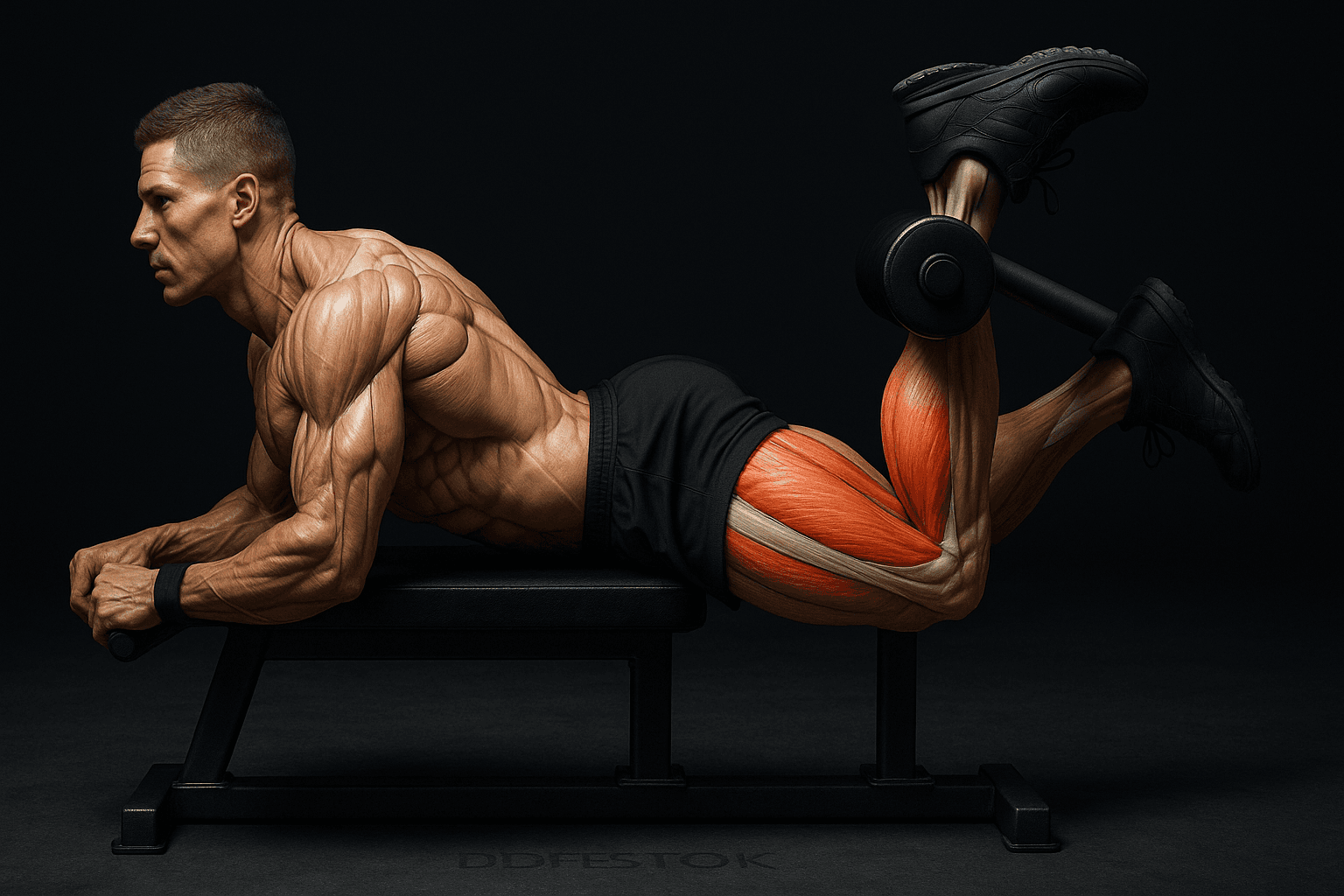
Photo by RepBro.
What muscles does the leg curl work?
The leg curl primarily trains the hamstrings — specifically the biceps femoris, semitendinosus and semimembranosus — because it is a knee-flexion movement. Secondary muscles include the gastrocnemius (calf) to a small degree and the posterior chain stabilizers (glutes and spinal erectors) only minimally. Different leg-curl variants (lying, seated, standing) change emphasis slightly: seated versions bias the distal hamstrings and reduce hip contribution, while standing or single-leg curls increase unilateral demand and stabilization.
How should I use the leg curl in a program?
- Position: Use leg curls as an isolation finisher or accessory exercise, typically after compound hip-hinge work (deadlifts, squats) or on a hamstring-focused day.
- Volume: 6–15 sets per week for hamstrings is a practical range for most lifters; 1–3 of those sets can be leg curls depending on your priorities.
- Load/Reps: 6–12 reps for strength/hypertrophy with controlled tempo; include some sets with a 2–4 second eccentric if you want more eccentric stimulus.
- Order: If you want to pre-exhaust the hamstrings for a heavier hip hinge, do a light 2–3 set leg-curl warmup first; otherwise, do leg curls after main lifts.
Use leg curls when you need targeted knee-flexion work, are addressing weak distal hamstrings, want a low-skill isolation movement, or have low back pain that makes heavy hip hinges difficult.
What are the best alternatives to the leg curl and when should you pick each?
Below are four practical substitutes. Each has a short how-to, when to pick it, suggested loading and a safety note.
- Romanian Deadlift (RDL)
- What it trains: Hamstrings, glutes, spinal erectors — emphasizes hip extension rather than knee flexion.
- When to pick it: You have access to a barbell or dumbbells, want a heavy compound option to build strength and posterior-chain mass, or need an exercise that transfers well to athletic movements.
- How to do it: Hinge at the hips with slight knee bend, keep a long spine, slide the bar/dumbbells down the thighs to mid-shin, then drive the hips forward to stand. Focus on feeling the stretch in the hamstrings.
- Loading/reps: 3–6 reps for strength, 6–10 for hypertrophy; 2–4 sets.
- Safety note: Stop on sharp pain; avoid excessive rounded spine; consult a professional if you have persistent low-back pain.
- Nordic Hamstring Curl
- What it trains: Eccentric and concentric knee flexion with very high eccentric demand on the hamstrings.
- When to pick it: You want a bodyweight or minimal-equipment option focused on eccentric strength and injury-reduction training, and you can tolerate the intense hamstring loading.
- How to do it: Kneel with feet anchored, slowly lower your torso forward resisting with hamstrings; use hands to catch and push back up if needed. Progress with assisted eccentrics and limited range before building full reps.
- Loading/reps: 3–6 reps with slow (3–5s) lowering, 2–5 sets. Eccentric-only sessions can use higher frequency.
- Safety note: Stop on sharp pain; progress conservatively — the eccentric load is intense. Get professional guidance if rehabbing a hamstring injury.
- Glute-Ham Raise (GHR)
- What it trains: Hamstrings at both the hip and knee — a hybrid between leg curl and hip-hinge that builds strength through a long range.
- When to pick it: You have access to a GHR machine or partner assistance, want a challenging closed-chain alternative, or aim to carryover to sprinting/athletics.
- How to do it: Anchor your feet, start upright or slightly inclined, lower under control using hamstrings and glutes, then return by knee flexion and hip extension. Use assistance bands or less range initially.
- Loading/reps: 4–10 reps, 3–5 sets depending on strength. Add weight cautiously with a vest once form is solid.
- Safety note: Stop on sharp pain; avoid rushing the eccentric; consult a specialist for progressions after injury.
- Swiss Ball or Slider Hamstring Curl (Single-leg option)
- What it trains: Hamstrings and glutes with added core demand; good for unilateral work and low-equipment settings.
- When to pick it: You lack heavy equipment, want to address imbalances, or need a lower-load, higher-control option for rehab or fatigue days.
- How to do it: Lie supine with heels on a ball or sliders, bridge the hips, then pull heels toward you by curling the ball/sliders while keeping hips elevated. Single-leg variations increase difficulty.
- Loading/reps: 8–15+ reps, 3–4 sets. Use single-leg for added intensity or progression.
- Safety note: Stop on sharp pain; keep hips elevated to protect the lumbar spine; consult a clinician if recent injuries exist.
How do I choose between these alternatives and the leg curl?
- Equipment limits: If you have only bodyweight or minimal gear, choose Nordic curls or Swiss-ball curls. If you have a barbell, RDLs give the best bang for strength and size.
- Injury considerations: If low-back pain prevents heavy hip hinges, seated/lying leg curls or Swiss-ball curls let you train hamstrings with less lumbar load. If you’re rehabbing a hamstring tendon issue, prefer slower progression and professional input before Nordics or heavy eccentrics.
- Plateau-busting: Swap isolation for compound (leg curl -> RDL) if hamstring growth stalls from lack of load. Add eccentric-focused Nordic reps 1–2 times per week to increase resilience and eccentric strength.
- Specificity: For sprinting or athletic demands, emphasize GHR and Nordic variations that train eccentric control across practical ranges.
Any final safety and programming notes?
- Safety: Stop immediately if you feel sharp or unusual pain. These notes are not medical advice; consult a qualified clinician or coach for injuries or pain that persists.
- Programming tip: Aim for 1–3 hamstring-focused sessions per week and mix one heavy/compound stimulus with 1–2 accessory or eccentric-focused exercises.
- Tracking: If you want a straightforward way to track sets, loads, and progressions, check out the [RepBro] (https://apps.apple.com/us/app/gym-workout-coach-repbro/id6763749305) app and comparison options at https://www.repbro.app/vs.
Honest takeaway: Leg curls are a useful isolation tool for the hamstrings' knee-flexion role, but pair them with hip-hinge and eccentric options (RDLs, Nordics, GHRs, or ball curls) to build balanced, resilient hamstrings.
Frequently asked questions
- Are leg curls enough to build strong hamstrings?
- Leg curls are an effective isolation exercise for knee flexion and the distal hamstrings, but they’re usually best combined with hip-hinge movements (like Romanian deadlifts) for full hamstring development.
- Do leg curls work the glutes?
- Leg curls primarily target the hamstrings; the glutes act minimally because leg curls focus on knee flexion, not hip extension.
- Can leg curls help prevent hamstring strains?
- Strengthening the hamstrings—including eccentric work—can reduce injury risk factors, but no single exercise guarantees prevention; follow progressive loading and consult a professional for rehab or return-to-sport plans.