Leg Extension: Proper Form, Step by Step
Definitive leg extension form guide: setup, alignment, cues, breathing, tempo, common mistakes and fixes. Safety-first, practical coaching for clean reps.
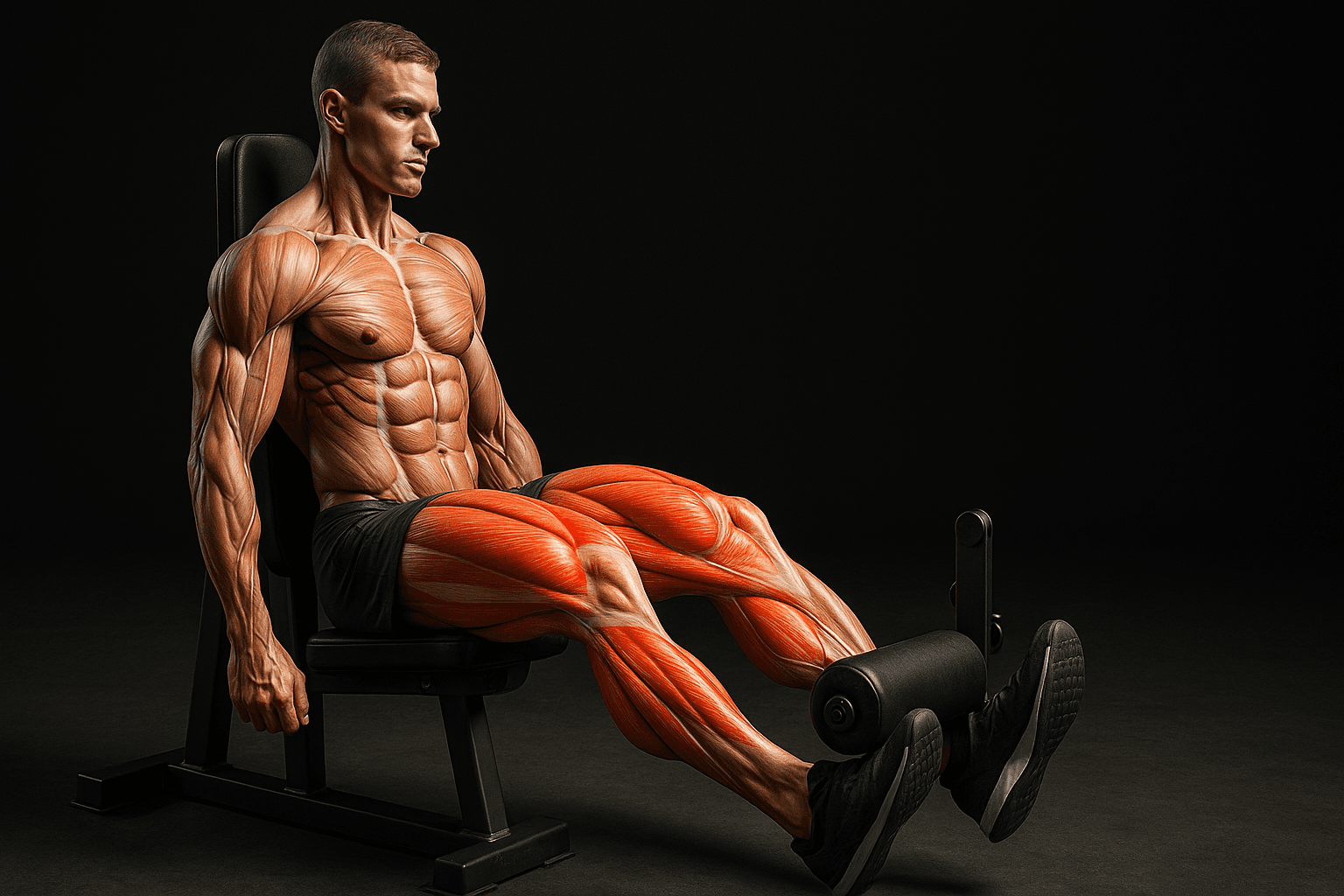
Photo by RepBro.
What is the correct answer to “leg extension proper form”?
Leg extension proper form means: sit with your back flat against the pad, align the machine axis with your knee joint, place the lower-shin pad just above the ankle, extend your knee with a controlled concentric phase without locking out, and return under control through the eccentric phase. Keep the pelvis down, avoid rocking, and choose a weight you can move with full range and good control for 8–15 reps.
What is the correct setup for the leg extension?
- Adjust the seat so your knee aligns with the machine’s pivot/axis. The axis should sit roughly at the level of your lateral femoral epicondyle (the outside of the knee). A 1–2 cm mismatch is acceptable; larger is not.
- Set the backrest so your hips are fully supported and your lower back sits flush against the pad. Your thigh should be horizontal or slightly angled downward, not drastically angled upward.
- Position the shin/ankle pad so it rests on the lower shin about 3–5 cm (1–2 in) above the top of your shoe or the medial malleolus (ankle bone). The pad should not be on the ankle joint itself.
- Adjust the foot angle—neutral or slight dorsiflexion (toes toward shin) is fine. Pointing toes slightly will shift emphasis slightly but keep it neutral to avoid compensations.
- Choose a weight you can control for 8–15 reps with the tempo described below. If you need to swing or use momentum, lower the weight.
How do I perform the leg extension step by step?
- Sit tall: chest up, shoulder blades down, hands on the machine handles or grips. Keep your pelvis pressed into the seat; don’t let your hips rise.
- Unrack/start with knees at about 90° of flexion (or your comfortable start position) and the pad resting on the lower shin.
- Initiate the concentric phase by driving through the shin pad—extend the knee smoothly until near full extension. Stop about 5–10° short of full lockout.
- Hold the top for 0.5–1s to maintain tension if part of your chosen tempo.
- Lower back down under control over 2–3s. Don’t let the weight slam back; maintain tension through the quads.
- Repeat for your programmed reps and then rack the weight carefully.
Execution cues: push through the foot rather than hyper-focusing on the toes; think of sending the front of the knee straight forward. Keep the thigh stationary and avoid letting the hips come off the seat. Maintain a small bend in the ankle rather than rigid plantarflexion.
What breathing and tempo should I use?
- Breathing: exhale on the concentric (as you extend), inhale on the eccentric (as you lower). That is the simplest rule and helps maintain intra-abdominal pressure safely. Avoid breath-holding on heavy loads unless coached otherwise.
- Tempo: start with a 1-0-2 tempo (1s concentric, no mandatory pause, 2s eccentric). For more time under tension use 1-1-3. For strength work shorter eccentrics (1–2s) are fine; for hypertrophy 2–3s eccentrics are common. Always keep the movement controlled—no bouncing.
What common mistakes should I avoid and how do I fix them?
- Mistake: hips lifting off the seat or body leaning back to extend. Fix: reduce load, reset the seat so the backrest supports hips, and press hips into the pad. Cue: “hips glued to seat.”
- Mistake: axis misaligned with the knee joint (too high or low). Fix: readjust the pivot point or move the machine’s seat forward/back until the axis lines with the knee’s lateral epicondyle.
- Mistake: pad placed too high (on the knee) or too low (on foot). Fix: place pad 3–5 cm above the ankle; if the pad contacts the knee you’ll cause pinching and limit range.
- Mistake: full lockout at the top causing joint stress. Fix: stop 5–10° before full extension to keep tension in the muscle and protect the joint.
- Mistake: using momentum or rapid uncontrolled reps. Fix: drop weight 10–30% until you can perform slow eccentrics and controlled concentric phases for all reps.
- Mistake: pointing toes or rotating feet excessively to ‘feel’ the quad. Fix: keep feet neutral. If a slight foot angle helps comfort, keep it consistent and do not use it to cheat the ROM.
When is the leg extension unsafe or not recommended?
Safety note: stop immediately if you feel sharp joint pain, catching, or a new severe ache. If pain persists, consult a qualified healthcare or strength professional; this guide does not diagnose. Leg extensions are an isolation movement—problematic if used with excessively heavy loads or poor alignment. Avoid aggressively forcing ROM beyond comfort and never sacrifice form to lift more weight.
Who benefits from leg extensions and how should they be programmed?
Leg extensions are a quadriceps isolation exercise useful for targeting the knee extensors, pre-exhausting the quads before compound moves, or adding volume. Use them 1–4 times per week depending on overall program. Typical sets: 2–5 sets of 8–15 reps for hypertrophy or 4–6 sets of 6–10 for heavier, lower-rep focus. Track fatigue and knee comfort—if tracking programming, logging sets and reps accurately helps; consider using an app like RepBro for consistent tracking.
Short FAQ
Q: Should I do leg extensions before squats?
A: Generally not if you need fresh quads for squats; leg extensions can pre-fatigue the quad. Use them after squats or on separate days unless your program intentionally pre-exhausts.
Q: How much range of motion should I use?
A: Full available pain-free range is fine—stop 5–10° shy of full lockout. Avoid forcibly extending past your comfort.
Q: Can I use leg extensions with knee issues?
A: Some people tolerate them with modifications; others do not. Stop on sharp pain and consult a professional rather than self-diagnosing.
Safety reminder: stop on sharp pain and consult a qualified professional for persistent or worrying symptoms.
One-sentence takeaway: The leg extension is a simple but precise quad isolation—set the machine to align with your knee, keep the hips down, use controlled concentric/ eccentric tempos, and stop short of lockout for safe, effective reps.
Frequently asked questions
- Should I lock my knees at the top of a leg extension?
- No. Stop short of full lockout—keep roughly 5–10° of knee flexion to avoid joint stress and maintain muscle tension.
- How many reps and tempo are best for the leg extension?
- Use 8–15 controlled reps per set. A good starting tempo is 1s concentric (raise), 1s hold, 2–3s eccentric (lower).
- Does leg extension hurt knees?
- Leg extensions can be safe when done with correct alignment and weights you control; stop on sharp pain and consult a professional for persistent pain.