Leg Press Alternatives at Home (Minimal Equipment)
Practical at-home substitutes for the leg press using bodyweight, dumbbells, or bands. What each preserves and loses, programming guidance, and when to use a gym.
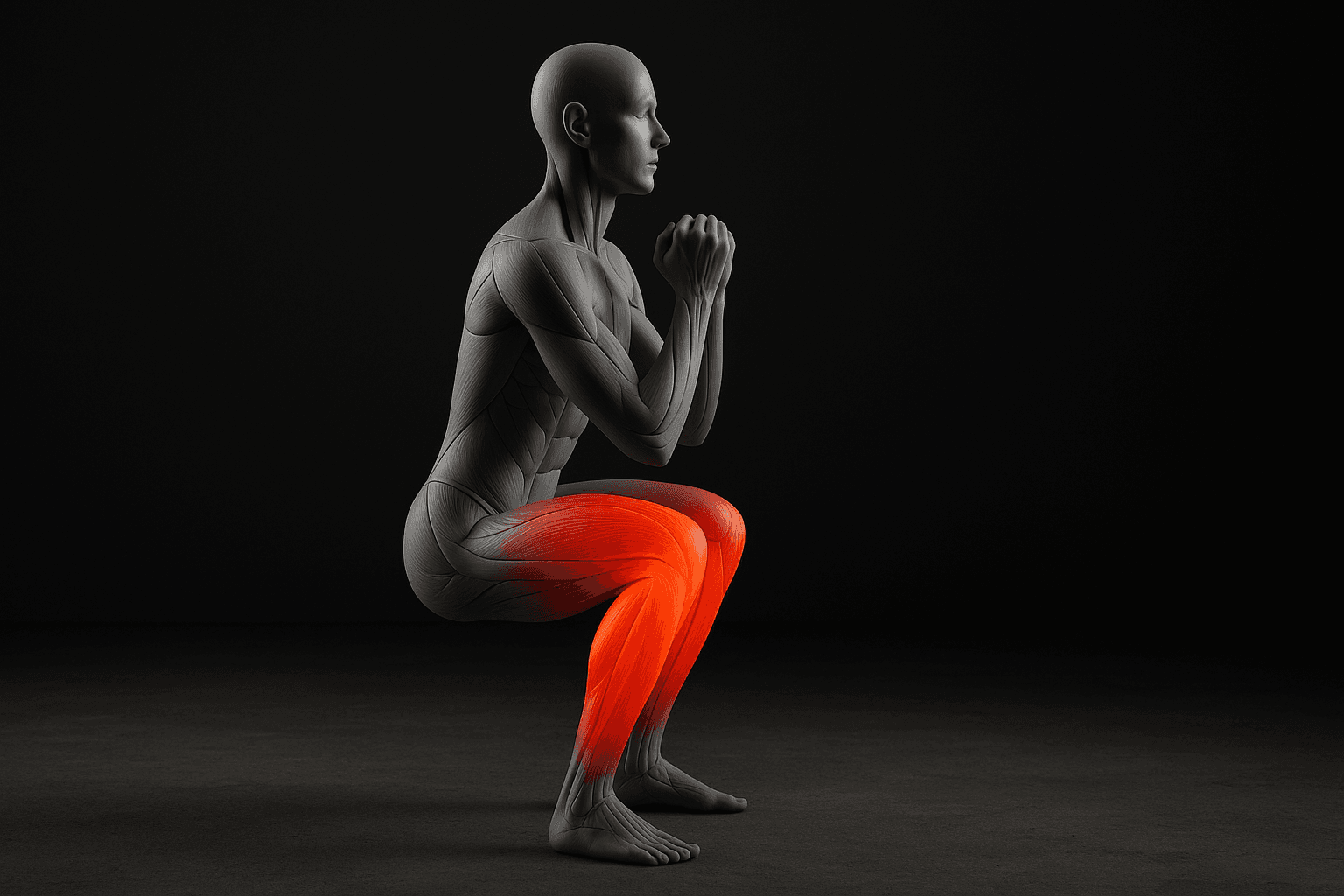
Photo by RepBro.
Answer-first: If you don’t have a leg press machine, use unilateral or supported bilateral moves—goblet squats, Bulgarian split squats, step-ups, single-leg Romanian deadlifts, and banded supine presses—progressing load, reps, or band tension. They preserve quad stimulus and range of motion but limit absolute bilateral loading and exact machine mechanics.
What practical leg-press alternatives can I do at home with minimal equipment?
- Goblet squat (dumbbell/kettlebell or heavy object)
- Bulgarian split squat (bodyweight, dumbbell, or backpack)
- Step-ups (box/bench and dumbbells)
- Single-leg Romanian deadlift (dumbbell/band) — for posterior chain balance
- Banded supine "leg press" (lie on back, loop band around feet and push)
Each requires little equipment and scales with load, band tension, or volume.
What does each substitute preserve and what does it lose compared to a leg press?
| Movement | Equipment | Preserves (what you keep) | Loses (what the leg press provides) | Loadability |
|---|---|---|---|---|
| Goblet squat | 1 dumbbell/kettlebell | Vertical knee travel, quad emphasis, trunk upright cue | Supported back, near-horizontal force vector, very heavy bilateral loads | Moderate (limited by single dumbbell) |
| Bulgarian split squat | Dumbbells/bodyweight | High per-leg loading, balance, unilateral strength and hypertrophy | Machine stability and very heavy absolute loads | High per-leg (good for overloading one side) |
| Step-up | Dumbbells/bench | Functional force, quad-dominant at higher step heights | Constant guided plane and extreme loading across both legs | Moderate–high depending on step and load |
| Single-leg RDL | Dumbbell/band | Posterior chain strength, hip stability, balance | Quadriceps-dominant drive of deep knee flexion like leg press | Moderate (great for balance and hamstrings) |
| Banded supine press | Heavy band | Similar movement pattern to leg press (hip and knee extension) | Linear machine loading curve and maximum absolute load | Variable—good for end-range training |
"Loadability" notes whether you can reach the same absolute weights as a leg press. With minimal equipment you will often trade absolute bilateral loading for unilateral intensity and higher weekly volume.
How should I program these substitutes for strength and hypertrophy?
Follow general evidence-based resistance training guidelines: train each major lower-body movement 2–3 times per week, use progressive overload, and choose rep ranges appropriate to your goals.
- For hypertrophy: 6–20 reps per set, 3–5 sets, accumulate sufficient weekly volume for quads and glutes. If absolute load is limited, use higher per-set reps and slightly more sets.
- For strength: if you can reach low-rep heavy loading (1–5 reps), prioritize that. At home, focus on heavy unilateral work (3–6 reps per leg) or paused tempo sets to increase difficulty.
- Progression: increase reps, add weight, lengthen eccentrics (3–5 second lowerings), reduce rest to increase density, or add band tension.
- Frequency: 2–3 sessions per muscle group per week to balance recovery and stimulus.
These are consensus-style recommendations from strength-and-conditioning literature; tailor to individual recovery and fatigue.
Which exercise most closely mimics the leg press movement pattern?
The banded supine press best approximates the leg press’s hip-and-knee extension under a horizontal force vector. Goblet squats and high step-ups also reproduce strong quad bias and similar joint angles. For maximal similarity to a seated leg press, use a supine or low-slung banded setup focusing on knee extension range.
When is an at-home swap adequate and when should I return to a gym?
Adequate at home when:
- Your goal is hypertrophy or general strength and you can progressively overload via unilateral work, bands, tempo, or higher volume.
- You want functional strength and balance improvements.
Return to a gym when:
- You need very heavy absolute bilateral loading for maximal strength phases (low-rep, high-load blocks).
- You have rehab or sport-specific demands requiring machine or barbell lifts under supervision.
- You need precise loading increments beyond your home kit.
Safety note
Stop any exercise if you feel sharp or unusual pain. Maintain tight core and neutral spine on loaded squats and split squats; avoid letting the knee track far past the toes aggressively under heavy load. Consult a qualified professional for persistent pain, recent injuries, or programming after major surgery. This article does not diagnose or promise injury prevention.
How to progress at home if your weights are light
- Use unilateral variants (Bulgarian split squats, step-ups) to increase per-leg stimulus.
- Add band resistance for accommodating load and stronger end-range tension.
- Increase time under tension (slower eccentrics, paused reps).
- Add sets per week rather than a single session when recovery permits.
- Track load, reps, tempo—progress one variable at a time.
If you want simple tracking for progressive overload, consider logging sets and weights—apps such as RepBro can help keep consistent records.
Comparison summary: when to pick each movement
- Choose goblet squats for straightforward bilateral quad work with a single weight.
- Choose Bulgarian split squats when you want heavy per-leg loading and balance work.
- Choose step-ups for functional strength and joint-friendly repetitions.
- Use single-leg RDLs to address posterior-chain balance and hamstring development.
- Use banded supine presses to replicate the leg-press movement pattern closely.
Limitations (what apps and articles can't do)
No app or article can see your form in real time and correct technique; they can’t replace hands-on coaching for complex movement retraining. Only a qualified professional can assess injuries, offer diagnosis, or give supervised rehabilitation. A training plan—even one well-designed—only works if you follow it consistently. Consistency and progressive overload matter more than the specific app you use.
This article summarizes practical options and programming principles for replacing a leg press at home with minimal equipment. Use sensible progression, prioritize safety, and consult professionals when needed.
Frequently asked questions
- Can bodyweight exercises replace the leg press for muscle growth?
- Yes—bodyweight and unilateral exercises can stimulate growth when they provide sufficient tension and volume. You’ll need to use progressions (adding reps, tempos, unilateral loading) and train quads 2–3 times weekly with 6–20 rep ranges to match the stimulus from heavier leg-press loading.
- How do I load the legs at home if I don’t have heavy dumbbells?
- Use unilateral exercises (split squats, step-ups) to increase relative load per leg, add bands for variable resistance, increase time under tension via slower eccentrics, or use higher weekly volume. Track progression by reps, sets, tempo, and band tension.
- When should I go back to the gym for a leg press or squat?
- Return when you want to: safely handle much heavier absolute loads than home tools allow; follow a maximal strength block (1–5 reps) requiring barbells or machines; or need machine specificity for rehab or testing under professional supervision.