Machine Chest Press: Proper Form, Step by Step
Clear, safety-first guide to machine chest press form: setup, execution cues, breathing, tempo, common mistakes with fixes, and a brief FAQ.
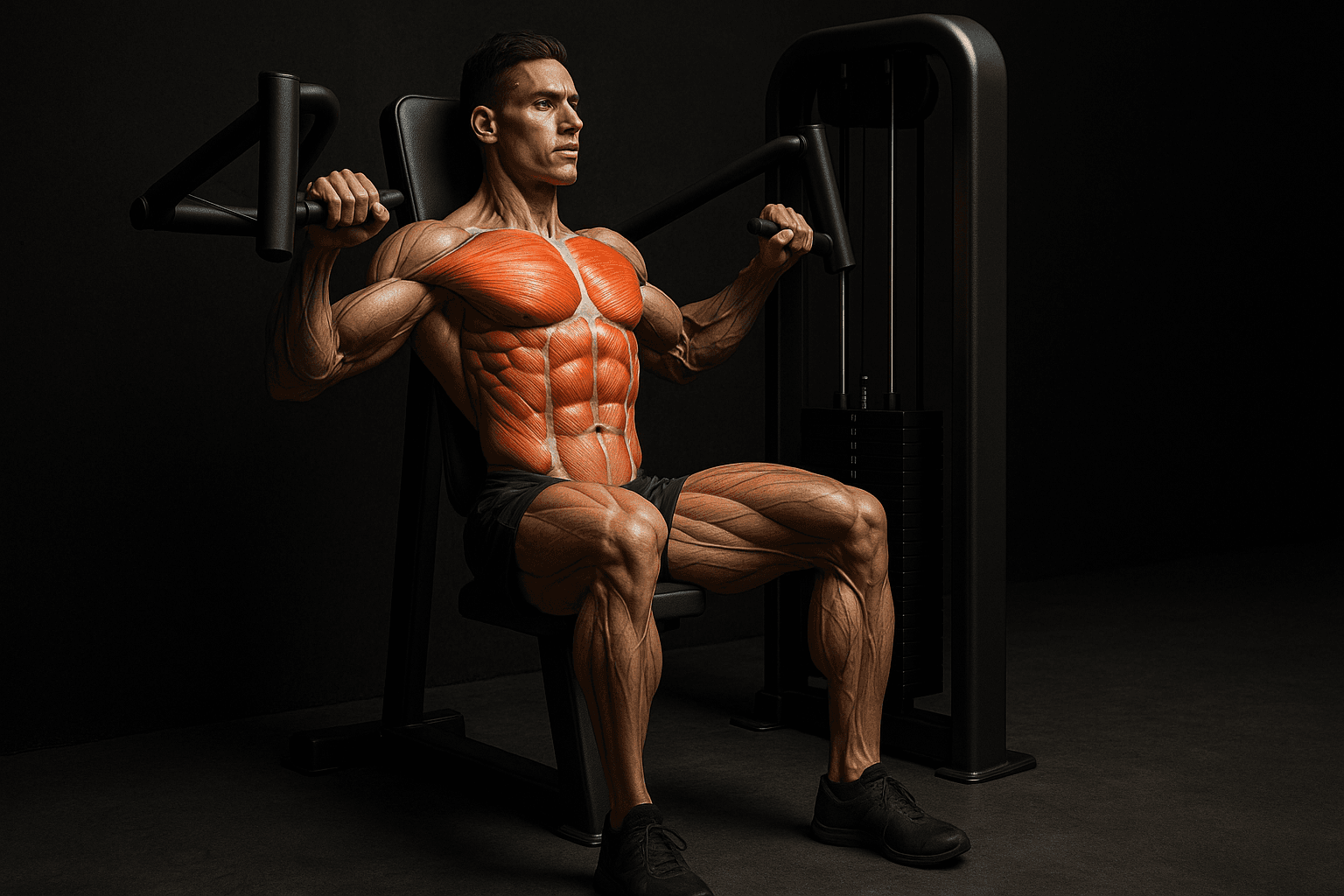
Photo by RepBro.
Machine chest press proper form is: set the seat so the handles are at mid-chest, chest proud, feet planted, push with a controlled tempo exhaling on the press, and stop just before locking the elbows. Follow the step-by-step setup and execution below to keep tension on the chest, protect the shoulders, and get consistent repetitions.
How do I set up the machine chest press properly?
- Seat height: Adjust the seat so the handles sit roughly at the middle of your sternum (mid-chest). If the handles are too high you’ll press toward the neck; too low and you’ll press into the abdomen. Aim for the center of the handle path to be level with your nipples.
- Back and shoulder position: Sit all the way back with your butt on the seat and an upright torso (slight natural arch okay). Retract the shoulder blades slightly — think "proud chest" — but don’t squeeze them together hard. The shoulders should remain down and back, not shrugged.
- Foot placement: Plant both feet flat on the floor, hip-width apart, with weight distributed through heels. If the machine has a footplate, press into it lightly for stability.
- Grip: Use a neutral grip if the machine allows (palms facing forward). Hands should be at a width where your forearms are roughly perpendicular to the floor at the mid-range of the press. If handles are fixed, choose the grip that aligns the elbows under the wrists.
- Range check: Before adding weight, perform 2–3 warm-up presses through the full, controlled range so you can confirm handle height and comfort.
What does a clean repetition look like?
- Start: Unrack the handles and take a full breath to brace the torso.
- Press (concentric): Exhale steadily as you press the handles away from your chest, driving with the chest and triceps. Extend the elbows until about 90–95% of extension — stop 1–2 cm (0.5 in) before full lockout.
- Top: Briefly squeeze the chest for 0.5–1 second; maintain scapular stability (don’t let shoulders creep toward the ears).
- Lower (eccentric): Inhale and control the handles back toward the starting position until they lightly touch your chest or come within 1–2 cm of it. Aim for a smooth, predictable descent.
- Repeat: Keep the same tempo every rep and avoid bouncing or jerking the handles off your chest.
What breathing and tempo should I use?
- Breathing: Exhale during the concentric (press), inhale during the eccentric (lower). For short, heavy sets you can use a braced exhale at the start then controlled breaths each rep.
- Tempo recommendations: Use concrete tempos to guide control.
- Hypertrophy: 2-0-2 (2 seconds press, 0-second pause at top, 2 seconds lower) or 1-1-2 (1s press, 1s squeeze, 2s lower).
- Strength (lower reps): 1-0-2 (1s explosive press, no pause, 2s lower) with heavier loads.
- Control is more important than speed — if you can’t control the 2s lowering, reduce the weight.
How many reps and sets are typical?
- General strength/hypertrophy guideline: 3–5 sets of 6–12 reps. Use 4–6 reps and heavier loads for strength-focused work; use 8–12 reps for muscle-building emphasis. Choose a load that leaves 1–3 reps in reserve.
What are common mistakes and how do I fix them?
- Mistake: Seat too low or too high. Fix: Reset the seat so handles align with mid-chest; test with empty stack if needed.
- Mistake: Shoulders shrugged toward ears. Fix: Retract and depress scapula slightly before each set; cue "chest up, shoulders down."
- Mistake: Locking elbows at the top. Fix: Stop short of full lockout (about 1–2 cm / 0.5 in) to keep tension on the chest and protect the joint.
- Mistake: Short ROM — not bringing handles close to chest. Fix: Lower until handles are 1–2 cm from chest; use lighter weight if mobility is limited.
- Mistake: Using momentum or bouncing. Fix: Slow down the eccentric to 2 seconds and eliminate abrupt rebounds; reduce load by 10–20% if needed.
- Mistake: Feet floating or unstable. Fix: Plant feet flat and press into the floor for a stable base.
When is the machine chest press a better choice than free weights?
- If you train without a spotter, the machine provides a guided path that can be safer for heavy sets.
- Machines isolate the chest more and reduce stabilizer demand, which can be useful for targeted work or early rehab phases.
- For a balanced program, consider pairing machine work with free-weight bench variations. For comparison of machine vs free-weight options, see this guide: https://www.repbro.app/vs
What safety checks should I follow?
- Stop on sharp or unusual pain and consult a qualified professional. Never self-diagnose or push through joint pain.
- Start each session with a brief warm-up (5–10 minutes light cardio or dynamic upper-body movements) and 1–2 warm-up sets of the press with lighter resistance.
- If the machine setup is unfamiliar or you experience persistent discomfort, ask a trainer to check your position.
Short FAQ (quick answers)
Q: Should I use full range every set? A: Yes, aim for full, controlled range each rep; reduce load if you can’t.
Q: Can I train chest press daily? A: No—muscle recovery needs at least 48 hours between intense chest sessions.
Q: Does grip width change the emphasis? A: Yes—narrow grips shift emphasis toward triceps; wider grips target more chest. Keep a natural, joint-friendly width.
Final setup and execution checklist
- Seat height: handles at mid-chest.
- Feet: flat, stable, hip-width.
- Torso: upright, slight arch okay, shoulder blades slightly retracted.
- Grip: wrists neutral, elbows under wrists.
- Range: stop 1–2 cm before lockout; lower to near-chest.
- Tempo & breathing: exhale on press, inhale on lower; 2-0-2 or 1-0-2 depending on goal.
Safety note: Stop if you feel sharp pain and consult a qualified professional — this guide is for technique only and not a diagnosis or medical advice. For tracking workouts and importing programs to try structured progressions, check out RepBro.
One-sentence takeaway: Set the seat so the handles meet mid-chest, brace the torso, press with controlled tempo and breathing, stop before locking the elbows, and prioritize pain-free, reproducible reps.
Frequently asked questions
- Should I lock my elbows at the top of the press?
- No. Stop 1–2 cm (about 0.5 in) short of full lockout. Avoiding full lockout keeps tension on the chest and reduces joint stress.
- How heavy should the weight be for proper form?
- Pick a weight you can control for 8–12 clean reps with the tempo you choose. If you must jerk, use momentum, or can’t maintain full range, reduce load by 10–20%.
- Is the machine chest press safer than the barbell bench press?
- Machines reduce the need for a spotter and guide the path, which can be safer for some. However, safety still depends on setup and technique; don’t assume correct form automatically.