Plank: Proper Form, Step by Step
A practical, safety-first guide to plank proper form: setup, execution cues, breathing, tempo, progressions, common mistakes and quick fixes.
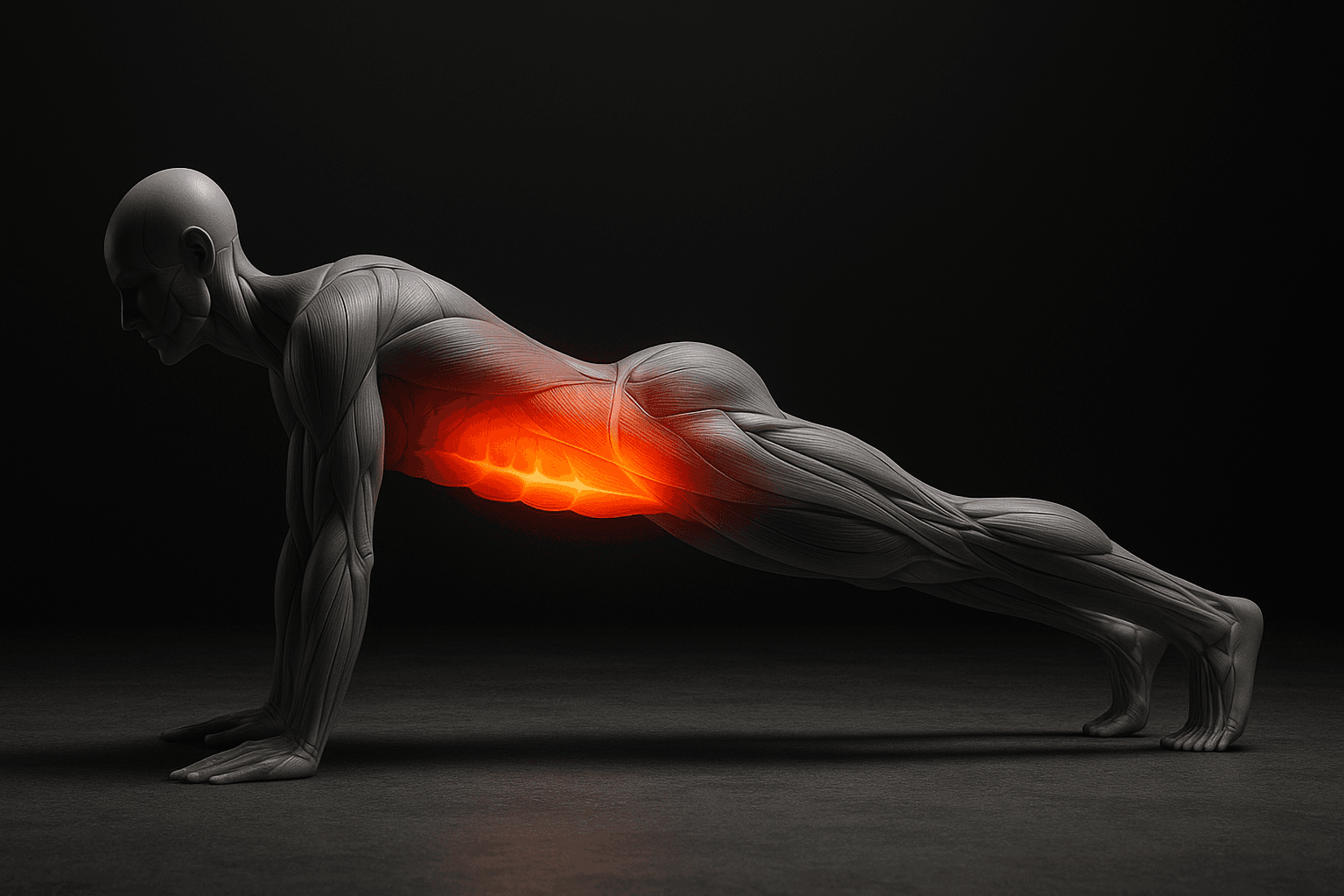
Photo by RepBro.
What is the plank proper form in one sentence?
Keep a straight line from head to heels with elbows (or hands) under the shoulders, ribs down, glutes engaged, and steady breathing — no sagging hips or hiking the butt.
What is the correct setup for a plank?
- Choose forearm (elbows under shoulders) or high plank (hands under shoulders). Prefer forearm plank to reduce shoulder strain.
- Elbows should be directly under the shoulders, about shoulder-width apart; forearms parallel and hands relaxed. For high plank, hands are flat and shoulder-width.
- Step both feet back so your body forms a single straight line from head to heels. Feet can be hip- to shoulder-width apart; narrower feet increase core demand.
- Look at a spot on the floor slightly ahead to maintain a neutral neck. Avoid looking up or tucking the chin excessively.
How do I execute the plank step by step?
- Assume the starting position described above.
- Brace the core as if preparing for a light punch to the stomach: draw the belly button slightly toward the spine without holding your breath.
- Squeeze the glutes and quads to support a rigid body line. Imagine a straight rod running from crown to heels.
- Keep the scapulae neutral: don't overly round the upper back (protract) or pinch the shoulder blades tightly together. Think “long spine, stable shoulders.”
- Hold the position for the target time while maintaining steady breathing (see the breathing and tempo section). When you can no longer keep the line, stop and rest.
What breathing and tempo should I use?
- Breathing: Avoid breath-holding. Use a calm rhythm: inhale 3–4 seconds, exhale 3–4 seconds (about 6–10 breaths per minute). Shorter 2-second breaths are acceptable for shorter holds.
- Tempo: The plank is an isometric hold; there is no concentric/eccentric tempo. Focus on consistent tension throughout the hold. For added challenge, use slow pulses (small 1–2 cm dips/raises) at a 2-second down / 2-second up tempo for 10–15 reps, but only once strict form is solid.
How should I structure sets and progression?
- Beginners: 3 sets of 20–40 seconds, rest 60–90 seconds between sets.
- Intermediate: 3 sets of 45–75 seconds.
- Advanced: 3 sets of 90–120 seconds or add loaded/single-leg variations.
Progress by adding 10–20 seconds per week or by increasing difficulty (elevated feet, single-leg holds) once you can complete target times with perfect form for 3 sets.
What are common plank mistakes and how do I fix them?
-
Hips sagging (lumbar drop)
- Problem: Lower back strains; loss of core tension.
- Fix: Reduce hold time or regress to a knee plank. Actively pull the bellybutton toward the spine and squeeze glutes. Cue: "Zip your ribs to your hips."
-
Butt hiking too high
- Problem: The movement becomes a standing bridge; the core gets less work.
- Fix: Think of lengthening from head to heels and push your chest toward the floor. Lighten foot spacing to make the plank harder but easier to control.
-
Shoulders shrugged near ears or locked out improperly
- Problem: Neck and upper trap strain.
- Fix: Push the floor away slightly (active shoulders) and depress shoulder blades—imagine sliding them down your back.
-
Neck extension or flexion (looking up or tucking chin)
- Problem: Neck discomfort.
- Fix: Keep a neutral neck; gaze 15–30 cm (6–12 in) in front of your hands/elbows.
-
Holding breath
- Problem: Fatigue and unnecessary spike in blood pressure.
- Fix: Use the breathing cadence above and remind yourself: inhale through the nose, exhale through the mouth or nose.
-
Using arms/shoulders to hold instead of core
- Problem: Core undertraining and shoulder overuse.
- Fix: Focus on bracing the core and squeezing glutes; drop to forearm plank or knees if shoulders tire first.
What are safe regressions and progressions?
- Regressions: Knee plank (maintain a straight line from head to knees), wall plank (hands on wall), incline plank (hands on bench or box).
- Progressions: Elevated feet, single-leg plank, weighted plank (small plate on upper back), slow plank-to-push-up transitions.
When should I ask a professional about pain?
Safety note: Stop immediately if you experience sharp joint pain, numbness, or tingling. If you have persistent lower-back or shoulder pain during or after planks, consult a licensed physical therapist, physician, or certified strength coach for diagnosis and program adjustments. This article provides technique guidance only and is not medical advice.
How does plank compare to other core exercises?
Planks train isometric anti-extension and anti-rotation capacity. For a quick comparison of plank versus dynamic core exercises and how to integrate them into a plan, see this comparison resource: https://www.repbro.app/vs. Use planks as the foundation for spinal stability and add dynamic moves (pallof press, dead bugs) for full-spectrum core development.
Quick checklist before each set
- Elbows/hands under shoulders
- Neutral neck and spine
- Belly button drawn in slightly (no breath-holding)
- Glutes and quads engaged
- Feet set at chosen width and steady
One-sentence takeaway: Master the basics—straight line, braced core, steady breathing—and build time or difficulty only when you can hold that position pain-free and without compensations.
For tracking and guided progression, consider using a tool like the RepBro app to log holds and measure improvements: https://apps.apple.com/us/app/gym-workout-coach-repbro/id6763749305.
Frequently asked questions
- How long should I hold a plank?
- Start with 3 sets of 20–40 seconds. Progress gradually—add 10–20 seconds per week. Work toward 2 minutes per set only if you keep perfect form.
- Should my lower back hurt during a plank?
- No. Sharp or persistent lower-back pain is a sign of technique issues or an underlying problem—stop and consult a qualified professional; do not self-diagnose.
- Which is better: forearm plank or high plank?
- Neither is universally better—both train the core differently. Forearm planks emphasize anti-extension; high planks add shoulder demand. Choose based on goals and comfort.