Plank: Muscles Worked and Best Alternatives
Which muscles does the plank train? Learn the primary and secondary muscles, programming tips, and 4 evidence-aware alternatives with when to use each.
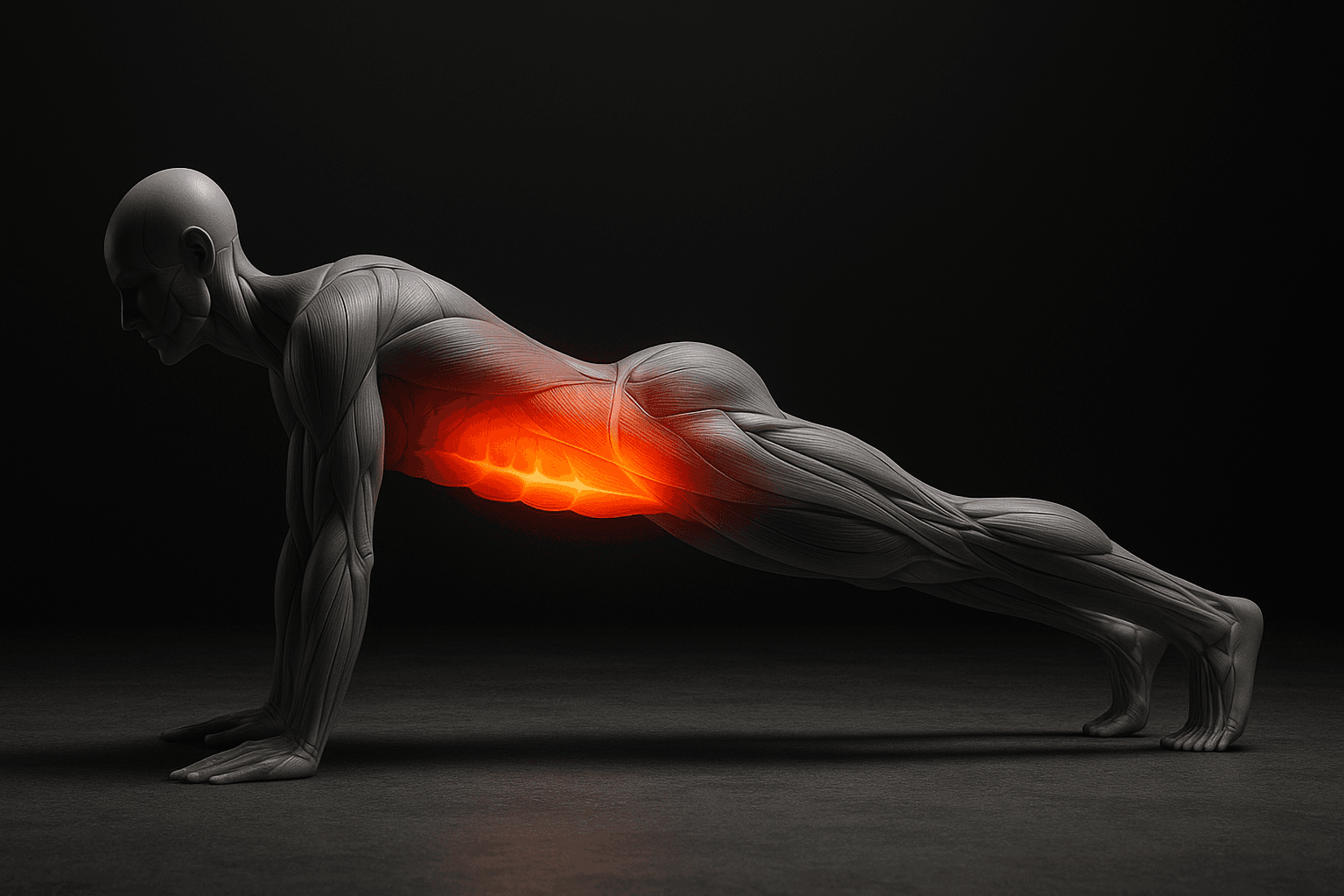
Photo by RepBro.
The plank primarily trains the core stabilizers: transverse abdominis, rectus abdominis and the internal/external obliques. Secondary muscles that do significant work are the erector spinae (lower back), gluteus maximus/medius, shoulders (deltoids), serratus anterior and even the quadriceps for knee extension/stiffness.
Which muscles does the plank work?
Primary: the plank is an isometric anti-extension and anti-flexion exercise for the front and deep core. Expect the following to be the main contributors:
- Transverse abdominis: deep corset-like stabilizer resisting abdominal distension.
- Rectus abdominis: resists trunk extension and helps maintain a neutral spine.
- Internal and external obliques: resist rotation and lateral flexion.
Secondary: holding a plank also loads muscles that keep the torso and hips aligned:
- Erector spinae (spinal extensors) — counteracts trunk collapse.
- Gluteus maximus and medius — maintain hip position and prevent sagging.
- Deltoids and serratus anterior — support the shoulder girdle in high/plank variations.
- Quadriceps — assist in keeping the knees extended and the body in a straight line.
In short: planks are core-dominant but recruit posterior chain and shoulder stabilizers, so they’re more whole-body than they look.
Where does the plank fit in a training program?
- Role: accessory/core-stability exercise. Use planks to improve trunk stiffness, transfer force between upper and lower body, and reduce energy leak in compound lifts.
- Frequency: 2–4 sessions per week for most people. Aim for 3 sessions if your program includes heavy compound lifts.
- Volume: beginners 3×10–20s; most trainees 3–4×30–60s; athletes or advanced lifters 3×60–90s or use progressive overload (weight/levers). Total weekly time under tension of ~3–6 minutes is a reasonable target for general stability work.
- Progression: increase hold time by 5–10 seconds per session, add external load (weight plate on the back, sandbag) for 3×30–60s, or increase lever (single-arm/leg) while maintaining technique.
- Placement in a session: early as part of warm-up if the goal is activation/stability, or late as accessory/core work. Avoid fatiguing maximal-plank sets immediately before heavy squats or deadlifts.
What are the best plank alternatives and when to pick each?
Below are 4 practical alternatives with clear reasons to choose them depending on equipment, injuries, or plateaus.
1) Dead bug — when to pick it
Why: single-axis, low-load anti-extension movement that emphasizes spinal control and pelvic stability with minimal compressive load. When to pick it: beginners, low-back sensitivity, or when you need to teach rib-cage-to-pelvis dissociation. No equipment needed. How to do it: lie on your back, brace the core, lower opposite arm and leg slowly without arching the lower back. Progress by increasing range, tempo control, or adding light ankle weights. Sets/reps: 3×8–12 reps per side.
2) Pallof press (band or cable) — when to pick it
Why: targeted anti-rotation core training under controlled load; it challenges the obliques and transverse abdominis in a functional way. When to pick it: you have a resistance band or cable machine and want to train torso stiffness under external rotational load, or if you’ve plateaued on time-based planks. How to do it: stand perpendicular to the anchor, press the handle straight out and resist rotation. Keep hips and shoulders square. Sets/reps: 3×8–15 reps per side.
3) Side plank — when to pick it
Why: unilateral core strength for obliques, hip abductors and shoulder stabilizers. It corrects side-to-side asymmetry that a standard front plank can miss. When to pick it: if you have lateral trunk weakness, uneven hip/shoulder control, or sport-specific needs (rotation/transfers). Good for those who tolerate axial load but need unilateral emphasis. How to do it: support on elbow or hand, stack feet or stagger, keep a straight line from head to heels. Progress to weighted side planks or leg lifts. Sets/time: 3×20–60s per side.
4) Bird dog — when to pick it
Why: dynamic cross-body anti-rotation and posterior chain coordination with low compressive load on the spine. When to pick it: rehabbing or managing low-back discomfort, or when you need to improve hip extension control and symmetrical hip/shoulder timing. How to do it: on hands and knees, extend opposite arm and leg while keeping the torso still; focus on minimal hip rotation. Sets/reps: 3×8–12 reps per side.
How to break a plank plateau
If you can hold a perfect plank for long but want more, don’t just chase time. Use these strategies:
- Add external load (5–25 kg) for 3×30–60s.
- Increase lever: raise one arm/leg or stagger limbs to create longer moments.
- Add rotation/anti-rotation: Pallof presses or loaded carries improve transfer.
- Move from isometric to eccentrically-loaded core work: cable chops, heavy carries, or weighted rollouts.
Exercise safety note
Stop any exercise that causes sharp or radiating pain; mild muscle burn is normal but not joint or nerve pain. If you have a history of serious spine or shoulder injury, consult a qualified clinician before progressing to loaded or unilateral variations.
How to track progress and choose the right option
Track time, load, and quality of each rep/hold—prefer quality over time. If you use an app to log sessions, you can compare short-term improvements in time under tension or load; try syncing or importing plans into RepBro or compare exercises using https://www.repbro.app/vs for structure.
One-sentence takeaway: The plank is a reliable isometric core exercise that primarily trains deep and superficial abdominal muscles plus secondary posterior-chain and shoulder stabilizers—use it alongside dead bugs, Pallof presses, side planks, or bird dogs depending on equipment, pain history, and your specific stability goals.
Frequently asked questions
- Is the plank enough for core strength?
- The plank is a useful isometric core stabilizer but not sufficient alone—pair it with anti-rotation, anti-extension and loaded core work for complete development.
- How long should I hold a plank?
- Beginners: 3×10–20 seconds; intermediate: 3×30–60 seconds; advanced: 3×60–90+ seconds or add progressive overload (weight/levers).
- Can planks help low back pain?
- Planks can improve trunk stability, which may help some people, but stop on sharp pain and consult a clinician to tailor exercises—do not use as a standalone treatment.