Rear Delt Fly: Muscles Worked and Best Alternatives
Which muscles does the rear delt fly work? Learn the primary and secondary muscles, programming advice, and 4 practical alternatives with when to pick each.
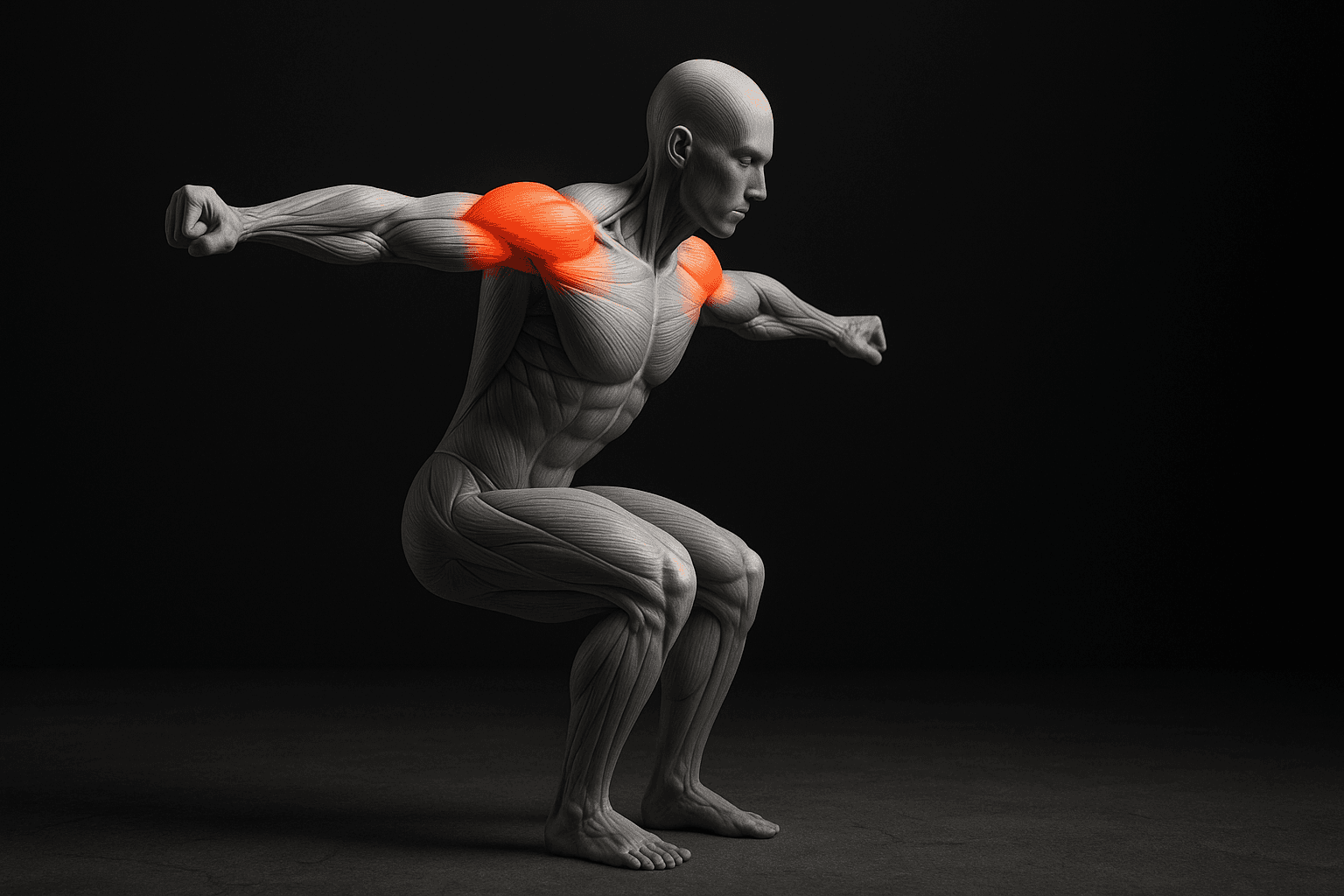
Photo by RepBro.
First paragraph answer The rear delt fly primarily trains the posterior (rear) deltoid. Secondary muscles include the middle trapezius, rhomboids, and the external rotators of the shoulder (infraspinatus/teres minor); the exercise also involves the scapular stabilizers. In short: posterior deltoid = primary; scapular retractors and rotator-cuff muscles = secondary.
What exactly does the rear delt fly do to the shoulder?
The rear delt fly moves the arm into horizontal abduction (lifting the arm out to the side and back when the torso is bent forward). The posterior deltoid produces that horizontal abduction; the middle trapezius and rhomboids assist by retracting and stabilizing the scapula. The rotator-cuff muscles help keep the humeral head centered in the socket through the movement.
How should I program the rear delt fly into my routine?
- Role: accessory/hypertrophy exercise for posterior shoulder balance and upper-back detail. Not a primary compound lift.
- Frequency: 2 sessions per week for most trainees.
- Volume: 2–4 sets per session, 8–20 reps depending on load and goal. Aim 8–12 reps for heavier sets or 12–20 reps for light, strict sets focused on tempo.
- Placement: place it after heavy pushing/pulling work (bench, rows, presses) or on an accessory day. If you do a lot of heavy rows, keep volume lower to avoid overworking the scapular retractors.
- Progression: increase load when you can complete target reps with good form for 2 consecutive sessions; otherwise add reps, sets, or slow the tempo.
How to perform a basic dumbbell rear delt fly (short form + safety)
- Sit or stand with a neutral spine and hinge at the hips until your torso is roughly parallel to the floor.
- Hold light-to-moderate dumbbells with palms facing each other, arms hanging under shoulders.
- With a slight bend in the elbow, lift the arms out to the sides until they are roughly in line with your torso (horizontal). Lead with the elbows, not the hands.
- Pause briefly at the top, then lower under control.
Tempo example: 1–2s up, 1–2s down.
Safety note: stop on sharp pain and consult a healthcare or movement professional for persistent or unusual pain; never push through joint pain.
What are the best alternatives to the rear delt fly, and when to pick each?
Below are four solid alternatives with practical guidance on when to choose them.
- Face Pulls (cable or band)
- Muscles targeted: posterior deltoid, external rotators, middle/lower traps, rhomboids.
- When to pick: if you have access to a cable machine or bands, want stronger external rotators and scapular control, or need a rehab-friendly option. Face pulls emphasize external rotation as well as horizontal abduction, which helps shoulder health when used correctly.
- Load/rep guidance: 3–4 sets of 10–20 reps with a controlled pause and focus on pulling the hands to eye/forehead level.
- Chest‑Supported (Incline Bench) Rear Delt Fly
- Muscles targeted: posterior deltoid with minimal lumbar load and less cheating through momentum.
- When to pick: if you have lower-back issues, trouble keeping torso position during bent-over flies, or want strict isolation without a spotter.
- Load/rep guidance: 2–4 sets of 10–15 reps, focus on strict motion and scapular retraction.
- Reverse Pec‑Deck (Machine) Fly
- Muscles targeted: posterior deltoid and mid-back stabilizers with fixed path and consistent resistance.
- When to pick: if you want a beginner-friendly, stable option or need to maintain training intensity when free-weights are fatiguing other muscles. Also useful for controlled overload (plate increments).
- Load/rep guidance: 3–4 sets of 8–15 reps, control the eccentric phase.
- Single‑Arm Cable Rear Delt Fly (High or Low Anchor)
- Muscles targeted: posterior deltoid with strong unilateral emphasis and constant tension.
- When to pick: when chasing a plateau, correcting left-right strength differences, or wanting continuous tension through the range. Good for progressive overload and tech drills.
- Load/rep guidance: 3–4 sets of 8–12 reps per arm; use a slow eccentric and keep shoulders pulled down.
How to choose among these alternatives?
- Equipment limits: use bands or face pulls if you lack machines; choose chest-supported dumbbell flies if you only have benches and dumbbells.
- Shoulder pain or rehab: prefer face pulls or chest-supported flies with light loads and focus on external rotation; stop if movements cause sharp pain.
- Plateau or imbalance: pick single-arm cable variations to expose and fix asymmetries, and use higher-frequency, lower-load work to improve motor control.
- Want heavier, safer isolation: pick reverse pec-deck or heavier cable work for progressive overload with less cheating.
How do these fit into a long-term plan?
- Combine: you can rotate variations across weeks (e.g., face pulls one week, reverse pec-deck the next) to hit the posterior deltoid from slightly different angles and stimuli.
- Recovery: treat rear delts as higher-rep accessory muscles; they recover faster than large prime movers but still need rest.
- Tracking: log sets, reps, load, and perceived effort. If you use the RepBro app, import and test different variations to see what improves strength and technique; for comparison planning see https://www.repbro.app/vs.
Quick troubleshooting
- If you feel the lats or lower traps doing most of the work, lighten the load and concentrate on leading with the elbows and pinching the shoulder blades.
- If you compensate with torso movement, switch to a chest-supported variation.
- If you get anterior shoulder pain, back off the range, reduce load, and prioritize external rotation work like face pulls.
One-sentence takeaway The rear delt fly mainly trains the posterior deltoid with important help from scapular retractors and rotator-cuff muscles—pick face pulls for shoulder health, chest-supported flies for lower-back safety, the pec-deck for stable overload, or single-arm cables to fix imbalances depending on your equipment and needs.
Frequently asked questions
- How often should I train rear delts?
- Train rear delts 2–3 times per week as an accessory (2–4 sets per session). They tolerate moderate volume and benefit from consistent, submaximal loading and varied angles.
- Are rear delt flies safe for bad shoulders?
- They can be safe if performed with good posture, light-to-moderate loads, and pain-free range of motion. Stop on sharp pain and consult a clinician for persistent pain or instability.
- Do rear delt flies improve posture?
- They strengthen posterior delts and scapular retractors, which can help posture when combined with thoracic mobility work and a balanced program, but they're not a standalone fix.