Romanian Deadlift: Proper Form, Step by Step
Definitive Romanian deadlift form guide: setup, hinge cues, breathing, tempo, common mistakes and fixes—safety-first, evidence-aware instructions for barbell or dumbbell RDLs.
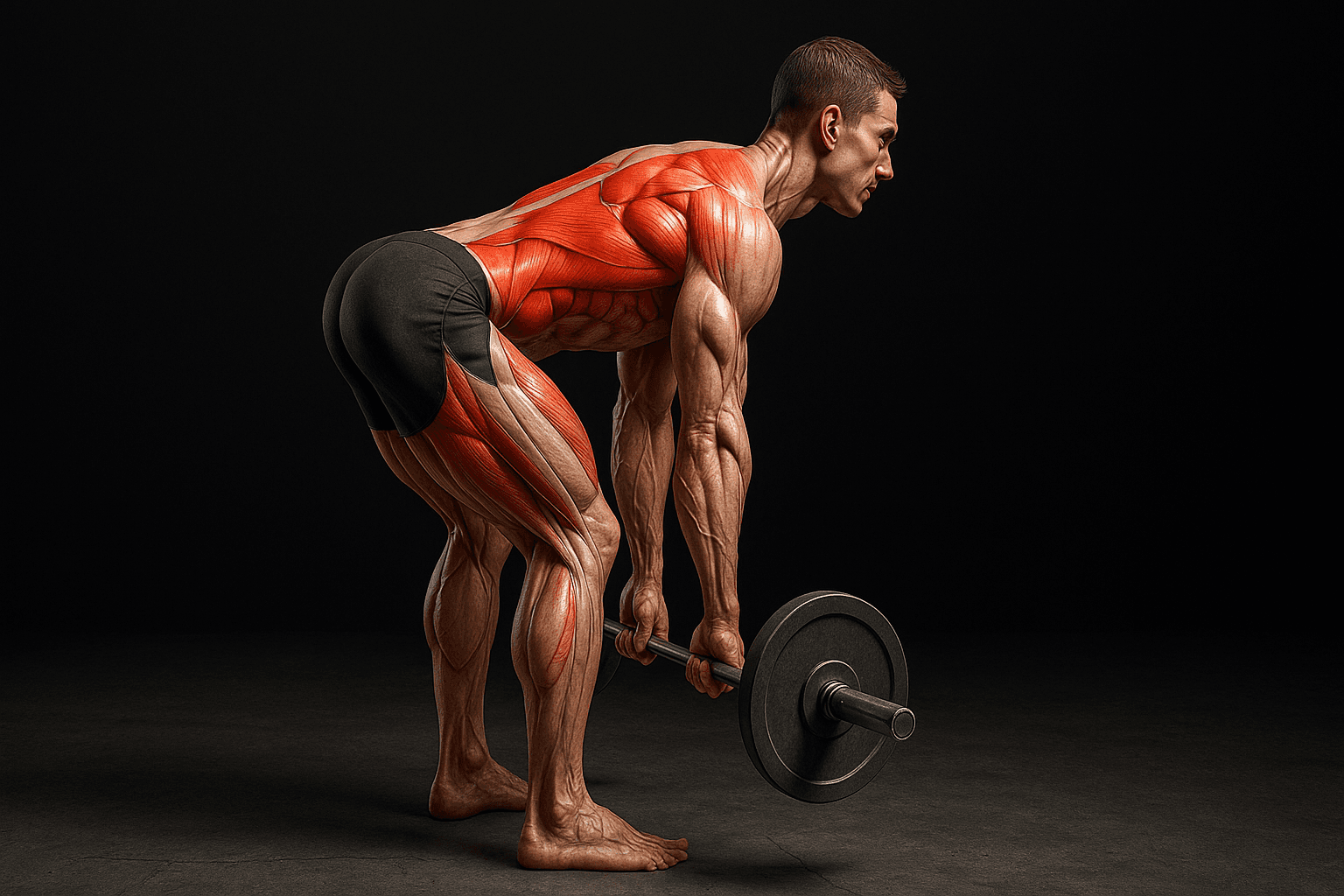
Photo by RepBro.
Romanian deadlift proper form: hinge at the hips with a slight knee bend, keep the bar close to your legs, maintain a neutral spine, and drive hip extension to return—those are the essentials you must follow every rep.
What is the Romanian deadlift and who should do it?
The Romanian deadlift (RDL) is a hip-hinge dominant lift that targets the posterior chain—glutes, hamstrings, and spinal erectors—while training the movement pattern used in many daily and athletic tasks. Use it as an accessory for strength and hypertrophy, or as a primary posterior-chain exercise. If you have acute back pain, stop and consult a health professional before continuing; this guide is not a diagnosis.
How do I set up for the Romanian deadlift?
- Load a barbell (or pick a pair of dumbbells) and stand with feet hip-width apart—about 30–40 cm (12–16 inches) between the feet—so the bar is over mid-foot.
- Grip the bar with hands just outside the thighs (about shoulder-width). Use a double overhand, mixed grip, or straps if needed for heavier sets.
- Unrack the bar with a conventional deadlift if starting from the floor, then take 1–2 steps back and re-establish your stance. If starting from a rack or dumbbells, begin standing upright.
- Set a slight, fixed knee bend: about 10–20 degrees. The knee angle does not change through the set.
- Brace your core: inhale diaphragmatically, tighten the abs as if expecting a punch, and keep a neutral cervical and thoracic spine.
How do I perform the Romanian deadlift (execution cues)?
- Start the descent by pushing the hips back—imagine your butt moving toward a wall behind you. Avoid bending at the waist first.
- Keep the bar within 5 cm (2 in) of the legs; let it shave the thighs and shins. This shortens the moment arm and reduces shearing forces.
- Maintain a proud chest and retracted shoulder blades—no rounded upper back.
- Lower until you feel a firm hamstring stretch or until the bar reaches mid-shin (often 10–15 cm above the ground). Do not force the bar to the floor.
- Drive the hips forward explosively by contracting the glutes and hamstrings to return to standing. Do not hyperextend the lower back at the top—finish with a neutral spine and hips fully extended.
Concrete cues: "push hips back," "bar close to legs," "chest up," "brace like you're being punched," and "squeeze glutes at the top."
What about breathing and tempo?
- Breathing: Inhale and brace at the top before lowering. Hold that intra-abdominal pressure through the descent and ascent. For heavy singles or near-max sets, experienced lifters may use the Valsalva maneuver briefly; if you have any cardiovascular or medical concerns, consult a professional first. Exhale after the top or between sets.
- Tempo recommendations:
- Strength: 3 s eccentric (descent), 0–1 s pause, 1 s concentric (ascent), 3–6 reps.
- Hypertrophy: 3–4 s eccentric, 0 s pause, 1–2 s concentric, 6–12 reps.
- Technique or conditioning: 2–3 s eccentric, 1 s pause at stretch, 1–2 s concentric, 8–15+ reps.
How much weight and how many reps?
- As an accessory: 6–12 reps per set with challenging but controlled load.
- For strength emphasis: 3–6 reps with heavier loads and longer rests.
- Start with light weight until form is consistent—use at least 2 warm-up sets before heavy work.
What variations should I consider?
- Dumbbell RDL: easier on grip and useful for beginners.
- Single-leg RDL: adds balance and unilateral load; use lighter weight and focus on stability.
- Trap-bar RDL: keeps the weight more centered; closer to a deadlift but still hip-hinge focused. For comparisons between movements (RDL vs conventional deadlift or RDL vs good morning), see this comparison resource: https://www.repbro.app/vs and use RepBro to track your lifts and technique progress.
Safety note
Stop immediately if you feel sharp or radiating pain and consult a qualified professional. This guide provides technique advice but does not replace personalized assessment or medical care.
Common mistakes and how to fix them
- Rounded lower or upper back
- Fix: Reduce load, focus on chest-up and retracted shoulders, brace before each rep. Practice hip-hinge drills (hinge to a box) with light weight.
- Knees bending too much (turning the RDL into a stiff-legged deadlift)
- Fix: Lock in a small knee bend (10–20°) and keep it fixed. Cue "push hips back, not knees forward."
- Hips rising too early or finishing with a back-extension thrust
- Fix: Push through the heels and squeeze glutes to drive hips forward; stop short of hyperextension.
- Bar drifting away from the legs
- Fix: Keep the bar touching or within 5 cm of the legs. Practice with a lighter load, slide the bar along your thighs.
- Pulling with the lower back instead of hinging with hips
- Fix: Emphasize hip travel—pretend you’re trying to touch a wall behind you with your butt. Use tempo (3–4 s descent) to build control.
- Grip failure
- Fix: Use lifting straps for heavy sets or switch to mixed grip; strengthen grip with farmer carries.
How should I warm up and progress?
Do 5–10 minutes of dynamic movement (leg swings, hip circles), then 2–3 warm-up sets of RDLs with 40–60% of working weight, focusing on shallow range and perfect hinge mechanics. Progress load by 2.5–5% per week for consistent increases, and deload every 3–8 weeks depending on fatigue.
Final tips
Record yourself from the side at eye level to check hip travel and spine position. Prioritize technique over load—an expertly performed lighter RDL beats a heavy, unsafe one.
One-sentence takeaway: Execute the RDL as a controlled hip hinge with a slight fixed knee bend, bar close to the legs, and a strong brace—stop on sharp pain and consult a professional if needed.
Frequently asked questions
- How deep should I go on a Romanian deadlift?
- Stop once you feel a strong stretch in the hamstrings or when the bar reaches mid-shin (roughly 5–10 cm above the shin) while keeping a neutral spine. Depth varies by hamstring flexibility and torso length; don’t round to chase depth.
- Should my knees be locked during the RDL?
- No. Keep a small, fixed bend in the knees—about 10–20 degrees—throughout the set. This maintains tension in the hamstrings and protects the patellar tendon. Avoid changing knee angle significantly during the reps.
- Is the RDL better than a conventional deadlift for hamstrings?
- The RDL emphasizes the hip hinge and hamstrings more than a conventional deadlift, which uses more knee extension and often more quad involvement. Choice depends on your goals; both can be used complementarily.