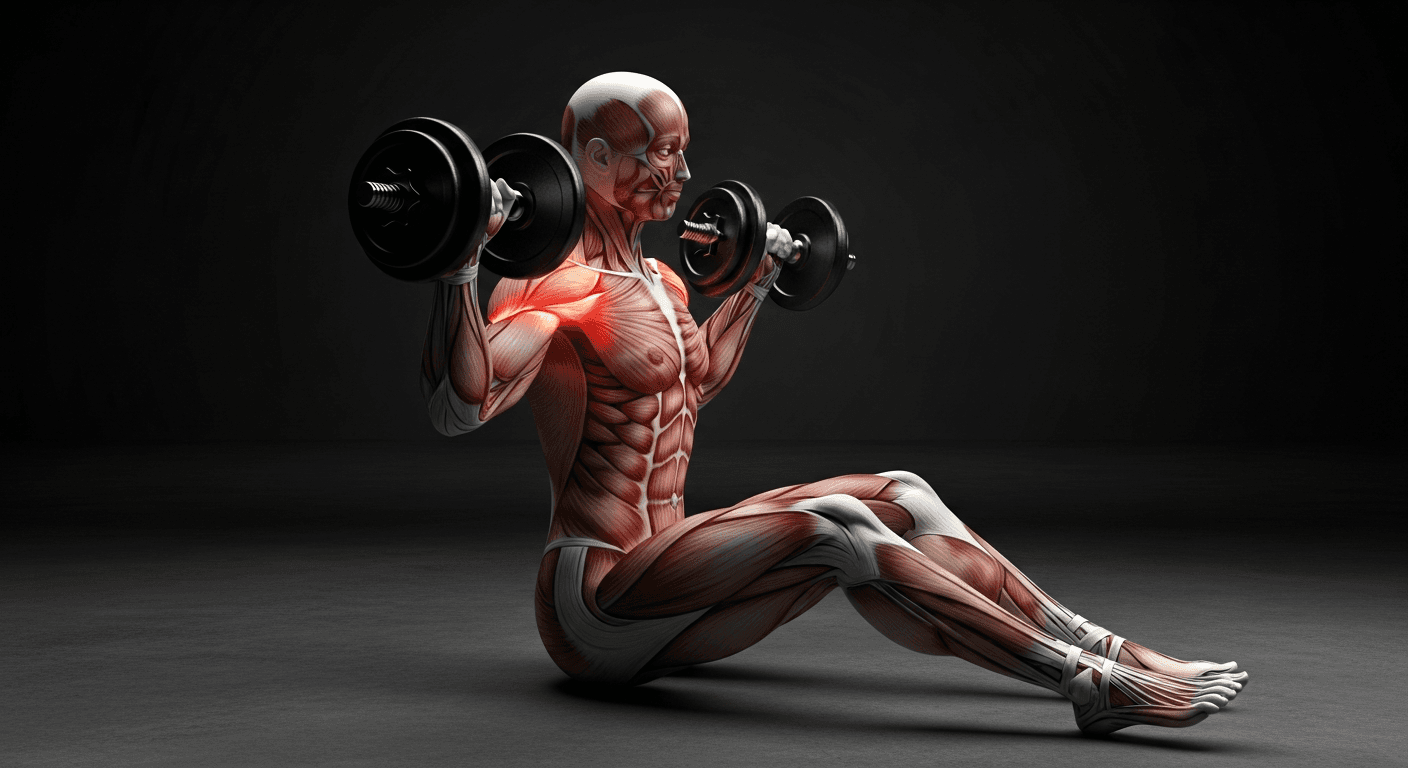
Seated Cable Row Alternatives at Home (Minimal Equipment)
Practical substitutes for the seated cable row you can do at home with dumbbells, bands, or bodyweight. What each keeps and loses, and when to stick to gym equipment.
Photo by RepBro.
Direct answer: If you don’t have a cable machine, you can reliably substitute seated cable rows with single-arm dumbbell rows, two‑arm bent‑over dumbbell rows, inverted rows (table/TRX), seated resistance‑band rows, or chest‑supported dumbbell rows. Each keeps the horizontal pull pattern but differs in tension profile, load progression, and low‑back demand.
What are practical seated cable row alternatives at home?
- Single‑arm dumbbell row (knee on bench or staggered stance)
- Two‑arm bent‑over dumbbell row (both hands, hip hinge)
- Inverted row using a sturdy table, rings, or TRX
- Seated resistance‑band row anchored to a door or heavy object
- Chest‑supported dumbbell row (incline bench or stability ball)
For each alternative: what does it preserve and what does it lose compared with a seated cable row?
-
Single‑arm dumbbell row
- Preserves: Horizontal pulling pattern, unilateral loading (helps fix side imbalances), lat and scapular retraction emphasis.
- Loses: Constant bilateral horizontal tension; requires trunk stabilization (more anti‑rotation demand), and set‑up often limits very heavy loading compared with two‑handed cable.
-
Two‑arm bent‑over dumbbell row
- Preserves: Heavy bilateral loading potential and similar elbow path if torso angle is controlled.
- Loses: Torso must be braced in a hip hinge, increasing low‑back demand; tension is not perfectly horizontal unless you adjust torso angle.
-
Inverted row (table or TRX/rings)
- Preserves: True horizontal pull, scapular retraction, bodyweight progression, excellent for technique and posterior chain coordination.
- Loses: Limited maximum load (your bodyweight) unless you change lever arm or add weight; harder to isolate lats compared with seated cable row.
-
Seated resistance‑band row
- Preserves: Continuous horizontal tension and similar hand path; easily replicates a seated position.
- Loses: Variable resistance curve (bands increase tension at end range); micro‑loaded progression may be jumpy unless you own many band tensions.
-
Chest‑supported dumbbell row (incline bench or ball)
- Preserves: Low back support and good scapular retraction control; close to cable row thoracic position.
- Loses: Often different line of pull depending on bench angle and may be awkward to set up if you lack an incline bench.
How should I choose between these at home?
- If your priority is matching the seated cable row’s position and low‑back support: use a chest‑supported dumbbell row or a seated band row.
- If you want to correct left/right strength differences: single‑arm dumbbell row or single‑arm band row.
- If you lack heavy dumbbells and want horizontal tension with minimal equipment: the inverted row or band row is preferable.
- If you aim to overload and get stronger with heavier loads: two‑arm bent‑over rows let you use heavier dumbbells, but they increase low‑back demand.
What about training variables: sets, frequency, progression and tempo?
- Frequency: Train back 2–3 times per week, spreading your weekly volume across sessions for better recovery and growth opportunities.
- Weekly volume: Aim your total weekly sets for the back within commonly recommended practical ranges used in current reviews for hypertrophy; distribute those sets across sessions. (Individual needs vary.)
- Progression: Add load when you can complete target reps with good form, increase volume (sets/reps), reduce rest, or slow the eccentric phase to increase time under tension.
- Tempo: With bands or bodyweight, slow eccentrics (2–4 seconds) help compensate for lower absolute loading by increasing mechanical tension.
Quick, evidence‑aware sample progressions for a home gym
- Beginner (2x/week): 3 sets of 8–12 reps of inverted rows + 3 sets of single‑arm dumbbell rows 8–12 reps each side.
- Intermediate (3x/week): 3–4 sets per session, rotating two main row types (band row, bent‑over DB row, chest‑supported), using progressive overload weekly.
- Use a 1–2 week deload every 6–12 weeks depending on fatigue and training history.
Comparison table: how do these options stack up?
| Exercise | Equipment | Horizontal tension | Low‑back stress | Unilateral option | Load progression | Setup ease |
|---|---|---|---|---|---|---|
| Seated band row | Band + anchor | High | Low | Yes | Moderate (more bands) | Easy |
| Single‑arm DB row | Dumbbell + bench/chair | Moderate | Moderate | Yes | High (heavier DBs) | Easy |
| Two‑arm bent‑over DB row | Dumbbells | Moderate | High | Limited | High | Moderate |
| Inverted row | Table/TRX | High | Low (if hips down) | Yes (unilateral variants) | Low unless weighted | Easy–moderate |
| Chest‑supported DB row | Dumbbells + bench/ball | Moderate | Very low | Yes | Moderate | Moderate |
When is a gym cable row worth using instead?
- You need fine incremental loading (small weight increments) for strength peaking.
- You require a constant horizontal line of pull and highly repeatable resistance curves for technique refinement.
- You’re training at very high absolute loads where home equipment can’t safely match the resistance. For most lifters pursuing hypertrophy and general strength, well‑programmed dumbbell, band, or bodyweight rows at home are adequate.
Safety note
Stop any exercise that causes sharp or unusual pain. Maintain neutral spine and controlled tempo; avoid extreme torso rotation under load. This article does not diagnose conditions—consult a qualified health or strength professional for injury, rehab, or personalized technique coaching.
Limitations — what apps and AI coaching cannot do for your rows
- No app or AI can see your form in real time and make the fine movement corrections a qualified coach does. Videos and sensors help but are imperfect.
- Apps can’t replace hands‑on guidance for injury rehab; an accredited clinician or physiotherapist should manage pain or complex movement issues.
- A program only works if you follow it consistently; even perfect programming won’t help without adherence and progressive overload.
If you track sets, reps, and progression you’ll get more consistent results; some lifters find logging in an app like RepBro useful for that purpose, but tracking alone won’t correct form.
If you need specific exercise swaps based on equipment you have, tell me what you own (dumbbell weights, bands, bench, TRX) and I’ll give a tailored substitute and a short 4–6 week progression plan.
Frequently asked questions
- Can I replace seated cable rows with dumbbell rows at home?
- Yes. Single-arm or two-arm dumbbell rows reproduce the main pulling pattern and allow good load progression. They change torso angle and reduce the constant horizontal tension provided by a cable, so adjust volume and tempo to maintain time under tension.
- Are resistance bands as effective as cables for rows?
- Bands can provide a very similar horizontal pull and continuous tension when anchored correctly. They give variable resistance (more at end range), so use slower eccentrics and higher time under tension to match training stimulus from a cable row.
- When should I go back to the gym for cable rows?
- If you need very heavy bilateral loading, precise constant horizontal tension, or progressive micro-loading beyond what bands/dumbbells permit, gym cables/stacked equipment are worth using. For most hypertrophy and general strength goals, home options are adequate.