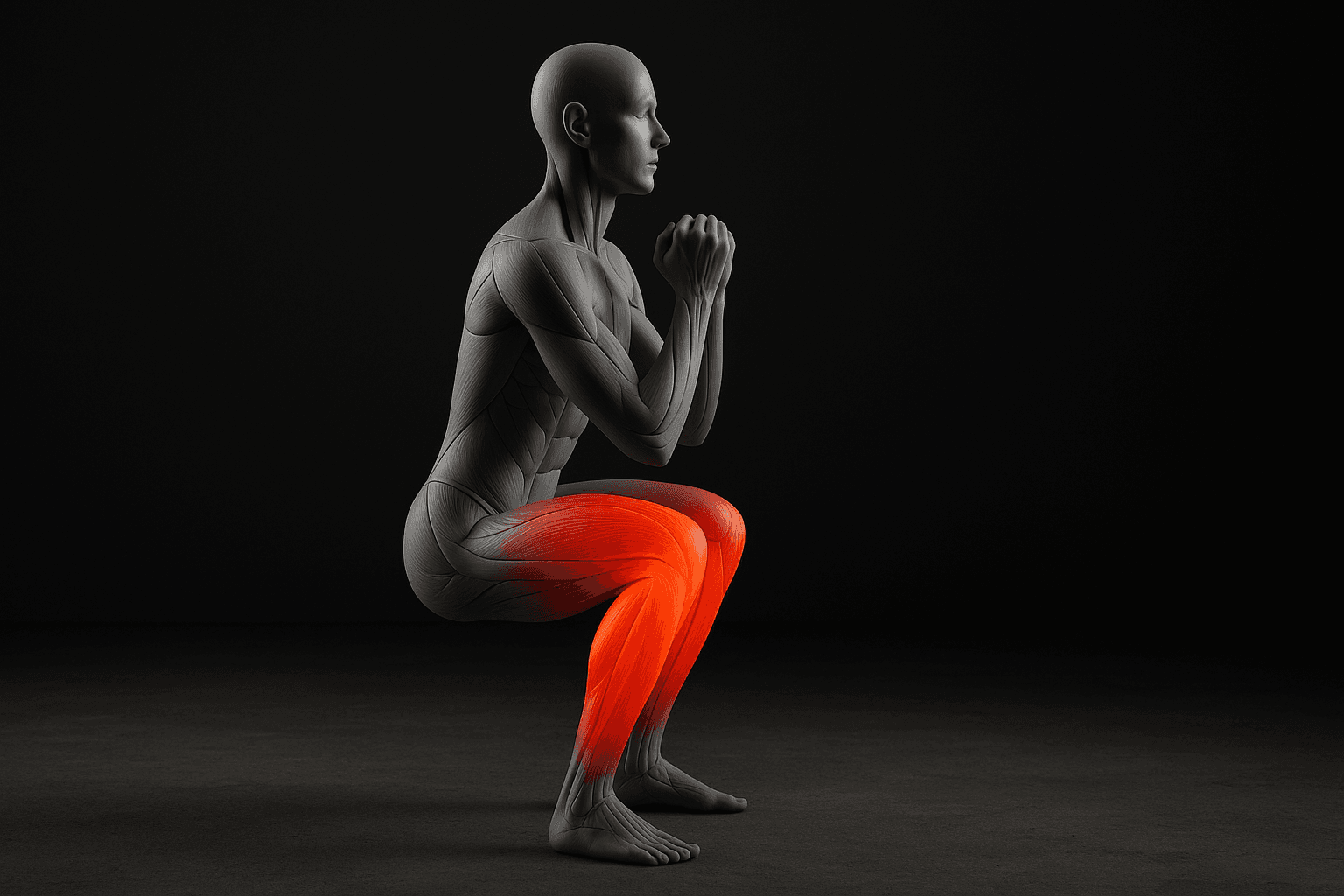
Standing Calf Raise Alternatives at Home (Minimal Equipment)
Practical at-home substitutes for standing calf raises using bodyweight, dumbbells, or bands. How each option compares, programming tips, safety, and when to return to the gym.
Photo by RepBro.
Do this: single-leg elevated heel raises or band-resisted standing raises replicate the standing calf raise’s range and unilateral demand while letting you progress with limited gear. If you need very heavy, controlled load for maximal strength, a gym machine is the next step.
What simple exercises replace the standing calf raise at home?
Here are 4–5 practical substitutions using minimal equipment (bodyweight, dumbbell, loop band).
- Single-leg elevated heel raise (bodyweight / dumbbell)
- How: Stand with the ball of your foot on a stair or 5–10 cm block, heel hanging. Push up through the forefoot, pause, then lower slowly through full stretch. Add a dumbbell held in the other hand or on the working-leg thigh to load.
- Equipment: step/box, optional dumbbell (1–40+ kg as available).
- Double-leg elevated heel raise with dumbbell
- How: Both feet on a step, holding a dumbbell at arm’s length or on your thighs; press up and lower slowly. More stable for higher absolute loads.
- Equipment: step, dumbbell.
- Band-resisted standing calf raise
- How: Anchor a loop band under a heavy object, loop around your forefoot or shoulders, and perform standing heel raises. Vary band thickness and foot position for tension changes.
- Equipment: loop band, sturdy anchor.
- Seated band or dumbbell calf raise (targets soleus)
- How: Sit with feet on a block, loop a band over your knees or place a dumbbell on your thighs, and raise heels. This shifts emphasis toward the soleus because the knee is flexed.
- Equipment: chair, band or dumbbell.
- Weighted calf walks / farmer’s carry on toes (directional overload)
- How: Walk on the balls of your feet with dumbbells or a backpack to keep calves under continuous tension. Useful for metabolic stimulus and endurance.
- Equipment: dumbbells or backpack.
What does each alternative preserve compared with a standing calf raise, and what does it lose?
Comparison highlights:
- Preserves: ankle plantarflexion range of motion, eccentric–concentric cycle, unilateral vs bilateral options, and the ability to manipulate tempo.
- Loses: absolute load ceiling (unless you have very heavy dumbbells or a loaded backpack), the precise machine stability that some standing calf raise machines provide, and in some variations the exact spine/bracing pattern used in heavy machine lifts.
Short practical notes per exercise:
- Single-leg elevated heel raise: preserves unilateral loading and full ROM; loses absolute load unless you have very heavy dumbbells. Good for strength and hypertrophy when you can progressively add weight.
- Double-leg elevated heel raise with dumbbell: preserves ability to use heavier absolute load with better stability; loses unilateral imbalance work.
- Band-resisted raises: preserves progressive tension across ROM and portable overload; loses consistent linear load profile (bands provide more variable resistance). Bands can be excellent for hypertrophy but are less ideal for maximal strength testing.
- Seated band/dumbbell raise: preserves soleus emphasis but loses gastrocnemius stretch under knee extension—so use this when you want to bias soleus.
- Calf walks: preserve continuous tension and endurance adaptations; lose the high-load concentric peak found in some standing machine variations.
When is an at-home swap adequate, and when should you return to a gym machine?
Choose at-home work if:
- Your goal is general hypertrophy and you can progressively increase tension via reps, tempo, band tension, or added weight.
- You need frequent, convenient calf training (calves respond well to moderately high frequency).
- You’re addressing unilateral balance or rehab-friendly progressions.
Consider the gym when:
- You cannot progressively overload anymore with available weights/bands and your calves have plateaued.
- You want maximal strength testing or very heavy, controlled overload under spinal load (some athletes need the specific machine setup).
- You require precise loading for a rehab protocol prescribed by a clinician.
How should I program sets, reps, and progression at home?
- Frequency: 2–3 sessions per week is a reasonable starting point for most lifters; adjust by monitoring recovery.
- Volume: 6–15 sets per week per muscle group is commonly used in hypertrophy-focused programs—split across sessions. For calves, higher reps per set (12–20+) are common, but heavier sets in the 6–12 range are useful if you can add load.
- Progression: first add reps, then tempo (slow eccentric 2–4 s, 1–2 s pause), then increase band tension or dumbbell load. Track loads and reps; aim for small, consistent increases.
- Unilateral vs bilateral: include some single-leg work to avoid asymmetries. If using unilateral, reduce load or increase sets to match total weekly work.
Evidence-based context: these programming choices follow broad strength and hypertrophy consensus—progressive overload, adequate frequency, and monitored volume are key. Individual responses vary; prioritize consistent, progressive stimulus.
How can I check form and stay safe?
Short safety note: stop when you feel sharp or unusual pain; mild delayed-onset soreness is normal after increased volume. Keep a controlled tempo and full, comfortable ankle range. If you have pre-existing ankle, Achilles, or lower-leg issues, consult a qualified clinician before pushing volume or load. Never attempt to diagnose via text; get hands-on assessment when needed.
When are bands better than dumbbells for calves?
- Use bands when you need portable progressive tension and variable resistance. Bands are useful for high-rep hypertrophy and for maintaining tension through the top of the movement.
- Use dumbbells when you want a heavier, more constant external load and clearer sets/reps progression.
What can’t an app or AI replace for calf training?
Limitations:
- No app or AI can visually correct your form in real time like a qualified coach watching you in person.
- Virtual tools can’t diagnose or manage injuries—see a physical therapist or sports medicine professional for pain or rehab needs.
- A plan only works if you do the work: consistency and adherence matter more than the platform used to track sets.
- Apps can’t feel your effort or recovery—self-monitor RPE and soreness and adjust volume accordingly.
- For advanced athletes seeking maximal strength progression, in-person coaching and heavy equipment may be necessary.
If you want to track progression reliably, consider logging sets, reps, load, and tempo in a tracker. (If tracking in an app helps you stay consistent, RepBro offers set-by-set logging and progression features.)
Final takeaways
You can approximate the standing calf raise effectively at home with elevated single-leg raises, band-resisted variations, seated raises for soleus, and weighted calf walks. These preserve key elements—ROM, concentric/eccentric control, and unilateral options—while the main limitation is absolute load ceiling. Use progressive overload, 2–3 sessions per week, and seek gym access when you can no longer add meaningful load or when clinical guidance requires machine-based rehab.
Frequently asked questions
- What is a quick alternative to standing calf raises at home?
- Do single-leg elevated heel raises. Use a stair or block, keep the ankle through full range, and add a slow 2–3 second pause at the top. They mimic the unilateral loading and range of a standing calf raise without a machine and are effective with progressive load.
- How often should I train calves at home?
- Train calves 2–3 times per week, allowing at least 48 hours between intense sessions. Use progressive overload—add reps, slow tempo, band tension, or weight. Calves tolerate higher frequencies, but monitor recovery and reduce volume if performance or soreness accumulates.
- When should I go to a gym for heavier calf work?
- Go to a gym when you need substantially heavier, safe overload for strength gains: when bodyweight or bands no longer allow progressive loading, or if you need seated machines or heavy standing machines to target specific calf muscles with heavier external load.