Tricep Pushdown: Proper Form, Step by Step
Learn the tricep pushdown proper form: setup, step-by-step execution, breathing, tempo, common mistakes and fixes—safety-first, practical cues for stronger triceps.
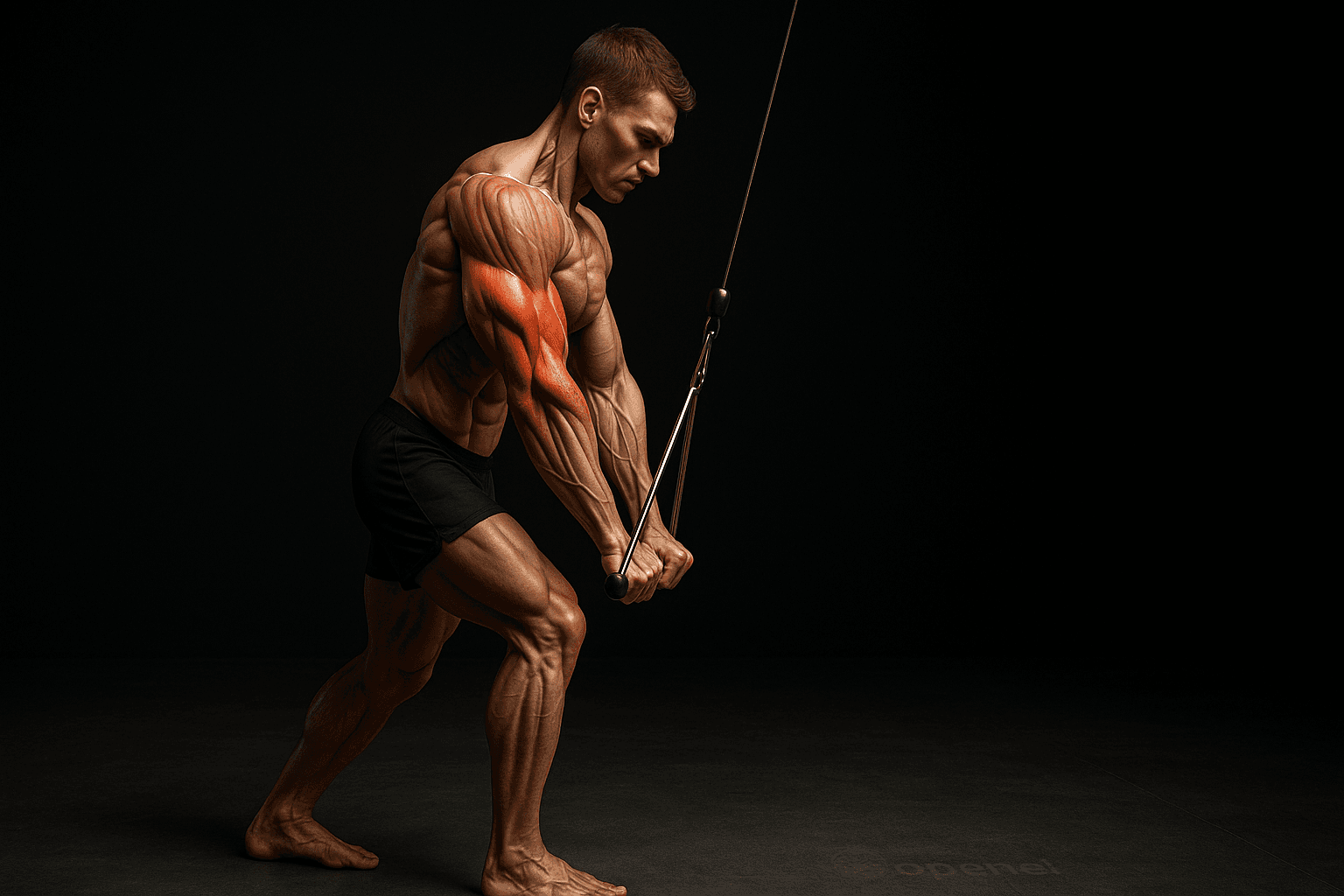
Photo by RepBro.
To answer the query directly: tricep pushdown proper form means setting up tall at a cable, elbows pinned to your sides, pushing straight down until the elbows are fully extended while keeping the wrists neutral and the shoulders still. Control the return; do not let the weight pull your elbows forward.
How do I set up for a tricep pushdown?
- Equipment: cable machine with a straight bar, V-bar, or rope attachment.
- Load: choose a weight you can control for 8–15 reps with good form. If you must swing or lean, reduce weight by 10–30%.
- Stance: stand with feet hip-width apart, one foot slightly forward for balance if needed. Knees soft, core braced.
- Grip: shoulder-width on a straight bar, neutral on a rope. Thumb can be wrapped or not—pick what feels secure.
- Body position: chest up, shoulder blades pulled down and back, torso upright (allow a 5–10° forward lean at the hips only if required by machine geometry).
Track warm-up sets: do 2 sets of 10–15 reps with light weight to groove the movement. If you track workouts, tools like RepBro make logging and progressive overload simpler.
How do you perform a tricep pushdown — step by step?
- Start position: stand under the cable with the bar/rope at chest height. Elbows at your sides, forearms roughly parallel to the floor, palms facing down (straight bar) or in (rope).
- Inhale to brace your core and stabilize your shoulders.
- Exhale and push the bar/rope straight down by driving only at the elbow joint. Keep the wrist neutral and the forearm motion the same plane.
- Finish with elbows locked or just shy of hyperextension—about 5–10° short of full lock keeps tension on the triceps.
- Pause 0.25–0.5 seconds at the bottom to eliminate momentum, then slowly inhale and return the bar to the start under control. Aim for the forearms to return to roughly parallel.
- Repeat for the planned reps.
Key execution cues: "elbows pinned", "drive through the forearm", "keep wrists neutral", "control the return".
What breathing and tempo should I use?
- Breathing: exhale during the concentric (push down), inhale during the eccentric (return). This matches natural intra-abdominal pressure patterns and helps core stability.
- Tempo examples:
- Strength: 2–0–1 (2s eccentric, 0s pause, 1s concentric) for 4–6 reps.
- Hypertrophy (recommended for most lifters): 2–1–1 or 3–0.5–1 (3s eccentric, 0.5–1s pause, 1s concentric) for 8–15 reps.
- Endurance: 2–0–2 for higher reps.
Choose a tempo that prevents dropping the weight quickly on the eccentric and avoids bouncing at the bottom. A deliberate eccentric forces better tension and lowers injury risk.
What are the most common mistakes and how do you fix them?
- Mistake: Using momentum or leaning the torso forward to cheat the weight.
- Fix: Reduce the load 10–30%, brace the core, and maintain an upright torso. Record a set on your phone to check for excessive lean.
- Mistake: Elbows drifting forward or outward (turning the movement into a shoulder or chest exercise).
- Fix: Pin elbows to your sides by visualizing pushing from the elbow hinge; try a single-arm cable attachment to isolate elbow position.
- Mistake: Letting wrists bend or flex, which reduces triceps tension.
- Fix: Use a thicker bar or rope if available; consciously keep wrists stacked and neutral. Lighter loads help train wrist stability.
- Mistake: Partial range of motion—not extending fully or not returning far enough.
- Fix: Pause briefly at the bottom for a full contraction, then return under control so the forearm reaches about parallel at the top. Use slightly lighter weight if you can’t maintain ROM.
- Mistake: Using too-heavy loads that cause elbow pain or pinching.
- Fix: Drop the weight and focus on clean sets. If sharp pain appears, stop and consult a professional.
For attachment comparisons (straight bar vs rope vs V-bar) and which one suits your goals, see the comparison guide here: https://www.repbro.app/vs.
What safety checks should I use?
- If you feel sharp or radiating pain in the elbow, shoulder, or wrist, stop immediately and consult a qualified professional—do not self-diagnose.
- Avoid locking the elbows aggressively if you have joint issues; finish just shy of full lock.
- Warm up the elbow and shoulder with light banded tricep extensions and 1–2 warm-up sets on the cable.
Short troubleshooting checklist (1-minute scan before each set)
- Can I perform 3 perfect reps with this weight? If no, drop weight.
- Are my elbows staying at my sides? If no, reduce load or switch to single-arm work.
- Are my wrists neutral? If no, switch attachment or lighten the load.
- Is my torso still? If no, brace core and reset stance.
FAQ
(See top for three common Q&As.)
Safety note: stop on sharp pain and see a qualified professional; this guide does not diagnose or treat injuries.
One-sentence takeaway: The tricep pushdown is a safe, effective triceps builder when you keep the elbows pinned, wrists neutral, use controlled tempo, and pick a weight that preserves strict technique.
Frequently asked questions
- Are tricep pushdowns better than skull crushers?
- They’re different: pushdowns are safer for elbow stress and great for high-rep volume; skull crushers load the long head more with a different stress pattern. Use both to vary stimulus.
- How many reps and sets should I do?
- For strength, 3–5 sets of 4–8 reps; for hypertrophy, 3–4 sets of 8–15 reps; for endurance, 2–3 sets of 15+ reps. Pick a weight that preserves form for the target rep range.
- Should my elbows move during the pushdown?
- No—minimize elbow travel. Small natural drift is fine, but large forward/back movement shifts work away from the triceps and into the shoulders.