The Most Common Tricep Pushdown Mistakes (and How to Fix Them)
Stop leaving gains on the table: the 6 most common tricep pushdown mistakes, why they happen, what they cost, and one concrete fix for each.
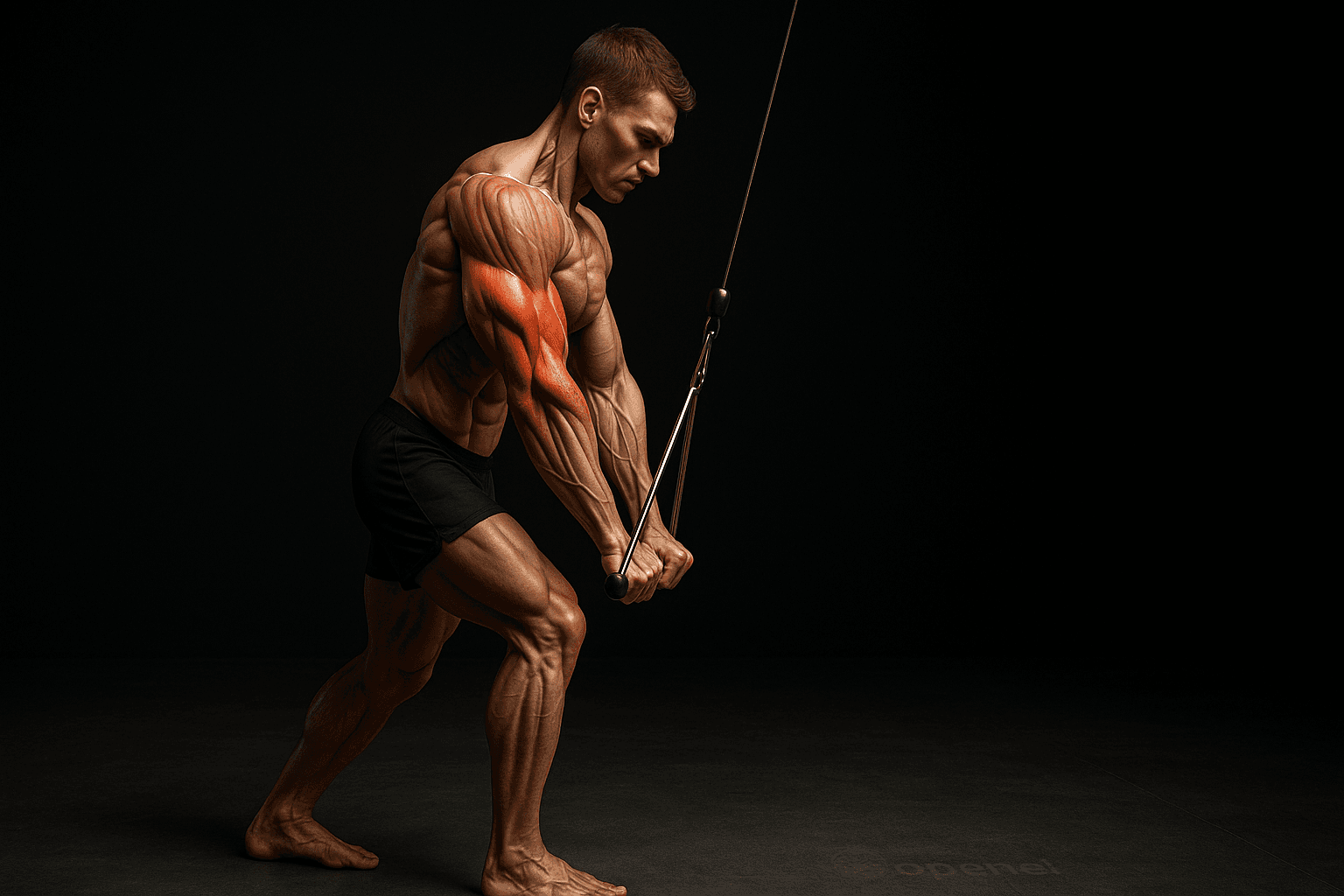
Photo by RepBro.
The most common tricep pushdown mistakes are: letting the elbows move, using body momentum, lifting too heavy (partial reps), bending the wrists, stopping short of full range, and using the wrong grip or attachment for your control. Fix each with a specific, simple cue and a measurable target so you get more triceps work for your time.
Why are my elbows moving during the pushdown?
Why it happens: People naturally shift their elbows forward or back to get a stronger mechanical advantage when the weight feels heavy. Fatigue, lack of arm awareness, or a cue of "push with the hands" also makes the upper arm travel.
What it costs: If the elbow travels more than ~5–10 cm (2–4 in) away from your side, the shoulder and chest help the movement, reducing triceps loading and slowing triceps development. It also increases stress on the shoulder joint if repeated under heavy load.
Fix: Pin the elbows. Stand so your upper arms are in contact with your ribs; imagine the elbow is a hinge and should only move 0–1 cm (0–0.4 in). Use a light enough load to complete 8–12 strict reps and tape a 5 cm (2 in) marker on the cable column to stop forward drift.
Why am I using torso momentum or leaning forward?
Why it happens: When the weight is heavy or you rush, you shift your torso back and forth to create momentum. The body instinctively cheats to finish a rep.
What it costs: Momentum converts the exercise from a triceps isolation to a semi-bodyweight pressing movement, reducing muscle tension and increasing spinal and lower-back strain. It also trains poor movement patterns.
Fix: Anchor your stance. Stand with a split or staggered stance, keep hips neutral, chest up, and aim for a 1–0–2 tempo: 1 second press down (concentric), 0-second pause, 2 seconds on the controlled return (eccentric). If you feel your torso moving, lower the load by ~20% immediately.
Why am I using too much weight and doing partial reps?
Why it happens: Many people prioritize load numbers over quality reps. As the set gets hard, they shorten the range to grind out reps.
What it costs: Partial reps train a shortened muscle range and reduce total time under tension. They also encourage the same cheating patterns described above and increase risk of tendon irritation around the elbow if you overload repeatedly.
Fix: Follow the 8–12 rep rule for hypertrophy or 4–6 for strength—pick a weight that lets you perform full-range reps with 1–2 reps left in the tank (Rate of Perceived Exertion ~8/10). If you can’t, drop the weight 10–25% until you can.
Why are my wrists bending instead of staying neutral?
Why it happens: A tight grip, weak wrist stabilizers, or an awkward attachment angle cause the wrists to flex or extend during the pushdown.
What it costs: Bent wrists transfer load away from the triceps to the forearm and increase strain on the wrist joints, which can lead to discomfort and limit training consistency.
Fix: Keep a neutral wrist. Use a light, closed grip and think "knuckles back." Try a V-bar or straight bar if the rope forces wrist deviation; set up so the top of your hand faces down and the wrist stays aligned with the forearm. Record one set and watch wrist angle—aim for <10° deviation.
Why do I stop short of full extension?
Why it happens: Many stop just shy of full extension to avoid the hard contraction at the bottom or to avoid tension in the elbow. Habit and the belief that "range equals risk" cause this.
What it costs: Stopping early reduces activation of the triceps long head and cuts total work by 15–30% per rep compared with full reps. Over time that reduces growth and strength gains.
Fix: Finish each rep with a controlled lockout: press until elbows are fully extended but not hyperextended—teach this by holding the final position for 0.5–1 second on each rep. Use a 6–12 rep range; if you can’t hold the lockout for 1 second on the last two reps, reduce weight by ~10%.
Why am I using the wrong grip or attachment for my goals?
Why it happens: People pick the first attachment available (rope, straight bar, V-handle) or mimic others without considering shoulder angle, wrist comfort, or the triceps head they want to emphasize.
What it costs: The wrong tool can reduce your ability to keep the elbows tucked, force wrist compensation, or emphasize the wrong triceps head—meaning slower progress and more discomfort.
Fix: Match grip to goal. Use a rope to get better long-head activation and external rotation at the bottom (good for shape), or a straight/V-bar if you want overall load and easier wrist alignment. Pick the attachment that allows strict elbows, neutral wrists, and full extension; if none do, reduce weight and prioritize form.
Safety note: When should I stop?
Stop immediately if you feel sharp joint pain, intense tingling, or numbness during the set. If pain persists, consult a licensed health professional—this article is not a diagnosis. Use conservative loads and prioritize fatigue-free form for 80% of your work sets.
Want a practical way to track form and tempo? Use a rep- and tempo-focused tracker like RepBro to record sets, note elbow movement, and compare attachments over time; for comparisons, see how different handles affect your setup at https://www.repbro.app/vs.
One-sentence takeaway: Fixing elbow position, eliminating momentum, choosing appropriate loads, keeping neutral wrists, using full range, and matching grip to goals will give you 20–50% better triceps stimulus without extra gym time.
Frequently asked questions
- How many reps and sets should I do for tricep pushdowns?
- For strength and hypertrophy, aim for 3–4 sets of 6–12 reps with a load that leaves you about 1–3 reps shy of failure on the last set; adjust for your overall program and recovery.
- Should my elbows move during pushdowns?
- Minimal elbow movement is normal, but the elbows should stay roughly at the sides with the upper arm stationary—avoid letting them swing forward more than ~5–10 cm (2–4 in).
- Is rope or straight bar better for tricep pushdowns?
- Both work; the rope lets you get more external rotation at the bottom which can improve long-head activation for some people, while a straight bar often feels more stable—use the one that lets you maintain strict form.