Walking Lunge: Muscles Worked and 4 Best Alternatives
Clear, practical guide: which muscles walking lunges train, where they fit in a program, and 4 solid alternatives with when to pick each.
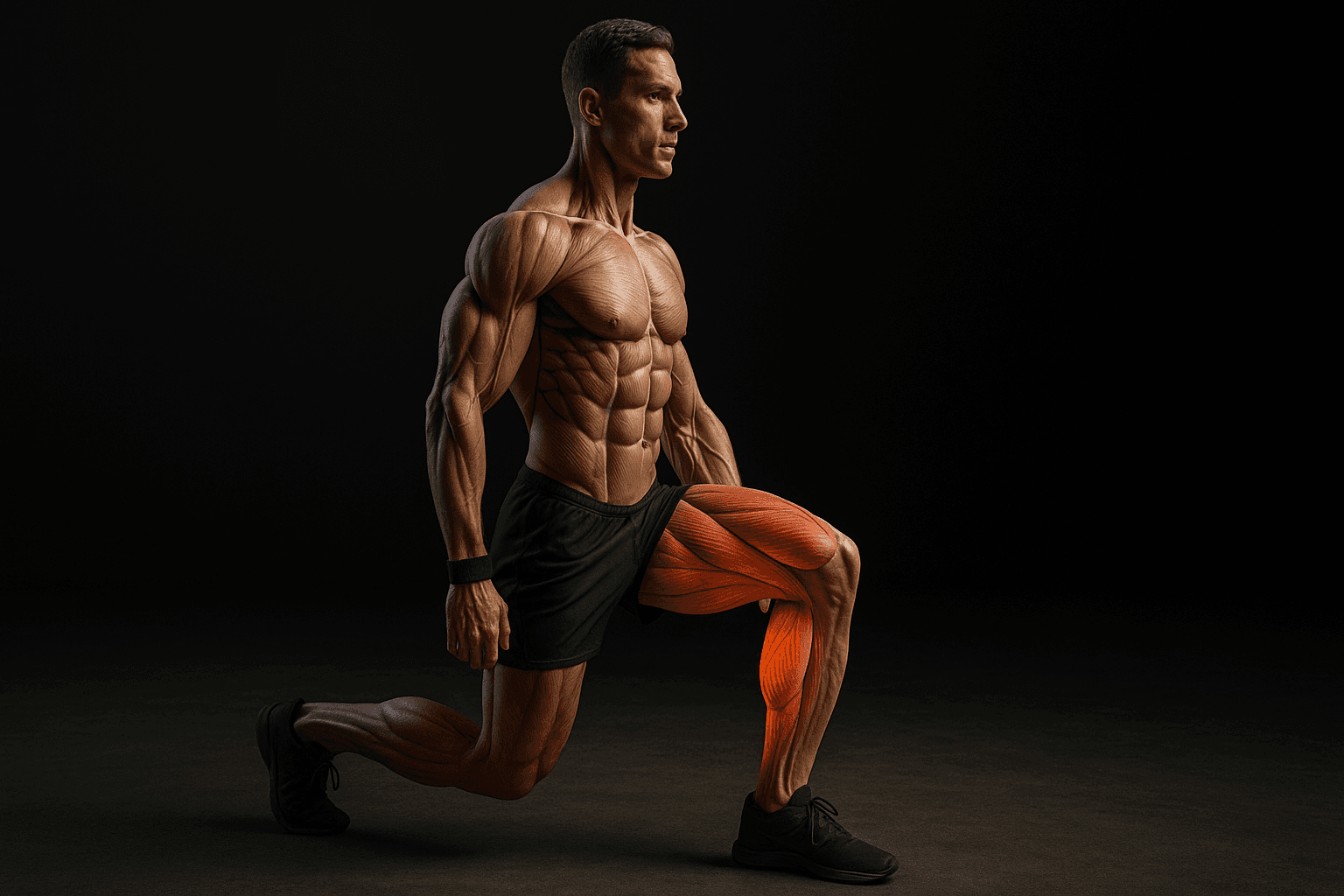
Photo by RepBro.
First paragraph answer
Walking lunges primarily work the quadriceps, gluteus maximus, and hamstrings; secondarily they recruit the adductors, hip abductors, calves, and core for balance and stabilization. They’re a unilateral, functional lower-body exercise useful for building single-leg strength, balance, and muscular coordination.
What muscles does the walking lunge work?
Primary muscles
- Quadriceps (vastus lateralis/medialis/intermedius + rectus femoris): drive knee extension when you push off each step.
- Gluteus maximus: extends the hip, particularly when the front leg pushes back to stand.
- Hamstrings (biceps femoris, semitendinosus, semimembranosus): assist hip extension and help decelerate the knee.
Secondary muscles
- Adductors and hip abductors (including gluteus medius/minimus): stabilize the pelvis and control lateral movement.
- Calves (gastrocnemius/soleus): contribute to stabilization and the final push-off.
- Core (obliques and rectus abdominis): resist rotation and keep the torso upright during alternating steps.
Why that matters: because the walking lunge is unilateral, it also challenges inter‑limb imbalances and forces stabilizers to work harder than most bilateral squats.
Where does the walking lunge fit in a training program?
- Role: Assistance or main lower-body exercise depending on load. Use it as an accessory for hypertrophy or as a primary unilateral strength movement when loaded with a barbell or heavy dumbbells.
- Frequency: 1–2 times per week per muscle group is effective for most trainees; advanced lifters can use it 2–3 times with varied intensity.
- Volume guidelines:
- Hypertrophy: 3–4 sets of 8–15 steps per leg, 60–90s rest.
- Strength: 3–5 sets of 4–8 heavy steps per leg (barbell or heavy dumbbells), 2–3 min rest.
- Conditioning: 2–4 sets of 20–40 steps total with lighter load or bodyweight, short rests.
- Progression: add 2.5–5 kg increments, increase step count by 1–3 steps per set, or change tempo (e.g., 3s descent).
How do I do a walking lunge safely?
Key form cues
- Step length: aim for front knee to reach roughly 90° of flexion at the bottom; that’s usually a 60–100 cm (24–40 in) step depending on height.
- Knee tracking: let the knee track over the middle of the foot, not collapsing inward.
- Torso: keep chest tall and a neutral spine—avoid excessive forward lean.
- Weight distribution: keep the weight mid-foot to heel of the front foot; push through the front heel for the drive.
- Eyes: look ahead, not at your feet, to help balance.
Safety note
Stop immediately on sharp or severe pain. If you have existing knee, hip, or balance issues, consult a qualified clinician or coach before progressing load—this article is informational, not a diagnosis. For technique tracking and exercise comparisons, you can log variants with the RepBro app or compare options at https://www.repbro.app/vs.
What are the best alternatives to walking lunges and when should you pick each?
- Reverse lunge
- Why pick it: easier to control balance and typically less shear on the front knee than forward or walking lunges.
- Equipment: bodyweight or dumbbells.
- When to use: early rehab, beginners, or when knee discomfort occurs with walking lunges. Use 3–4 sets of 6–12 reps per leg.
- Bulgarian split squat
- Why pick it: increases single-leg loading and time under tension, excellent for breaking plateaus and adding strength without forward stepping.
- Equipment: bench/box and dumbbells or barbell.
- When to use: you want more max strength and hypertrophy on one leg, or you don’t have runway space for walking lunges. Program it for 3–5 sets of 6–12 reps per leg.
- Step-up (box step-up)
- Why pick it: generally knee-friendly, great for power and single-leg strength, and easy to scale by box height or load.
- Equipment: sturdy box/bench and optional dumbbells/barbell.
- When to use: limited space, persistent forward knee discomfort, or you want to train vertical force production. Use 3–4 sets of 6–12 reps per leg.
- Goblet or front-loaded split squat / static lunge
- Why pick it: maintains upright torso and lets you add load without a long stepping pattern; simpler balance demand than walking lunges.
- Equipment: kettlebell or dumbbell for goblet, or dumbbells for front-loaded variations.
- When to use: limited space, poor balance, or as a progression before adding walking steps. Program 3–4 sets of 8–15 reps per leg.
How to choose between alternatives
- Equipment limits: if you lack a bench or box, reverse lunges and goblet split squats require minimal gear. If you have a barbell and runway, walking lunges or heavy barbell walking lunges work well.
- Injuries or pain: choose reverse lunges or step-ups when the forward step aggravates a knee; always reduce load and check form.
- Plateauing: switch to Bulgarian split squats or heavy step-ups to alter load distribution and overload a different range of motion.
- Balance and space: goblet split squats or static lunges are best if space is limited or balance is poor.
How should I progress if I want more strength or size?
- Strength focus: increase load and reduce reps—3–5 sets of 4–8 steps per leg, add 2.5–5 kg weekly if you can maintain form.
- Hypertrophy focus: moderate load with 8–15 steps per leg, increase total sets or tempo (e.g., a 3s eccentric).
- Variety: rotate between walking lunges, Bulgarian split squats, and step-ups across 4–6 week blocks to avoid adaptation.
Final safety reminder: stop on sharp pain, start light to dial form, and consult a qualified coach if you’re unsure.
One-sentence takeaway
Walking lunges are an effective unilateral exercise for quads, glutes, and hamstrings—pick reverse lunges, Bulgarian split squats, step-ups, or goblet/static lunges when you need different loading, space, or knee-friendly options.
Frequently asked questions
- Are walking lunges good for glute growth?
- Yes—walking lunges target the gluteus maximus as a primary mover, especially with longer steps or added load, but combine them with other hip-dominant exercises for best results.
- Do walking lunges hurt knees?
- Walking lunges are not inherently bad for knees; discomfort often comes from poor form, excessive step length, or pre-existing conditions—stop on sharp pain and consult a professional.
- How many reps and sets should I do?
- For hypertrophy, 3–4 sets of 8–15 steps per leg; for strength, 3–5 sets of 4–8 steps per leg with heavier load; rest 60–90s (hypertrophy) or 2–3 min (strength).