Wall Sit: Muscles Worked and Practical Alternatives
Clear, evidence-aware guide to which muscles a wall sit trains, how to program it, and 4 alternatives with when to choose each (equipment, injuries, plateaus).
Photo by RepBro.
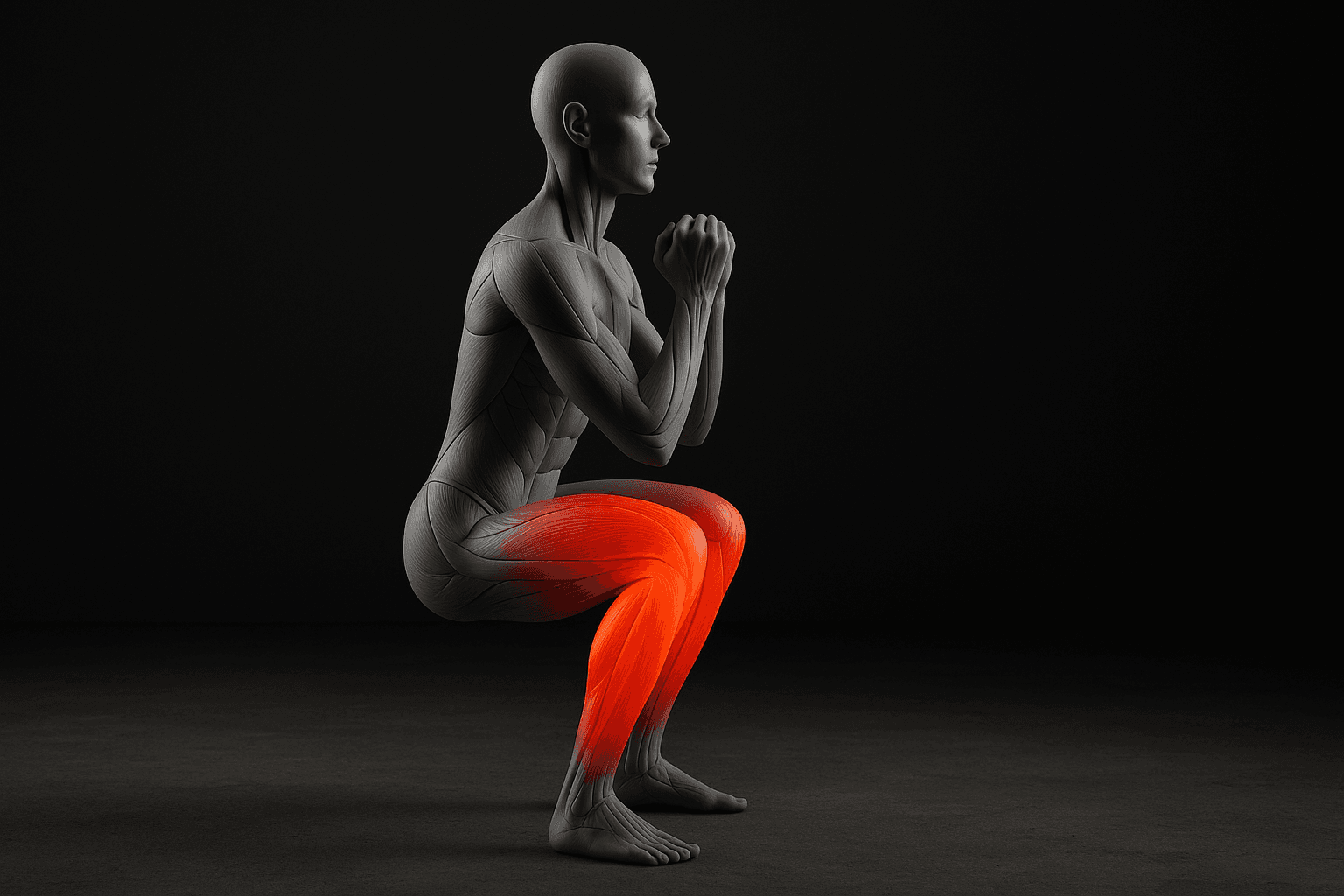
Answer-first: The wall sit is primarily an isometric quadriceps exercise (vastus lateralis/medialis/intermedius and rectus femoris) with secondary activation of the glutes, hamstrings, calves, and core. It trains strength endurance at a fixed knee angle rather than maximal concentric force.
What muscles does the wall sit train and how intense is the work?
Primary: the quadriceps group — the three vastii and rectus femoris — produce the main force resisting knee flexion during the hold. Secondary: gluteus maximus and medius provide hip stability and support; hamstrings act eccentrically/isometrically to balance the joint; gastrocnemius and soleus (calves) help stabilize the ankle; the abdominals and lumbar extensors engage to keep the torso upright.
Intensity depends on knee angle and body position. A 90° knee angle places a large demand on the quads and increases patellofemoral joint contact forces; a shallower angle reduces relative quad load. Because the muscle action is isometric at a fixed angle, strength gains tend to be angle-specific and improve local muscular endurance more than maximal dynamic strength.
How should I program wall sits in a training week?
Place wall sits as an accessory or rehab tool, not a core strength-builder for heavy dynamic lifts. Typical uses:
- As an accessory after compound leg work to increase quad endurance.
- As a low-impact conditioning or rehab option when loading is limited.
- As a mobility/activation drill in warm-ups when done briefly.
Programming guidelines consistent with general resistance-training consensus:
- Frequency: 2–3 times per week for most trainees when used as assistance work.
- Volume: 2–4 sets per session of controlled holds. Use multiple moderate-duration sets instead of a single maximal-duration hold to maintain quality.
- Progression: increase hold time, add sets, shorten rest, or add load (weighted vest or plate) once hold durations are comfortably achieved. Track performance and include lower-intensity weeks for recovery.
How do wall sits compare to squats and lunges?
| Feature | Wall Sit | Squat | Lunge |
|---|---|---|---|
| Movement type | Isometric | Dynamic (concentric/eccentric) | Dynamic, unilateral or bilateral |
| Primary stimulus | Quad endurance at fixed angle | Full-range strength, power | Single-leg strength, balance, hypertrophy |
| Equipment | None | Barbell/dumbbells | Dumbbells or bodyweight |
| Joint stress | Reduced shear, potentially higher patellofemoral load at deep flexion | Higher compressive/shear loads depending on load | Asymmetric loading, can be knee-friendly if performed correctly |
Use wall sits when you need a low-equipment, low-skill, time-under-tension quad stimulus. Use squats for general strength and hypertrophy across ranges and lunges for single-leg strength and balance.
What are solid alternatives to the wall sit and when should I pick each?
Below are four practical alternatives. Pick based on equipment, injury status, and training goals.
- Static (split) lunge hold
- What it trains: unilateral quad and glute isometric strength and balance.
- When to pick it: you have no equipment but want unilateral overload to correct imbalances; when knee pain limits bilateral loading; when you want more hip involvement than a wall sit.
- Downsides: harder to hold proper balance for beginners; can still stress the front knee if depth is deep.
- Bulgarian split-squat hold (rear foot elevated, isometric)
- What it trains: high unilateral quad and glute demand, significant core stabilization.
- When to pick it: you have space and a bench or sturdy chair; you want greater single-leg loading and carryover to single-leg strength. It's useful when plateaus arise from bilateral work.
- Downsides: requires balance and some flexibility; may challenge knee if posture is incorrect.
- Back squat (controlled tempo)
- What it trains: full-range concentric and eccentric quad, glute, hamstring strength and power.
- When to pick it: you have access to a barbell and want to improve dynamic maximal strength and rate of force development. Replace or complement wall sits with squats to improve transfer to lifts.
- Downsides: higher technical demand and joint loading; requires programming and recovery.
- Isometric single-leg hold (wall-supported or box-supported) or step-up hold
- What it trains: single-leg quad endurance and balance with reduced bilateral compensation.
- When to pick it: you need to address unilateral deficits, return from some injuries, or when equipment is minimal but you want more progression than a bilateral wall sit.
- Downsides: more fatiguing per leg, requires control.
How do I choose between these options if I'm injured or hitting a plateau?
- Equipment limits: choose bodyweight holds (lunge or single-leg hold) if no weights are available; choose squats if you need dynamic overload and have barbells.
- Knee pain or patellofemoral issues: prefer shallower knee angles, unilateral holds that allow stance adjustment, or consult a clinician. Avoid deep 90°+ holds if they produce pain.
- Plateaus: change the stimulus—switch from bilateral isometric holds to unilateral holds, add external load, vary joint angle, or move to dynamic movements (slow eccentric squats) to increase strength transfer.
How should I progress wall sits safely?
- Improve technique and posture first (pelvis neutral, weight on heels, torso upright).
- Increase time progressively: use multiple working sets with manageable durations rather than one maximal hold.
- Add load only after you can perform high-quality holds comfortably.
- Use deloads: reduce volume or intensity for planned recovery weeks.
Safety note: stop the exercise if you feel sharp joint pain or numbness. If you have a history of knee or hip injury, consult a qualified medical or rehab professional before adding isometrics. This article does not diagnose or guarantee injury prevention.
Where does wall sit sit in a practical program?
Think of it as an accessory for quad endurance, a rehab-friendly option, or a time-under-tension tool to complement heavy squats or deadlifts. For tracking hold times or progressive overload, simple apps that log durations can help you stay consistent; one such app is RepBro, though tracking can be done on any spreadsheet or notebook.
Limitations: what an article or app can't do for you
- No app or article can see your form and give real-time corrections; video feedback from a qualified coach is necessary for detailed technique changes.
- Persistent pain or complex injuries require assessment and treatment from a licensed clinician or physical therapist.
- A plan, however well designed, only works if you are consistent; small, regular progress beats chasing the perfect program.
Summary: Wall sits primarily load the quadriceps as an isometric endurance exercise, with support from glutes, hamstrings, calves, and core. Use them as accessory work, for low-equipment conditioning, or in rehab contexts. When you need unilateral overload, greater dynamic strength, or to overcome plateaus, pick one of the alternatives above based on equipment, comfort with single-leg work, and pain history.
Frequently asked questions
- Does a wall sit build the quadriceps?
- Yes. The wall sit is an isometric exercise that primarily targets the quadriceps (vastii and rectus femoris). It produces sustained quads activation through a fixed knee angle, so it improves endurance and strength at that joint angle rather than producing large increases in maximal concentric force.
- How often should I do wall sits?
- Wall sits can be trained as an accessory 2–3 times per week. Use multiple short sets rather than one very long hold for better quality. Progress by increasing hold time, adding sets, or adding external load, and back off volume during planned deload weeks.
- Are wall sits safe for knees?
- For many people, wall sits are knee-friendly because they avoid dynamic joint shear, but they can increase patellofemoral load at deep knee angles. If you have current knee pain or a history of knee injury, check with a qualified clinician before making them part of your program.