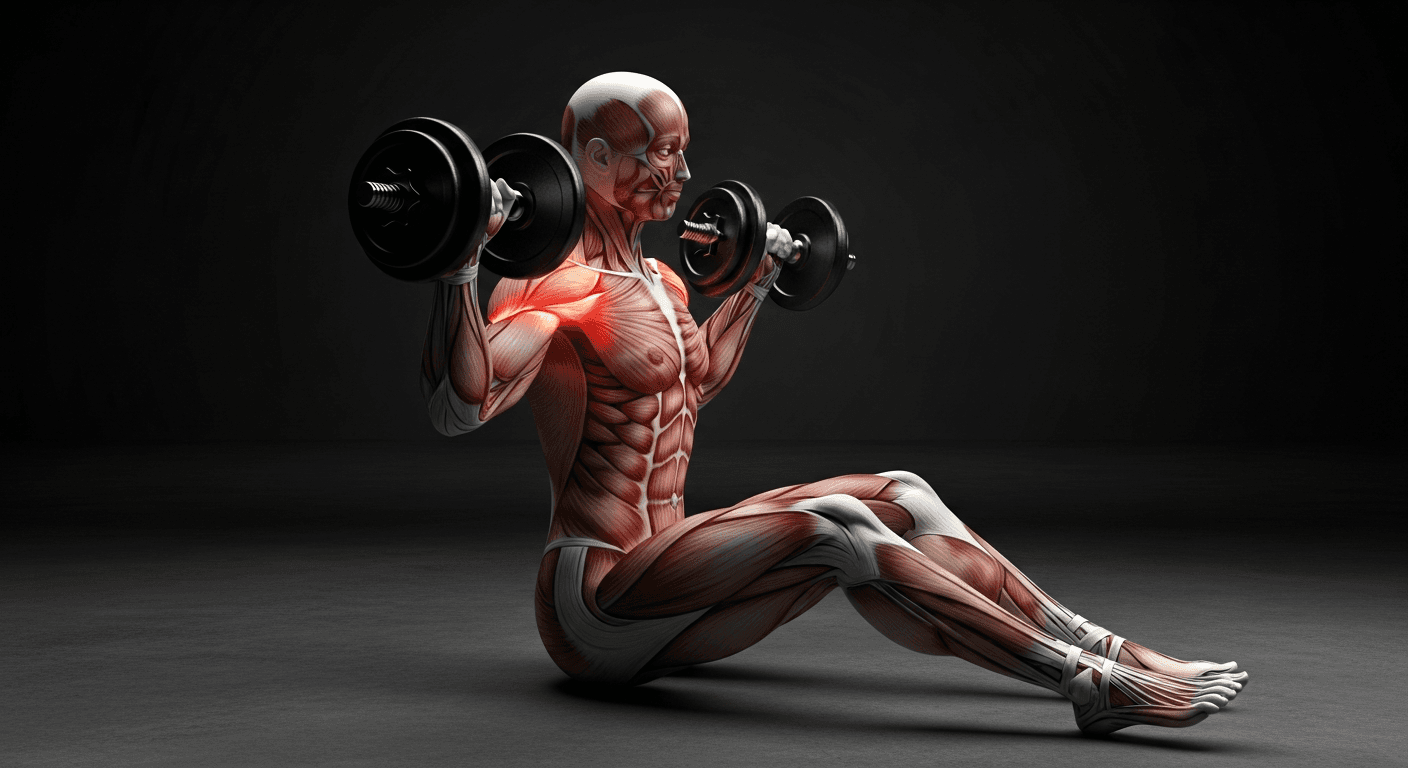
Is the Mind–Muscle Connection Real?
Short, evidence-aware look at whether focusing on a muscle changes activation and growth, with practical guidance, numbers for programming, and limits of apps and AI.

Photo by RepBro.
Is the Mind–Muscle Connection Real?
Yes — focusing attention on a target muscle measurably changes its activation in many situations. The effect is strongest for isolation or single-joint movements and with lighter-to-moderate loads; it becomes smaller during maximal compound lifts. Mindful focus can improve set quality but does not replace volume and progressive overload for growth.
What exactly do people mean by "mind–muscle connection"?
The phrase describes using intentional mental focus and specific movement cues to increase neuromuscular activation of a target muscle. Practically that means squeezing, feeling, or imagining the muscle working so you recruit more motor units in that muscle during the lift. It’s a cueing and attention strategy, not a mysterious physiological shortcut.
Does focusing actually change muscle activation or strength?
Electromyography (EMG) research generally shows increased electrical activity in a target muscle when lifters direct attention toward it, especially on isolation exercises (e.g., biceps curls, chest flyes). The increase is usually smaller or inconsistent during multi-joint, heavy compound lifts (e.g., squat, deadlift, bench press) because the nervous system prioritizes overall task efficiency and other prime movers.
In practical terms:
- Expect the clearest, repeatable effects on isolation and single-joint movements.
- Expect limited transfer to maximal strength on compound lifts; lifting heavier with technically sound form still drives strength best.
- Increased EMG does not automatically equal greater hypertrophy, but higher activation combined with appropriate sets, reps, and progressive overload can help growth.
How should I use it in my training program? Concrete recommendations
- Use mind–muscle focus primarily on isolation work: 1–4 exercises per muscle group where you can actually feel the target muscle (e.g., flyes, lateral raises, preacher curls, leg extensions).
- Apply focused cues for 1–3 sets at the start of a muscle’s work or within the exercise where the muscle is under most tension.
- Keep most compound lifts focused on bar/path, safety, and progressive loading rather than trying to maximize squeeze on one small muscle.
Programming numbers (common, evidence-aligned ranges):
- Weekly volume for hypertrophy: aim for roughly 10–20 sets per muscle per week, distributed across 2–3 sessions.
- Rep ranges: use 6–20 reps depending on load and goal; mind–muscle cues are easier to apply with moderate loads where form is controlled.
- Frequency: train each muscle about 2–3 times per week for balanced stimulus and practice.
- Deloads: consider a lighter week every 4–12 weeks depending on fatigue; reduce volume or intensity by ~30–50% for a recovery week.
(Those are coaching-consensus ranges used to organize training; focus cues are a complementary tool, not the primary driver of volume or overload.)
How to practice the mind–muscle connection (step-by-step)
- Warm up the joint and use very light sets to find the movement path where you feel the muscle.
- Use 1–2 deliberate warm-up sets of 8–15 reps, emphasizing a slow, controlled tempo and a brief pause at peak contraction.
- Apply a tactile cue if possible (touch the muscle) or a specific mental image (e.g., "pull the weight using the outer quads").
- On 1–3 working sets for that muscle, reduce load about 10–30% from your heaviest working set to prioritize quality of contraction and time under tension.
- Return to heavier compound work where focus on load and bar path matters most.
Practical example: For lateral raises, do 2 warm-up sets of 15 with a slow pause, then 2 working sets where you consciously lead with the elbows and hold the top for 1 second.
Comparison: Focused contraction vs heavy loading
| Factor | Mind–muscle focus (isolation) | Heavy compound loading |
|---|---|---|
| Best exercise type | Single-joint/isolation | Multi-joint/compound |
| EMG increase | Often noticeable | Small or inconsistent |
| Transfer to 1RM strength | Low | High |
| Hypertrophy contribution | Helpful for local stimulus | Primary driver via total overload |
| Practical use | Improve activation and set quality | Build systemic strength and overload |
When will focusing not help or be counterproductive?
- When form or overall load is compromised. If focusing makes you cheat the movement (momentum, spine position changes), back off.
- During true maximal attempts where technical bar path and full-body coordination are the priority.
- If you spend all training time on feeling rather than increasing volume/load over weeks, you’ll limit progress.
Safety note
Stop any set that produces sharp or unusual joint pain. If you have persistent pain, restricted movement, or a recent injury, consult a qualified health professional before changing your program. This article is educational — it does not diagnose or promise injury prevention.
How does mind–muscle connection fit with progressive overload?
They are complementary. Progressive overload (increasing reps, weight, sets, or density over time) is the primary driver of long-term hypertrophy and strength. Mind–muscle strategies help you get better quality reps, greater localized fatigue, and potentially more effective sets from the same volume. Use focus to improve the stimulus per set, then increase volume or load over weeks.
Limitations — what apps and AI coaching cannot do
No app or AI can reliably watch you through a camera and correct all technical flaws or confirm internal tension patterns. They can give cues, reminders, and programming, but they can’t: see exact joint angles, feel compensations, diagnose injuries, or replace hands-on coaching when movement issues or pain exist. A plan only works if you show up and execute consistently. For injuries, rehabs, or complex technique faults, consult a qualified coach, physiotherapist, or medical professional.
Apps can help track volume and prompt technique cues; for example, tools like RepBro provide structured sessions and reminders, but they don’t replace in-person assessment.
Bottom line
Yes — the mind–muscle connection is real and useful, especially for isolation movements and improving set quality. It’s a tool to boost activation and time under tension, not a substitute for progressive overload, sufficient weekly volume, and careful programming. Use focused cues for targeted work, prioritize load and form on compound lifts, and treat mind–muscle practice as one component of a consistent, progressive plan.
Further questions lifters ask
- How many sets should be "focused" per muscle per week? Aim for 2–6 focused sets spread across sessions; most hypertrophy stimulus should still come from overall weekly volume.
- Can beginners benefit? Yes — beginners often find that learning to feel a muscle helps technique. However, beginners should also prioritize learning movement patterns and gradual overload.
- Will it reduce soreness? Not necessarily. Greater localized activation can increase muscle damage and soreness for a while; manage volume and recovery accordingly.
Limitations and safety recap: stop for sharp pain; apps and AI are tools, not replacements for qualified, hands-on assessment; consistent progressive overload and adequate recovery remain the primary drivers of progress.
Frequently asked questions
- Does thinking about a muscle actually change how it works?
- Yes. Directing attention to a target muscle can increase its electrical activation (EMG) on many single-joint or isolation exercises. The effect is smaller on heavy compound lifts. Increased activation can help training quality, but it isn’t a replacement for progressive overload.
- Will a better mind–muscle connection make my chest grow faster?
- It can improve chest activation during isolation work (e.g., flyes) and may increase time under tension and set quality. For overall growth, use focused cues plus adequate weekly volume (roughly 10–20 sets/week per muscle), progressive overload, and recovery.
- How do I practice the mind–muscle connection effectively?
- Use lighter warm-up sets to feel the target muscle, pause briefly at peak contraction, slow the eccentric a little, and use 1–3 focused sets per session on isolation moves. Prioritize form and progressive overload for the rest of the workout.