How Many Days a Week Should You Train? The Honest Answer by Goal
Training frequency depends on your goal: 3-4 days for muscle growth, 4-5 for strength, 2-3 for beginners. Recovery capacity and consistency matter more than maximizing days.
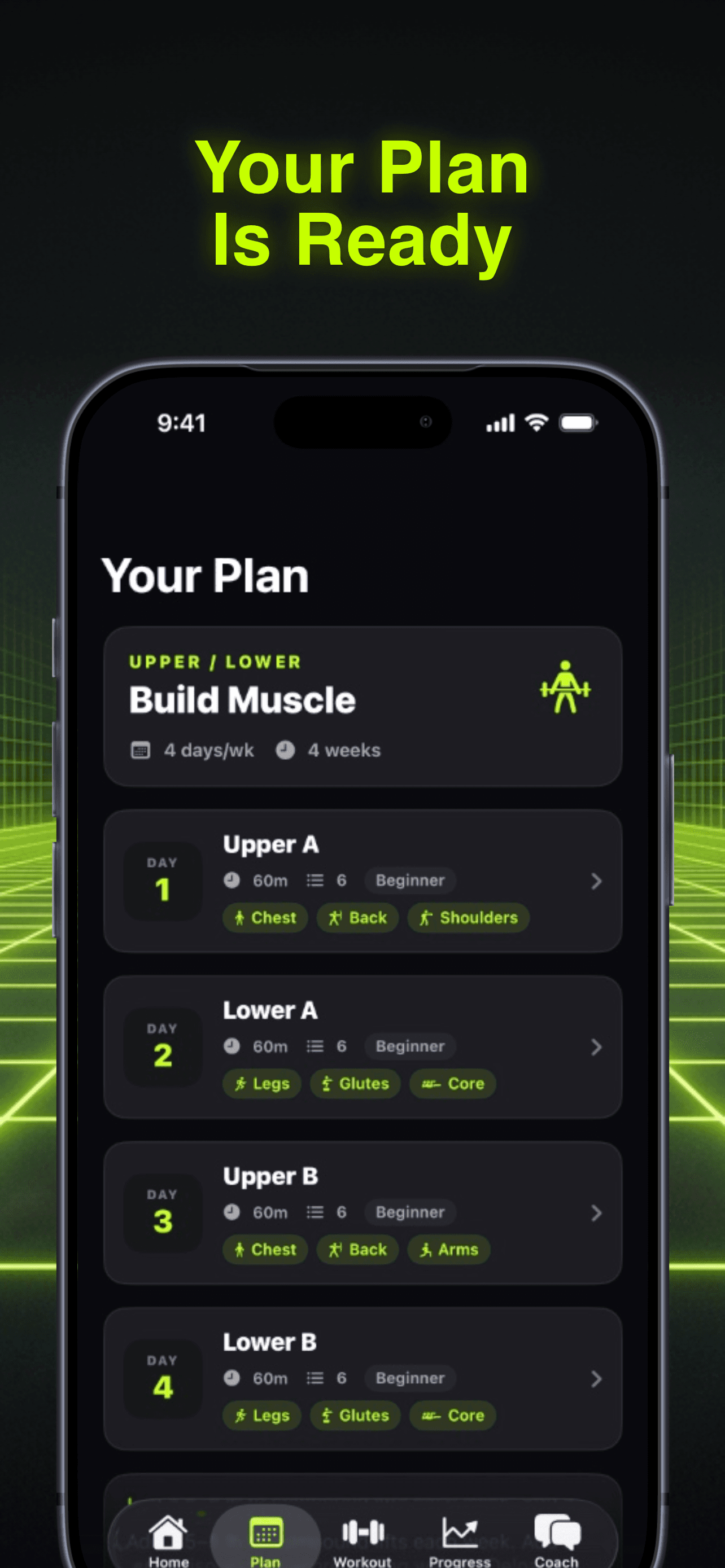
Photo by RepBro.
You ask how many days a week you should train. The answer isn't what most fitness influencers tell you.
The short answer: 3-4 days per week for muscle growth, 4-5 days for strength gains, and 2-3 days if you're a beginner. Your recovery capacity, available time, and consistency matter more than hitting some magic number. Most lifters do better training fewer days with higher quality than cramming in extra sessions they can't recover from.
The real question isn't how many days you can train. It's how many days you can train well, week after week, for months.
What the Research Says About Training Frequency
Multiple studies show that training each muscle group 2-3 times per week produces better muscle growth than once per week. But there's a point of diminishing returns.
A 2016 meta-analysis found that training frequency of 2x per week was superior to 1x per week for muscle hypertrophy. However, the difference between 2x and 3x per week was much smaller. The key factor wasn't frequency alone—it was total weekly volume.
Here's what matters more than raw training days:
- Volume per muscle group per week (10-20 sets for most muscles)
- Recovery between sessions (48-72 hours for the same muscle group)
- Sleep and stress management (7+ hours, manageable life stress)
- Consistency over months (showing up beats perfection)
Training Frequency by Goal
For Muscle Growth: 3-4 Days Per Week
If your primary goal is building muscle, 3-4 training days hits the sweet spot. This allows you to train each muscle group twice per week while leaving adequate recovery time.
3-day full body split:
- Monday: Full body
- Wednesday: Full body
- Friday: Full body
4-day upper/lower split:
- Monday: Upper body
- Tuesday: Lower body
- Thursday: Upper body
- Friday: Lower body
Both approaches let you accumulate 12-16 sets per muscle group per week—the range where most lifters see optimal hypertrophy. You get 48+ hours between sessions targeting the same muscles.
I've programmed hundreds of lifters, and the ones who build the most muscle aren't training 6 days a week. They're the ones who show up consistently to their 3-4 planned sessions and push hard when they're there.
For Strength: 4-5 Days Per Week
Strength gains benefit from higher training frequency because skill acquisition matters. The squat, bench, and deadlift are skills that improve with practice.
4-day routine:
- Monday: Squat focus + accessories
- Tuesday: Bench focus + accessories
- Thursday: Deadlift focus + accessories
- Saturday: Light technique work + accessories
5-day routine:
- Add a second squat or bench day with different intensity/volume
Strength athletes often train 5-6 days per week, but they're also managing training as their primary stress. If you work a demanding job and have family obligations, 4 days might be your ceiling for quality training.
For Beginners: 2-3 Days Per Week
New lifters need time to adapt. Your nervous system, connective tissues, and work capacity all need to catch up to your enthusiasm.
Start with 2-3 full body sessions per week. Focus on learning movement patterns and building the habit. You'll make faster progress training 3 days consistently than attempting 5 days and burning out after two weeks.
Beginner template:
- Monday: Squat, bench, row
- Wednesday: Deadlift, overhead press, pull-ups
- Friday: Squat, bench, row
Add weight to the bar each session. When you can't, add sets or reps. Simple progression beats complex programming for the first 6-12 months.
The Reality Check: Recovery Capacity
Your optimal training frequency depends on factors beyond your goal:
Age: Recovery slows after 30. A 25-year-old might handle 5 days better than a 45-year-old handles 4.
Sleep: If you're getting 5-6 hours nightly, you can't recover from high-frequency training. Fix sleep before adding training days.
Stress: High work stress, relationship issues, or financial pressure all impact recovery. Your body doesn't distinguish between training stress and life stress.
Training experience: Advanced lifters can often handle higher frequencies because they've adapted to training stress over years.
Available time: A rushed 30-minute session often produces worse results than a focused 60-minute session.
How to Find Your Sweet Spot
Start conservative and add frequency gradually:
- Week 1-4: Train 3 days per week, focus on consistency
- Week 5-8: If recovering well, add a 4th day
- Week 9-12: If still progressing, consider a 5th day
Monitor these recovery indicators:
- Sleep quality (falling asleep easily, staying asleep)
- Morning resting heart rate (elevated = poor recovery)
- Motivation to train (dreading workouts = overreaching)
- Performance in the gym (strength/reps declining)
If any of these decline for more than a week, reduce training frequency by one day.
The 3 vs 5 Day Split Debate
The internet loves debating 3-day vs 5-day splits. Here's the truth: both work if programmed correctly.
3-day advantages:
- More recovery time
- Easier to maintain consistency
- Better for busy schedules
- Less risk of overtraining
5-day advantages:
- More practice with movement patterns
- Higher weekly volume potential
- More specialization possible
- Better for competitive lifters
Choose based on your schedule and recovery capacity, not what your favorite influencer does. A 3-day split you follow for a year beats a 5-day split you quit after a month.
Common Frequency Mistakes
Training through poor recovery: If you're not sleeping or managing stress, adding training days makes things worse.
Copying elite athletes: Professional lifters train 6+ days because it's their job. They nap, eat perfectly, and manage stress. You probably don't.
Ignoring life context: Your training frequency should match your life phase. New parent? Busy work period? Adjust accordingly.
All-or-nothing thinking: Missing one day doesn't ruin your week. Consistency over months matters more than perfect adherence.
The best training frequency is the one you can maintain while making progress. For most lifters reading this, that's 3-4 days per week with full body or upper/lower splits.
Start there. Train hard when you're in the gym. Recover well between sessions. Add frequency only when you're consistently hitting your current schedule and recovering fully.
Your next workout matters more than your perfect plan. Pick a frequency you can stick to, and get started.
Frequently asked questions
- Is 3 days a week enough to build muscle?
- Yes, 3 days per week is sufficient for muscle growth when you train each muscle group 2-3 times per week with adequate volume (10-16 sets per muscle group weekly). Many lifters see excellent results with 3-day full body routines.
- Should beginners train 5 days a week?
- No, beginners should start with 2-3 days per week. New lifters need time for their nervous system and connective tissues to adapt. Focus on consistency and learning proper form before increasing frequency.
- Can you train the same muscle every day?
- No, muscles need 48-72 hours to recover between intense training sessions. Training the same muscle daily prevents proper recovery and can lead to decreased performance and increased injury risk.
- What's better: 3-day full body or 5-day split?
- Both can be effective. Choose based on your schedule and recovery capacity. 3-day full body is better for beginners and busy schedules, while 5-day splits allow more specialization for intermediate-advanced lifters.
- How do I know if I'm training too frequently?
- Signs include poor sleep quality, elevated morning heart rate, decreased motivation to train, declining performance in the gym, and feeling constantly fatigued. Reduce frequency by one day if these persist for more than a week.